
Guide · Remodeling
Basement finishing marketing: how remodelers get more basement jobs
How to market basement finishing as its own service line: answer the homeowner's worries about water, radon, escape windows and permits from primary sources, build a basement page and gallery, run a basement-only Google Ads ad group and real-photo Meta ads, and judge it all by cost per signed basement job.

The short answer
Market basement finishing as its own service: one page and gallery of your finished basements, clear answers to the homeowner's worries (water, radon, escape windows, permits), a separate Google Ads ad group for basement searches, and real-photo Meta ads within the Housing rules. Then judge it by cost per signed basement job, not by clicks.
Key takeaways
- A basement buyer has their own questions: Is it dry? What about radon? Can it be a bedroom? Do I need a permit? Answer them before the first call.
- EPA says to check for moisture and test for radon before a basement becomes living space. Quote it, date it and show how you handle both.
- Give basements their own page, gallery and Google Ads ad group, and block searches for work you do not do.
- Use real finished-basement photos in Meta ads, and check Meta's Housing rules first.
- Count consults, proposals and signed basement jobs by source. Indoor work can run all year; your own lead dates show when your homeowners plan.
Want us to find your three biggest lead leaks?
Free Growth DiagnosisWhy market basement finishing on its own?
Because the homeowner who wants a finished basement is not shopping for "a remodel". They have a space they already own and a set of worries that a kitchen or bath buyer does not have: water, air, light, a way out in an emergency, the ceiling, and whether the city needs to see it.
If basements are one service line among several, they still deserve their own marketing:
- Their own searches. Someone who types a basement search wants a basement page, not your home page.
- Their own worries. Below-grade questions decide who gets the call. The company that answers them clearly, before the visit, looks like the safe choice.
- A photo-led decision. Homeowners want to see a finished basement that looks like the one they picture: a family room, a guest suite, a home office.
- Their own numbers. If basements are mixed in with every other project, you cannot see what a signed basement job costs you.
In your Google Business Profile, list basement finishing as a service; your main category follows the work you do most. Our guide to Google Business Profile for remodelers covers that set-up.
What do homeowners worry about before they call, and how should you answer?
Water, radon, escape windows and permits come up again and again. Here is what the primary sources say, and how to turn each worry into a clear answer on your page and at the consult.
Water and moisture. EPA's page on remodeling and indoor air says: "Before beginning any conversion of basement space into living space, check the basement for leaks or other signs of moisture problems." It explains why: "Because damp basements promote biological growth, including molds, they are not healthy places to live in." And it is clear about the order: "Thus, any moisture problems should be corrected before you proceed." EPA's mold guide puts it in one line: "The key to mold control is moisture control."
So say on your page how you check for moisture before you quote, and what happens if you find a problem. If you do not do waterproofing yourself, say so, and say what you do instead (for example, the job waits until a specialist has fixed it).
Radon. The same EPA page says: "Because EPA recommends testing for radon on the lowest lived-in level of a home, even if you've previously tested, if you have not tested in the basement, you should test again." And: "Because fixing a radon problem will usually be easier and less expensive before the basement is finished, you should test before you begin your remodeling project." EPA's retest page adds: "If your living patterns change and you begin occupying a lower level of your home (such as a basement) you should retest your home on that level." EPA's radon zone map page also says the map "should not be used to determine if individual homes need to be tested."
So a radon test belongs in your "before we start" steps, for every basement and every region. Ask at the first call if they have tested the basement. Explain who does the test and what happens if a problem shows up. Do not quote levels or test times on your page; point to EPA.
Escape windows and bedrooms. Building codes set rules for escape windows in finished basements and bedrooms. Which rules apply depends on the code your city has adopted, and your inspector decides. So do not put sizes or code wording in your marketing. Ask at the first call if the homeowner wants a bedroom or a guest room down there, and explain that this may mean an escape window, which you check with the local code before you price it.
Permits and inspections. Say plainly that you pull the permits your city requires and that the work is inspected where the city asks for it. Show the steps in order on your page. Homeowners who worry about resale or insurance want to hear this early.
Ceiling height, ducts and posts. Many basements have low beams, ducts or posts in the way. Ask about them at the first call, look at them at the consult, and say what can and cannot move. The height a room needs to count as living space is again a question for your local code and inspector.
Put all of this on one "Before we start" section of your basement page, plus a short FAQ: moisture check, radon test, permits and inspections, escape windows if there will be a bedroom, ceiling and ducts. This is general information, not legal or building-code advice. Check your city's rules and your own process before you publish it.
What should your basement page and photos show?
One page for basement finishing, built for the person who searched for it.
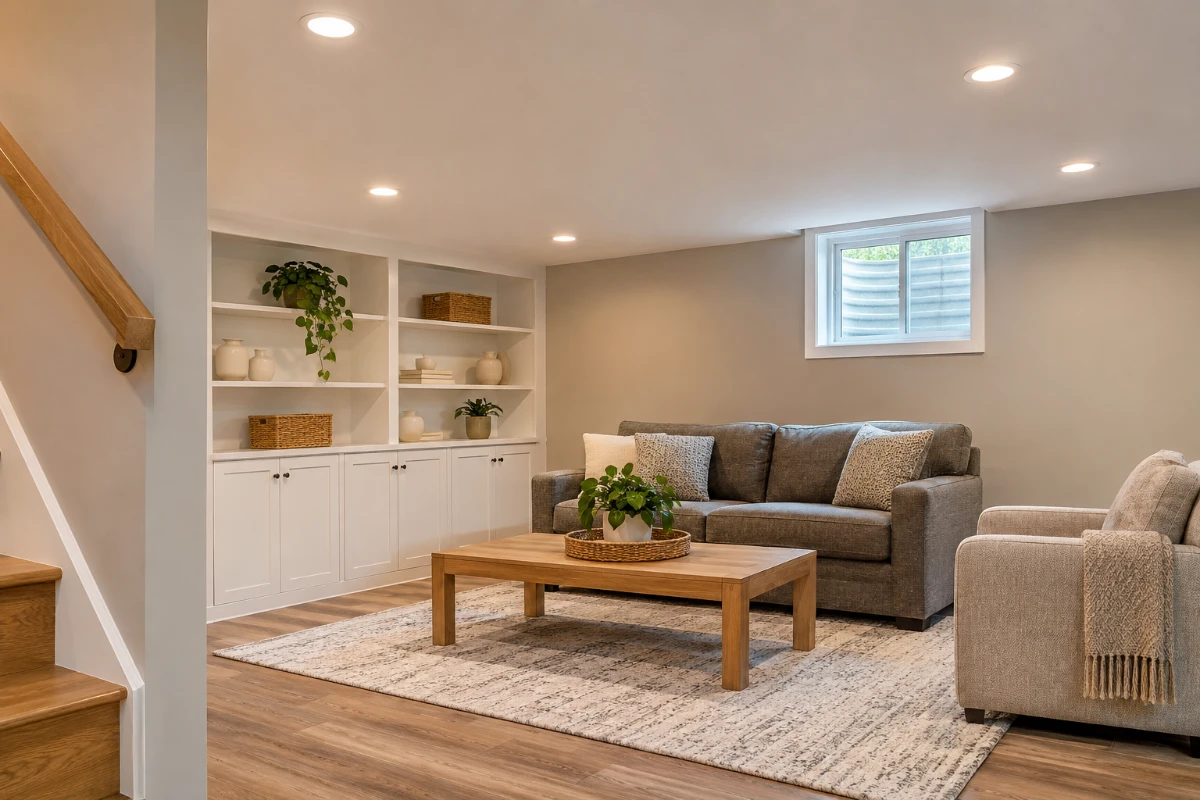
- A clear first screen: "Basement finishing in {city and nearby towns}", the main kinds of basement you build, one strong photo, and one next step (a short form or a call button).
- A gallery by project type: family room, home theater, guest suite, home office, home gym, playroom. Use the types you actually build, with your own photos.
- Before and after from the same corner. Stand in the same spot for both photos. It shows the change better than a wide shot of each.
- Photos of the steps, not only the finish: the moisture check, framing, insulation, the inspection, the drywall. They answer "will they do it right?" without a word.
- The "Before we start" section from above, and your FAQ.
- Reviews that name the basement. Ask every basement homeowner for a review after the job, and invite them to mention the room and the town. Put those reviews on the page.
- Homeowner permission for every photo, and no house numbers, street signs or faces of family members unless they agree in writing.
If basements are a big part of your work, give each main type its own section or page (a basement guest suite answers different questions from a basement gym). Keep them connected to the main basement page.
How should you set up Google Ads for basement jobs?
Change only what is different for basements. The general set-up (campaigns, match types, search terms, Google Ads or Local Services Ads) is in our guide to Google Ads for remodelers, in the sections "How should a remodeler set up Google Ads campaigns?" and "Should remodelers use Google Ads or Local Services Ads?".
What changes for basements:
- Its own ad group or campaign. Keep basement searches apart from kitchen, bath and general remodeling searches, so each gets its own ads, its own budget decision and its own numbers.
- Its own landing page. Send basement clicks to the basement page or a basement landing page, never the home page. The ad and the page should say the same thing: basement finishing, your area, one next step.
- Basement search themes. For example, searches like "basement finishing {city}" or "finished basement contractor". Check the real search volume in your own Keyword Planner for your area before you plan around any search; we state no volumes here.
- Negatives for the work you do not do. If you only finish basements, block searches that are not your job:
- do-it-yourself searches (DIY, how to, kits, materials);
- rentals and apartments, if you do not finish basement rentals;
- waterproofing-only and foundation repair, if you do not do them;
- jobs and careers searches.
- Count signed jobs, not form fills. Send signed basement jobs back to Google Ads as offline conversions, so the account learns which searches turn into contracts. We set that up as part of call and lead tracking.
Do Facebook and Instagram ads work for basements?
They can, because a finished basement is a photo-led project, like a kitchen. A homeowner may see a finished basement in their feed and start to picture their own before they ever search.
- Use real photos and short walk-through videos of your own finished basements: the stairs coming down, the main room, the light.
- Show the before and after from the same corner.
- Remarket to people who looked at your basement gallery with the next step, a short form or "see more basements we finished". Our retargeting guide covers how.
- Ask good form questions: what they want the space for, if the basement has had water, and when they hope to start. These save your team a call.
Before you launch, check Meta's rules: Meta's Housing category names housing repairs, and it limits targeting. See which Meta ad rules remodelers should check first.
What should happen at the first call and the consult?
Answer fast, then ask the basement questions that tell you if it is a fit and what to bring to the visit. The general method (what makes a lead a fit, how to ask about budget, what to do with "later") is in our guide on how to qualify a homeowner before the visit. For basements, add:
- Water history: "Has the basement ever had water, a damp smell or a wet wall?"
- Radon: "Have you tested the basement for radon?" If not, explain the test step from your "Before we start" page.
- Use: "What do you want the space for?" Family room, home office, gym, guest suite.
- Bedroom or not: "Will anyone sleep down there?" If yes, the escape-window question for your local code comes up.
- The space: low beams, ducts, posts, the stairs, a bathroom wish.
- Timing: "When would you like to start, and is anything waiting first?"
- Who decides: both partners at the consult if possible.
Reply to new inquiries quickly, by phone or by text if they asked for texts (texts only with consent). After the consult and the proposal, follow up around the homeowner's own dates; our guide to remodeling estimate follow-up covers that part.
Is there a best season for basement marketing?
No dated study we found shows a basement planning season. Basement work is indoors, so it can run all year. When your homeowners plan it, your own lead dates show best.
The only data we found is one contractor's own look at county basement permits. Four Seasons Home Improvement, which analyzed basement permits in Montgomery County, Maryland (published April 2026), wrote: "the permit data shows that most homeowners still initiate projects in the spring (April peaks at 116 permits)". Its limits: it is one county, and a permit marks the start of work, not the month the homeowner began to plan.
So use your own data. Pull the date of every basement inquiry and every signed basement job from the last two years. Find the months your inquiries come in and the months your jobs start, then plan your ads and photos a few months ahead of the start dates. Our remodeler marketing calendar shows how to find your own busy and slow months.
How do you know your basement marketing works?
Make basements their own project type in your CRM, and give every lead a source. Then track:
- Basement inquiries by source (Google Ads, Meta, your page, referrals, shared sites);
- Consults held;
- Proposals sent;
- Signed basement jobs;
- Cost per signed basement job: what you spent on a source ÷ the basement jobs you signed from it.
Worked numbers in this guide show the method; they are not real client results. For example: over a quarter, Google Ads brings 40 basement inquiries, 18 consults, 9 proposals and 3 signed basement jobs. Meta brings 60 inquiries, 12 consults, 5 proposals and 1 signed job. Meta's inquiries look like more, but Google signed three times as many basement jobs. Divide each source's spend by its signed jobs to see which one really costs less.
Basement decisions can take months, so judge a source over a quarter or more, not a week. Our guide to cost per signed job shows how to set it up by lead source, and the cost-per-signed-remodel calculator on our marketing for remodelers page lets you try your own numbers.
Where Digital Hark fits
Digital Hark builds the growth system for remodelers: Google and Meta ads in your own accounts, landing pages, tracking of calls, forms and signed jobs, and a fast first reply and follow-up list (texts only with consent). For a basement line, that means its own ad group, its own page and its own numbers. Your team calls the homeowners, runs the consults and sells the jobs; we never call your leads or sell for you. You own every ad account, page and lead. If you advertise financing for basement projects, our financing guide covers the wording.
Common questions
How do remodelers get more basement finishing jobs?+
Treat basements as their own service: one page and gallery of your finished basements, clear answers to water, radon, escape-window and permit questions, a basement-only Google Ads ad group with its own landing page, and real-photo Meta ads. Then track consults, proposals and signed basement jobs by source.
Should basement finishing have its own Google Ads campaign?+
At least its own ad group, with its own ads and landing page. That keeps basement searches apart from kitchen and bath searches and shows what a signed basement job costs. Block searches for work you do not do, such as DIY, rentals or waterproofing-only, if you do not offer them. Selling floors on their own as well? See how to split flooring ads by floor type.
What should a basement finishing website show?+
A gallery by project type, before-and-after photos from the same corner, photos of your steps (moisture check, framing, inspection), a "Before we start" section on moisture, radon, permits and escape windows, reviews that name the basement, and one clear next step. Use your own photos, with the homeowner's permission.
Should homeowners test for radon before finishing a basement?+
EPA says yes: "you should test before you begin your remodeling project", because fixing a radon problem is usually easier before the basement is finished. EPA also says to test the basement even if the home was tested before, if the basement itself was not. Point homeowners to EPA's radon pages.
Is winter the best time to market basement finishing?+
No dated study we found shows that. Basement work is indoors, so it can run all year. Look at the dates of your own basement inquiries and job starts over the last two years, and plan your ads a few months ahead of the months your homeowners want to start.
Are shared lead sites worth it for basement jobs?+
Only if they turn into signed jobs at a cost you can live with. A shared request can go to more than one company, so the talk often starts with price. Judge every source by consults, proposals and signed basement jobs, not by the number of leads.


