
Guide · Leads
Roofing deductible and storm sales laws in Florida, Georgia, North Carolina and Missouri
One table, four states, read from the law itself: what Florida, Georgia, North Carolina and Missouri say about deductible offers, storm ads, talking to the insurer, cancelling a contract and the notices your contract needs. Then what it means for your ads, contracts and follow-up.
The short answer
Don't offer to pay, waive or rebate a homeowner's deductible anywhere. Florida and Missouri ban offers to pay or rebate it by law, and Florida ads that push a roof claim must carry a deductible notice. Georgia, Missouri and North Carolina let homeowners cancel within five business days after an insurer's denial. Check with a lawyer in each state.
Key takeaways
- Deductible rules are not the same in every state. Florida and Missouri put a ban in the law. Georgia's Attorney General warns against deductible offers, but the Georgia code section we read has no deductible line. North Carolina's law we read has none.
- In Florida, any ad that pushes a homeowner to contact you to make a roof claim must state three things, in a set font size.
- In Florida, Georgia and Missouri, don't offer to handle, negotiate or adjust the claim for the homeowner. Florida and Georgia make an exception only for a licensed public adjuster.
- In Georgia, Missouri and North Carolina, the homeowner can cancel within five business days after the insurer's denial (in Georgia and Missouri, its written notice). Plan payments and work around that clock.
- Your contract needs state-specific notices. Your lawyer writes the final wording.
Want us to find your three biggest lead leaks?
Free Growth DiagnosisWhat do these four states' laws say?
If you work storms in Florida, Georgia, North Carolina or Missouri, these are the rules we found in each state's law, side by side. Texas has its own rules: see what Texas law allows roofers to say and do after a storm and our Texas page.
General information, not legal advice. Laws change. The versions we read: Florida, the official 2026 Florida Statutes; Georgia, a third-party copy marked current as of March 28, 2024; North Carolina, a third-party copy that includes the 2024 roofing rule; Missouri, a third-party copy marked current as of January 1, 2025.
| Rule | Florida | Georgia | North Carolina | Missouri |
|---|---|---|---|---|
| Deductible or rebate offers | Banned. No rebate, gift, gift card, cash, coupon, deductible waiver or other thing of value for an inspection or a roof claim | Not in the code section we read. The Attorney General warns deductible offers "can be signs of fraud" | Not in the law we read | Banned: no advertising or promising to pay or rebate any part of a deductible, including discounts and allowances |
| Ads that push a roof claim | Must state three things in a font of at least 12 points and at least half the largest font; includes door hangers, cards, magnets, flyers, pamphlets and e-mails | No offering or advertising to represent or negotiate the claim | Not in the law we read | No advertising to pay or rebate a deductible, or to represent or negotiate the claim |
| Talking to the insurer for the homeowner | No interpreting the policy or adjusting the claim unless a licensed public adjuster | No representing or negotiating the claim, except a licensed public adjuster | Not in the law we read | No representing or negotiating the claim |
| Cancel after an insurer's denial | Not in 489.147 | Before midnight on the fifth business day after the insurer's written notice | Five business days after a claim denial | Before midnight on the fifth business day after the insurer's written notice |
| Cancel after a state of emergency | 10 days after signing or by the official start date, whichever comes first, if signed within 180 days of a declared emergency in that area | Within one year of a natural disaster, SB 201 cancel rules apply | Not in the law we read | Not in the law we read |
| Payment or work before the window ends | Not in 489.147 | No payment until the five days end, except emergency work the homeowner acknowledges in writing | No work and no payment until the five days end, except written-acknowledged emergency work | If cancelled, refund within ten days; you may keep the reasonable value of written-acknowledged emergency work |
| Notices the contract needs | Three notices, two in 14-point bold (see the Florida section) | 10-point bold cancel statement plus a detachable "NOTICE OF CANCELLATION" form in duplicate | No roofing-specific notice wording in the law we read | 10-point bold cancel statement plus a "NOTICE OF CANCELLATION" form |
| Assignment of benefits | Void for policies issued on or after January 1, 2023 | Illegal in contracts within one year of a natural disaster (SB 201, from July 1, 2025) | Not in the law we read | Not in the law we read |
| How violations are treated | Fines and license discipline | No penalty line in the code section we read; the Attorney General calls breaking the SB 201 rules illegal | Class 1 misdemeanor (the 2024 roofing rule) | An unfair practice under the Missouri Merchandising Practices Act |
"Not in the law we read" means we did not find it in the section we read. It does not mean the state has no rule anywhere. Ask a lawyer in that state.
Florida: the strictest rules for storm roofing ads and contracts
Florida's rules sit in § 489.147 of the Florida Statutes, "Prohibited property insurance practices; contract requirements." The state last changed it in 2025 (ch. 2025-40).
Ads that push a roof claim. Florida calls it a "prohibited advertisement": any written or electronic communication by a contractor "which encourages, instructs, or induces a consumer to contact a contractor or public adjuster for the purpose of making an insurance claim for roof damage," if it does not state three things "in a font size of at least 12 points and at least half as large as the largest font size used in the communication". The three statements are:
- "The consumer is responsible for payment of any insurance deductible;"
- "It is insurance fraud punishable as a felony of the third degree for a contractor to knowingly or willfully, and with intent to injure, defraud, or deceive, pay, waive, or rebate all or part of an insurance deductible applicable to payment to the contractor for repairs to a property covered by a property insurance policy; and"
- "It is insurance fraud punishable as a felony of the third degree to intentionally file an insurance claim containing any false, incomplete, or misleading information."
"The term includes, but is not limited to, door hangers, business cards, magnets, flyers, pamphlets, and e-mails." A contractor may not solicit a homeowner with such an ad, and soliciting covers contact in person, by e-mail, telephone or other real-time contact directed at one person, and delivery to a specific person.
No gifts or deductible help for an inspection or a claim. A contractor may not offer "a rebate, gift, gift card, cash, coupon, waiver of any insurance deductible, or any other thing of value in exchange for" letting the contractor inspect the roof or making a roof claim. Florida also limits referral rewards (489.147 (2)(c)), and Virginia has its own reward rule (59.1-618, from January 1, 2027). Our referral program guide covers both.
No adjusting. No "interpreting policy provisions or advising an insured regarding coverages or duties" or adjusting the claim, "unless the contractor holds a license as a public adjuster".
A real estimate. No agreement authorizing repairs "without providing a good faith estimate of the itemized and detailed cost of services and materials" for claim repairs.
Your canvassers count as you. "The acts of any person on behalf of a contractor, including, but not limited to, the acts of a compensated employee or a nonemployee who is compensated for soliciting, shall be considered the actions of the contractor." Train every door knocker and sales rep on these rules.
Three contract notices. We describe them here; the statute gives the exact words, and your lawyer should put them in your contract.
- A notice that you may not engage in the gift and deductible practices above. Without it, the homeowner "may void the contract within 10 days after executing it."
- On every residential roof contract, on the page the homeowner signs, in bold type of at least 14 points: a notice telling the homeowner to contact their insurance company to verify coverage before signing.
- For contracts signed after a declared emergency (below): a cancel notice in bold type of at least 14 points, "immediately before the space reserved for the signature of the residential property owner".
Cancelling after a state of emergency. If the contract was signed "within 180 days" of events in a Governor's state of emergency declaration, and the home is in that area, the homeowner may cancel "without penalty or obligation within 10 days after the execution of the contract or by the official start date, whichever comes first". The official start date is when materials for the final roof start going on, a permit has been issued, or a code-compliant temporary repair has been made. The homeowner cancels by certified mail, return receipt requested, or another mailing with proof, to the address in the contract.
No assignment of benefits. For residential and commercial property policies "issued on or after January 1, 2023", a policyholder may not assign post-loss benefits, and "An attempt to assign post-loss property insurance benefits under such a policy is void, invalid, and unenforceable." Don't build an offer or a form around it.
Violations. A contractor who breaks § 489.147 faces fines and license discipline.
Georgia: five business days after a denial, and no claim talks
Georgia's roofing rule is O.C.G.A. § 10-1-393.12. It covers a "residential roofing contractor": a person or business "in the business of contracting or offering to contract with an owner or possessor of residential real estate to repair or replace roof systems."
Cancel after a denial. When the contract is to be paid from an insurance policy, the homeowner "may cancel the contract prior to midnight on the fifth business day after the insured has received written notice from the insurer that all or any part of the claim or contract is not a covered loss under such insurance policy." The contract must carry a 10-point bold cancel statement and a detachable "NOTICE OF CANCELLATION" form in duplicate.
No payment first. The contractor "shall not require any payments from an insured until the five-day cancellation period has expired", except for emergency work the homeowner acknowledges in writing as needed to prevent damage.
No claim talks. "A residential roofing contractor shall not represent or negotiate, or offer or advertise to represent or negotiate, on behalf of an owner or possessor of residential real estate on any insurance claim in connection with the repair or replacement of roof systems." A licensed public adjuster is the exception. The Attorney General's office puts it plainly: "roofers are not allowed to file claims on their customers' behalf unless the roofer is (or employs) a licensed public adjuster to file its customers' claims."
Deductibles. The code section we read has no deductible line. The Attorney General's office warns homeowners: "Be skeptical of any contractor that offers to pay your insurance deductible or offers other no-cost incentives, as these can be signs of fraud." So don't make deductible offers in Georgia either.
After a natural disaster: SB 201. Georgia's SB 201 (2025), as the Attorney General's office describes it: "Under the section of the law that went into effect on July 1, 2025, if a contractor enters into a contract with a homeowner within one year of a natural disaster to repair, replace, or mitigate damage to the homeowner's home caused by the disaster, it is illegal for the contractor to" do several things, including "Enter into a contract with the homeowner in which the homeowner assigns insurance proceeds to the contractor;" and "Fail to substantially commence work on the contracted services within one year of the execution of such contract;", and to fail to follow the five-business-day cancel rules with a 10-point bold "NOTICE OF CANCELLATION".
Licensing, one line. The same page notes that "certain specialty occupations such as roofers, tree removal services, painters, drywall contractors and repair handymen are not required to be licensed by the state." Check your city and county.
North Carolina: the 2024 roof contract rule
North Carolina added a roofing rule to G.S. § 14-401.13 in 2024 (SL 2024-11, enacted June 20, 2024, effective October 1, 2024).
Five business days, no work, no payment. "contracts for residential roof replacement or repair shall be subject to a five-business day cancellation period following an insurance claim denial for the work to be performed under the contract, during which time the seller shall not begin work or collect any payment until the five business days have expired."
Emergency work. If the roofer "has performed emergency services, acknowledged by the insured in writing to be necessary to prevent further damage to the premises," the roofer "shall be entitled to collect the amount due for the emergency services at the time they are rendered." Get that written acknowledgment before you tarp.
Violations. "Notwithstanding any other provision of this section, a violation of this subsection is a Class 1 misdemeanor."
Who it covers. The law's definition of roof replacement and repair services leaves out work by a general contractor licensed under the state's general contractor law. So the 2024 rule covers roofers who are not licensed general contractors. If you hold a North Carolina general contractor license, ask your lawyer how it applies to you.
Deductibles. The law we read has no deductible rule. (The bill's title mentions rebates, but that part is about insurers and agents, not roofers.) Don't offer deductible help anyway.
The general three-day rule. The North Carolina Department of Justice also notes that "under North Carolina law in some instances you can cancel a contract within three days of signing it."
Missouri: deductible rebates and claim talks are both out
Missouri's rule is RSMo § 407.725, "Work and services for insured persons, contractors not to induce sales". It is wider than roofing: a "contractor" is anyone in the business of contracting with an owner of residential or commercial real estate to "repair or replace roof systems or perform any other exterior repair, replacement, construction, or reconstruction work".
No deductible pay or rebate. "A contractor shall not advertise or promise to pay or rebate all or any portion of any insurance deductible" to get the sale. And "a promise to pay or rebate includes granting any allowance or offering any discount against the fees to be charged". The law also counts any compensation, gift, prize, bonus, coupon, credit, referral fee or other item of money value. The Missouri law says pay or rebate, so a discount off your price for the deductible is out.
Five business days after a denial. The homeowner "may cancel the contract prior to midnight on the fifth business day after the insured party has received written notice from the insurer that all or any part of the claim or contract is not a covered loss under the insurance policy". The cancel statement and the "NOTICE OF CANCELLATION" form go in "boldface type of a minimum size of ten points". If the homeowner cancels, you refund within ten days; you may keep the reasonable value of emergency work they acknowledged in writing.
No claim talks. A contractor "shall not represent or negotiate, or offer or advertise to represent or negotiate, on behalf of an owner or possessor of real estate on any insurance claim".
Violations. A violation "shall be considered an unfair practice pursuant to the Missouri merchandising practices act". The Missouri Attorney General's advice to homeowners shows how your crew is judged: "Be wary of any contractor who comes to your home to solicit work or tries to rush you."
What does this mean for your ads, door hangers and website?
The lines below show the idea; they are not legal advice. Have your lawyer check your real ads.
| Ad line | Florida | Georgia | North Carolina | Missouri |
|---|---|---|---|---|
| "We'll cover your deductible." | Never | Never (AG warning) | Never (no rule found, still don't) | Never |
| "Free gift card with every roof inspection." | Never | Risky | Risky | Risky |
| "A discount on your new roof if you file a claim." | Never | Risky | Risky | Never |
| "We handle your insurance claim" / "We talk to your adjuster for you." | Never, unless a licensed public adjuster | Never, unless a licensed public adjuster | Don't | Never |
| "Free roof inspection and a written, itemized estimate." | Fine | Fine | Fine | Fine |
| "Call your insurance company before you sign anything." | Fine | Fine | Fine | Fine |
| "Storm damage? Call us." with any push to file a roof claim | Only with the three statements in the required size | Fine without claim talk | Fine | Fine without deductible or claim talk |
Three habits keep you safe in every state:
- Talk about the roof, not the claim. Inspection, photos, a written estimate, your crew, your warranty terms. Leave the policy to the homeowner and their insurer.
- In Florida, treat every storm ad as a possible "prohibited advertisement". That means door hangers, cards, flyers, e-mails and online ads. If it encourages a roof claim, it carries the three statements at the right size.
- One rule set for every channel. The same wording limits apply to your landing page, your Facebook and Google ads and your door hangers. Our guides to Facebook ads for roofers and Google ads for roofers cover the platform side.
What does this mean for your contracts and follow-up?
A contract check per state. Your lawyer writes the final wording. This list shows what to ask them about.
| State | What the contract needs | Size and place |
|---|---|---|
| Florida | Notice that you may not offer gifts or deductible help; insurance notice; emergency cancel notice for contracts signed within 180 days of a declared emergency in the area | 14-point bold on the signature page (insurance notice); 14-point bold right before the homeowner's signature (cancel notice) |
| Georgia | Five-business-day cancel statement and a detachable "NOTICE OF CANCELLATION" form in duplicate; SB 201 rules after a natural disaster | 10-point bold |
| North Carolina | No roofing notice wording in the law we read; the five-day, no work, no payment rule still applies | Ask your lawyer |
| Missouri | Five-business-day cancel statement and a "NOTICE OF CANCELLATION" form | 10-point bold |
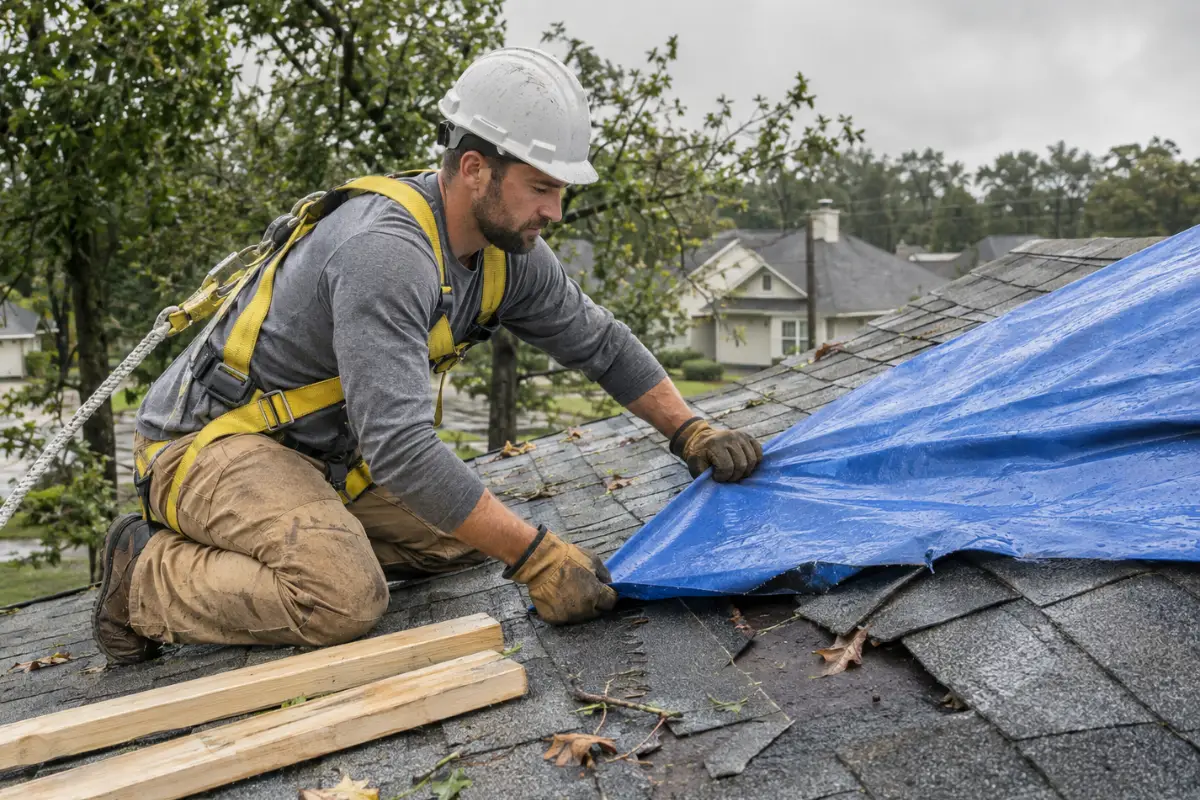
Follow-up around the five-day clock. In Georgia, Missouri and North Carolina the clock starts with the insurer's denial (in Georgia and Missouri, when the homeowner gets the insurer's written notice). Until it runs out: no payment in Georgia and North Carolina, no work in North Carolina. In Missouri, a cancelled job means a refund within ten days. For tarps and other emergency work, get the homeowner's written acknowledgment that it is needed to prevent damage. Our estimate follow-up guide for roofers shows how to plan follow-up around insurance and storm claims, so a call or a message (texts only with consent) does not push a homeowner inside that window. Check what texting rules to check first before any automated message (texts only with consent).
On the first call. Ask only for the claim status, and give no deductible or coverage advice. Our guide to qualifying roofing leads covers that call.
Working storms across state lines: a short checklist
Before storm season, for every state you work in:
- One contract version per state, with that state's notices at the right size and place, checked by a lawyer licensed there.
- An ad wording check: no deductible, gift or discount offers tied to an inspection or claim, no "we handle your claim". In Florida, the three statements on any ad that pushes a roof claim.
- One named person for insurance questions, who only asks for the claim status and sends the homeowner to their insurer.
- Canvassers and sales reps trained. In Florida their acts count as the company's.
- A Florida state-of-emergency watch: contracts signed within 180 days of a declared emergency in the area need the cancel notice.
- A five-day clock in your CRM for Georgia, Missouri and North Carolina jobs, starting on the date of the insurer's denial (the written notice in Georgia and Missouri).
- A form for written emergency-work acknowledgment, ready on every truck.
- A local license and registration check for each city and county you work in.
Where Digital Hark fits
Digital Hark builds the marketing side: ads, roofing landing pages, call and form tracking, and follow-up (texts only with consent), with the wording kept inside rules like these. Your company stays responsible for its own compliance and contracts, and your lawyer has the last word. We are not lawyers. We never call your leads, book inspections or sell jobs; the homeowner conversations stay with your team. More on how we work with roofing companies.
Common questions
Can a roofer pay or waive the homeowner's deductible in Florida?+
No. Florida bars contractors from offering a rebate, gift, cash, coupon, deductible waiver or other thing of value for a roof inspection or a roof claim, and its required ad statement says paying, waiving or rebating a deductible with intent to defraud is a third-degree felony. General information, not legal advice. Planning a giveaway? See why an entry is never tied to an inspection or a claim.
Is it legal in Georgia for a roofer to cover the deductible?+
The Georgia roofing code section we read has no deductible line. The Georgia Attorney General's office warns that offers to pay the deductible or other no-cost incentives can be signs of fraud. Don't make the offer. General information, not legal advice.
Can a homeowner cancel a roofing contract if insurance denies the claim?+
In Georgia, Missouri and North Carolina, yes: within five business days after the insurer's denial (in Georgia and Missouri, after its written notice). Florida's roofing law has a different rule: a cancel within 10 days of signing or by the official start date, whichever comes first, for contracts signed within 180 days of a declared state of emergency in the area. General information, not legal advice.
Can a roofer talk to the insurance company for the homeowner?+
Not to adjust or negotiate the claim in Florida, Georgia or Missouri. Florida and Georgia allow it only for a licensed public adjuster, and Missouri bars representing or negotiating the claim. The North Carolina law we read has no such line. Let the homeowner deal with their insurer. General information, not legal advice.
What must a Florida roofing ad say?+
If it encourages a homeowner to contact you to make a roof claim, it must state that the homeowner pays any deductible, that paying, waiving or rebating a deductible with intent to defraud is insurance fraud, and that filing a false claim is insurance fraud, in a font of at least 12 points and at least half the largest font. General information, not legal advice.
Does North Carolina have a roofing deductible law?+
Not in the law we read. North Carolina's 2024 roofing rule is about cancelling: five business days after a claim denial, with no work and no payment until it ends. Don't offer deductible help anyway. General information, not legal advice. Running a military or senior discount? See how to keep a discount off the deductible.


