
Guide · Leads
Roofing yard signs, door hangers and neighbor postcards: what the rules allow
A street-by-street plan for roofing companies: a 5-point rule check before anything goes up, how to run yard signs, door hangers and Every Door Direct Mail postcards inside the rules, a job-by-job plan, and how to see which of them bring signed roofs.
The short answer
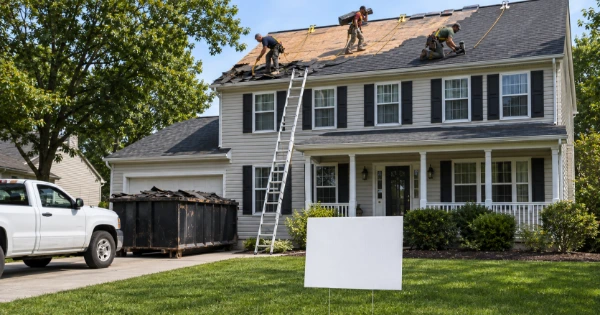
Every roof you finish is seen by the whole street. Ask the customer's permission for a yard sign, check your city's sign rules and their HOA, leave door hangers on doors, never in mailboxes, and use USPS Every Door Direct Mail for postcards. Track each channel by signed jobs.
Key takeaways
- Get the customer's yes in writing: for the sign, for photos of their roof and for naming their street. Never print the house number.
- Sign rules differ by city, county and HOA. Look up your own; the city rules in this guide are examples only.
- Door hangers go on the door or the knob. Never in, on or hung from a mailbox; that is federal law everywhere. Respect "No Soliciting" and "No Handbill" signs.
- For postcards to the whole route, USPS Every Door Direct Mail (EDDM) is built for it. Pick routes by your job map and roof age.
- Give every channel its own tracked number or QR code, and judge it by signed jobs, not leads.
Want us to find your three biggest lead leaks?
Free Growth DiagnosisWhy market around a roofing job?
For a few days, your crew, your trucks and a new roof are the most visible thing on the street. The neighbors watch the work, see the cleanup and see the finished roof. Many of their homes were built around the same time, so their roofs are often the same age as the one you just replaced.
PipelineOn, a software vendor, puts it as their view: "Proximity to existing jobs is the strongest predictor of response." The street that watched you work already knows your name.
Yard signs, door hangers and postcards are a channel you own. No platform sets the price per lead and nobody else gets the same lead. Our guide to where roofing leads come from lists jobsite signs and neighbors as one of the sources; this guide is the how-to behind that row.
Before you start: a 5-point rule check
Run these five checks before the first sign goes in the ground. Rules differ by city, county and HOA. This is general information, not legal advice.
| # | What to check | Where to look | Why |
|---|---|---|---|
| 1 | The customer's written permission | A line in your contract or a short permission form: yard sign yes or no, photos of the roof yes or no, naming their street yes or no | It is their lawn, their roof and their address. Never print the house number. |
| 2 | Your city's sign code | Search "[your city] sign code construction sign", or call the city's planning or code office | Cities set how many signs, how big, how long, and whether you need a permit. |
| 3 | The HOA rules, if there is an HOA | The customer checks their community's rules (or asks the HOA manager) | HOA rules can limit or ban yard signs. |
| 4 | Your city's handbill and solicitation rules | Search "[your city] handbill" and "[your city] solicitor permit" | Some cities set rules for leaving door hangers, and many require a permit to talk to homeowners at the door. |
| 5 | The mailbox rule | Federal law and USPS rules (the same in every US city) | Nothing without postage may go in, on or hang from a mailbox. |
If a check comes back unclear, wait. A sign that goes up a week late costs you less than a sign the city pulls, or a customer who feels you used their lawn without asking.
Yard signs: what's allowed and how to do it
Start with permission in writing. Add one line to your contract: "Customer allows [Company] to place one yard sign on the property during the work and for up to [number] days after completion, where local rules allow." Add a second line for roof photos and a third for naming their street in your marketing. A tick box for each is enough. If they say no to the sign, the job still goes ahead; the neighbors still see the crew.
Then check your city. Sign rules for jobsites are local, and they differ more than most roofers think. One example:
- Tiburon, California (the town's guidance page): "A sign may be temporarily located on a site where construction is underway." "There can be a maximum of three such signs per site." Residential construction signs are "no more than 6 square feet in size", "These signs cannot be illuminated", and they "shall be removed no later than ten days following completion of construction."
That town allows up to three small signs and sets a short removal deadline. Your city may differ. This is an example, not the rule: look up your own.
Where the sign goes. On the customer's own lot, on the site where the work is happening. Never on the sidewalk strip, the street side of the curb, a median, a utility pole or any other public property, and never on a neighbor's lawn.
When it goes up and comes down. PipelineOn's common advice is "Put the sign up before you start the job, not after." and "Keep the sign up for 30-60 days if the homeowner allows it." Add one condition: only as long as your city allows. In Tiburon, that is no later than ten days after the work is done. Put the removal date in the job's checklist so the sign does not stay up by accident.
HOA communities. The National Association of REALTORS® notes that "homeowners who live in a community with an HOA must agree to abide by the rules," and common HOA rules cover "Home exteriors, such as limitations on paint colors, yard signs, fencing…" The state HOA laws we read do not protect contractor signs: Arizona's HOA law protects political signs and for-sale or for-rent signs, and says nothing about a contractor's sign; Florida's HOA law protects a security company's sign near the door, not a roofer's yard sign. So in an HOA, the customer's community rules may limit or ban your sign. Ask the customer to check before it goes up. With no HOA, the city rule still applies.
What goes on the sign. Keep it readable from a passing car:
- Your company name and one short message, such as "New roof by [Company]".
- One phone number, or a short web address or QR code, used only for yard signs, so you can count the calls it brings.
- Your license number, if your state or city requires it on advertising (check).
- Nothing else: no prices, no offers about insurance, no customer name.
Door hangers: where can they go, and what goes on them?
On the door or the knob. Never the mailbox. Federal law makes it an offense to knowingly put mailable matter "on which no postage has been paid, in any letter box" with intent to avoid postage. The USPS Domestic Mail Manual is wider still: "no part of a mail receptacle may be used to deliver any matter not bearing postage, including items or matter placed upon, supported by, attached to, hung from, or inserted into a mail receptacle." So a door hanger never goes in a mailbox, on top of one, under the flag or hung from the post. One Texas city's handbill page says the same in plain words: "No handbills are allowed in mailboxes." Tell the crew member who walks the street: door or knob only, and if a home has no safe spot on the door, skip it.
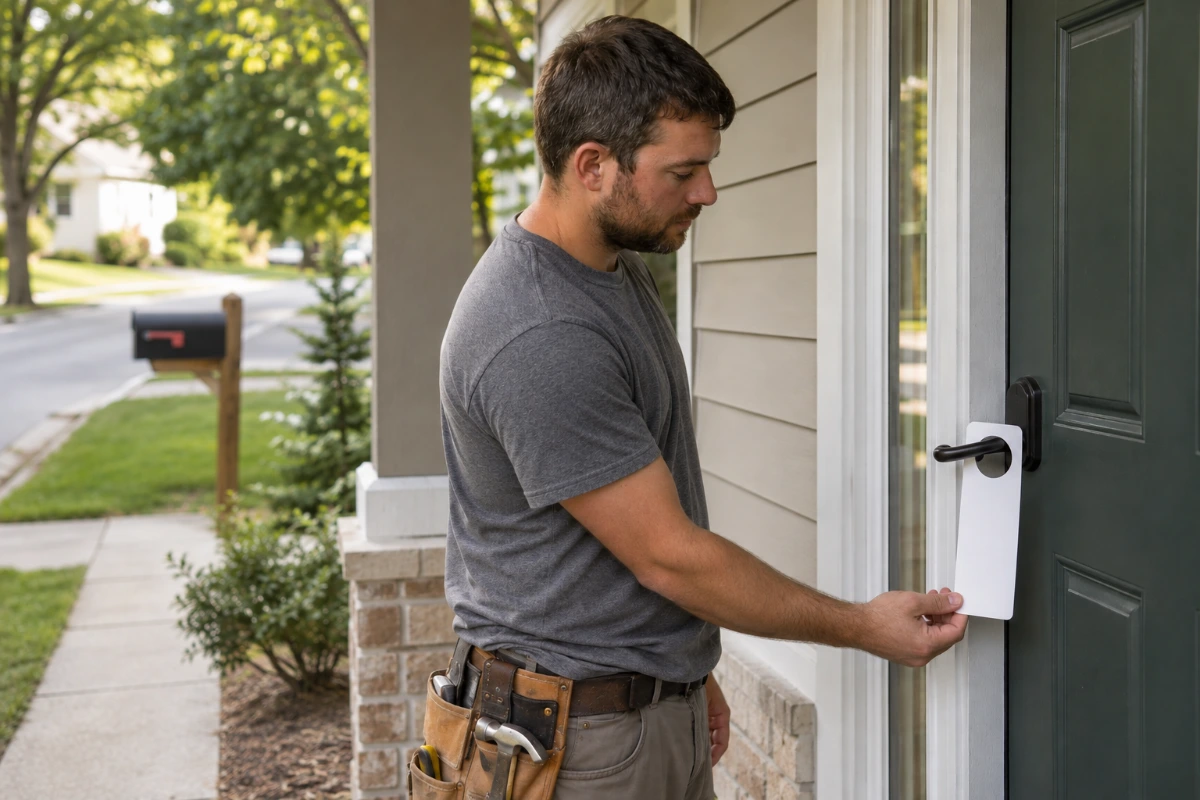
Respect the signs on the door. Grapevine, Texas: "“No Soliciting” and “No Handbill” signs must be observed." A home with either sign gets no hanger.
Leaving a hanger is not the same as selling at the door. In Grapevine, "A permit is not required to distribute handbills that contain business information, product information and coupons" and "As long as there is no contact with the property owners, a permit is not required to leave handbills." But "A handbill may not be used to take orders; this is considered solicitation." So the hanger informs and invites a call; it is not an order form. Talking to homeowners at the door is a different matter: Grapevine requires a solicitor's permit for door-to-door sales, Fort Collins, Colorado says "Companies must get a City permit before door-to-door sales.", and Springboro, Ohio names roofing companies among those that need a solicitor's license. This guide does not cover door knocking. If your crew talks to neighbors at the door, check your city's solicitation rules first.
What to put on the hanger. The idea is old. The Journal of Light Construction described it in 2006: "This is a door hanger that briefly describes the product(s) being installed on a neighbor's house." A good hanger today:
- "We're replacing a roof on your street." Name the street only if the customer said yes; never the house number.
- What to expect: the work days, trucks, noise, and that the crew cleans up every day. Neighbors like being warned.
- Your company name, license number if required, and one phone number or QR code used only for door hangers.
- If you use a QR code: it opens a short form with a consent box for texts (texts only with consent). Nobody gets a text who did not tick it.
No gifts for inspections or claims. Do not offer a gift card, a rebate or "we cover your deductible" for a roof inspection or an insurance claim, on a hanger or anywhere. Some states limit this by law. Our referral program guide lists which state rules limit rewards, and in Texas, see what Texas law allows roofers to say and do after a storm.
Neighbor postcards with Every Door Direct Mail (EDDM)
A door hanger reaches the few homes your crew can walk to. A postcard can reach the whole route. USPS built a service for exactly this.
What EDDM is. USPS: "Use Every Door Direct Mail® (EDDM®) services to promote your small business in your local community." "Mailpieces are simply addressed to 'Postal Customer'" and "your mail will be delivered to every address on your selected routes." USPS PostalPro adds that it works "without requiring names and addresses on the mailpieces" and lets you "Send mail to every address in a defined geographic area". You need no mailing list, and the postcard goes through the mailbox the legal way: with postage.
How to do it, step by step:
- Pick routes in the EDDM Online Tool (eddm.usps.com). "You can select multiple routes for a single mailing." The tool also gives "delivery statistics for specific carrier routes", with categories such as Route, Residential, Total, Age, Size, Income and Cost.
- Choose routes by your job map and roof age, not by the people. Start with the routes around the job you just finished and around your past jobs, then add routes where the homes (and so the roofs) are about the same age. The tool offers age and income columns; we don't recommend picking routes by them. Pick by the roofs.
- Choose Retail or BMEU. EDDM Retail: "Send at least 200 and up to 5,000 pieces per day per ZIP Code™" and "No special mailing permit needed". EDDM through a Business Mail Entry Unit (BMEU): "Pay with a bulk mailing permit" and "No volume limit on size of the mailing". Most single-job mailings fit Retail.
- Check the size before you print. "EDDM flyers, postcards, and other flats are considered USPS Marketing Mail® products." USPS points you to its Mailpiece Size Checker and its "Physical Standards for Flats". Check your design there; your printer should know the standard too.
- Add the indicia. "Every EDDM mailpiece must include the EDDM Retail Indicia above and to the right of the address block."
- Bundle and drop off. "Bundle your mailing in stacks of 50-100 mailpieces." "Take the mailing to the Post Office for your selected ZIP Code™."
Postage. USPS lists the current postage on its EDDM page (usps.com/business/every-door-direct-mail.htm). Check it there before you plan the mailing.
What goes on the postcard. A photo of the finished roof, if the customer said yes to photos. PipelineOn's common advice: "If you replaced a roof on Elm Street, a photo of that roof (with permission) makes the mailer feel local and credible." Then one message, your company name, license number if required, and one phone number or QR code used only for postcards (the QR form with a consent box; texts only with consent). Never the customer's house number; the street name only with their yes. And the same rule as on the hanger: no gifts for inspections or claims.
When it should arrive. PipelineOn suggests: "Time the mailing to arrive 5-7 days after the job completes." JLC's 2006 version repeats the hanger "Thirty days later" with "a direct mail postcard a few days later." Both are common advice, not rules. About a week after the job, then once more a month later, is a simple start; your tracking will tell you whether the second round earns its place.
What about ads around the job?
Many roofers want to put online ads around one finished job. The platforms make that hard:
- Facebook and Instagram: if your ads fall under Meta's Housing category, there is no ZIP code targeting and a minimum radius of 15 miles in the US. See our guide to Facebook ads for contractors and the map in Facebook ads for roofers.
- Google: housing ads cannot target ZIP codes, and radius targeting needs at least 1 km. Our retargeting ads guide explains it.
- Nextdoor: ads target by state, city, DMA or postal code; a radius is only for free posts. Our Nextdoor ads guide covers it.
Two free steps belong in the same week: post the job photos on your Google Business Profile (our Google Business Profile guide for roofers shows what to do after the profile is live), and ask the customer for referrals (our referral program guide shows who to ask and when).
So the street itself, with a sign, a hanger and a postcard, is the tightest targeting you have.
A simple job-by-job plan
Run the same steps on every job, so it happens even in a busy month:
- Contract signed. Ask the three permission questions: yard sign, roof photos, naming the street.
- Run the rule check. City sign code, HOA (the customer checks), handbill and solicitation rules. The first time you work in a city, write down what you found, so the next job there is quick.
- Sign up before the work starts, on the customer's lot, never on public property.
- Door hangers to the nearest homes, on the first work day or the finish day. Pick a number your crew can do without slowing the job; on the door or knob only, and skip any home with a "No Soliciting" or "No Handbill" sign.
- Postcard to the route (EDDM), timed to arrive about a week after the job.
- Job photos on your Google Business Profile, if the customer said yes to photos.
- Ask the customer for a referral, once they have seen the finished roof.
- Sign down on time, by your city's deadline or the date in the contract, whichever comes first.
- Log every lead's source, from the first call.
Your team runs every step on the street. The set-up behind it (tracked numbers, QR forms, CRM fields) is the part you can build once and reuse.
How do you know it works? Track by signed jobs
Hook Agency's common advice: "Always include a way to track responses, such as a unique phone number, QR code, or specific website URL." PipelineOn says the same for mail: "Every campaign needs its own tracking number or promo code."
Set it up once:
- One tracked phone number per channel: yard sign, door hanger, postcard. Each forwards to your office line.
- One QR code per channel, each opening the same short form with a hidden source field and a consent box for texts (texts only with consent). See what texting rules to check first.
- Ask "How did you hear about us?" on every first call, and pick the answer from a fixed list.
- CRM lead sources: "Jobsite sign", "Door hanger", "Postcard (EDDM)". Count by channel, never by which house scanned a code.
Then look each quarter at leads, inspections, estimates and signed jobs per channel, and at cost per signed job: what you spent on that channel ÷ the jobs you signed from it. Our guide to cost per signed job shows how to track it.
Worked numbers in this guide show the method; they are not real client results. One quarter, three channels:
| Channel | Leads | Inspections held | Estimates sent | Signed jobs |
|---|---|---|---|---|
| Jobsite sign | 6 | 5 | 5 | 3 |
| Door hanger | 9 | 6 | 5 | 2 |
| Postcard (EDDM) | 14 | 8 | 7 | 2 |
On leads, the postcard looks like the winner. On signed roofs, the sign leads with three. Add what each channel cost you that quarter, divide by signed jobs, and you know which one to grow and which one to fix.
Mistakes to avoid
- A yard sign without the customer's written permission.
- A sign on the sidewalk strip, a median or any other public property.
- Leaving the sign up past your city's limit.
- A door hanger in, on or hung from a mailbox.
- Ignoring a "No Soliciting" or "No Handbill" sign.
- Printing the customer's house number, or their street without their yes.
- Offering a gift, gift card or deductible help for an inspection or a claim.
- Texting someone who did not opt in (texts only with consent).
- Judging the channel by leads instead of signed jobs.
Where Digital Hark fits
Your team orders the signs and postcards, walks the street and makes the calls. Digital Hark builds the part behind them: the tracked phone numbers, the QR landing page and form with a consent box, the CRM lead-source fields, a fast first reply (texts only with consent), and the ads that run alongside in your own accounts. Our tracking service sets up the numbers and sources so each channel shows its signed jobs. We never call your leads, book inspections or sell jobs, and we don't print, hang or mail anything; the street and the sales stay with your team. Every account, page and lead is yours. More on how we work with roofing companies.
Common questions
Do you need permission to put a yard sign on a customer's lawn?+
Yes. It is their property, so get their yes in writing, ideally a line in the contract with a tick box. Ask at the same time about photos of their roof and naming their street. Even with their yes, the sign must follow your city's sign rules and any HOA rules.
Can an HOA stop a roofing yard sign?+
It can. Common HOA rules cover yard signs, and the state HOA laws we read (Arizona and Florida) do not protect contractor signs. Ask the customer to check their community's rules before the sign goes up. This is general information, not legal advice.
How long can a roofing yard sign stay up?+
It depends on your city and on what the customer agreed to. For example, Tiburon, California says construction signs must be removed no later than ten days after the work is done. Look up your own city's sign code and put the removal date in your job checklist.
Can you put door hangers in mailboxes?+
No. Federal law bars putting unpaid mail matter in a mailbox, and USPS rules add that nothing without postage may be placed on, attached to or hung from one. Put door hangers on the door or the knob, skip homes with "No Soliciting" or "No Handbill" signs, and follow your city's handbill rules.
Do you need a permit for Every Door Direct Mail?+
Not for EDDM Retail: USPS says you can send at least 200 and up to 5,000 pieces per day per ZIP Code with no special mailing permit. For larger mailings through a Business Mail Entry Unit, you pay with a bulk mailing permit. USPS lists current postage on its EDDM page.
Can you target Facebook ads around one roofing job?+
Usually not tightly. If your ads fall under Meta's Housing category, you can't target ZIP codes and the minimum radius in the US is 15 miles. A yard sign, door hangers and an EDDM postcard reach the street around the job far more closely. Offered a vendor's "geofence" instead? See what geofencing ads really are.


