
Guide · Remodeling
Window and door replacement marketing: get the leads and keep energy and tax-credit claims honest
How window and door companies can split their Google Ads, block the searches that are not theirs, run real-photo Meta ads, and write energy-savings, ENERGY STAR and tax-credit lines that hold up in 2026. Quoted from the IRS, the FTC and ENERGY STAR, then turned into a checklist.
The short answer
Run window and door jobs as their own campaigns, with their own page, photos and negative keywords, and judge them by signed jobs. Keep claims honest: the federal tax credit ended for windows installed after December 31, 2025, "up to" savings claims need proof, and only certified products are "ENERGY STAR certified". General information, not legal or tax advice.
Key takeaways
- Window, entry door, patio door and glass repair are different jobs. Give each its own ad group or campaign and page, and block "windows" searches that mean software, cleaning or car glass.
- The IRS says the home improvement credit is "not allowed for any property placed in service after Dec. 31, 2025." Take it out of your ads, pages and sales sheets.
- In its 2012 window cases, the FTC said "up to" savings claims need proof that almost every buyer gets that much. Describe the product, not money saved.
- Say the window is "ENERGY STAR certified" for the homeowner's climate zone. Never "ENERGY STAR rated", never "EPA approved", and no logo unless you are a partner.
- Count leads, in-home visits and signed jobs by source, not clicks.
Want us to find your three biggest lead leaks?
Free Growth DiagnosisHow are window and door searches different from remodeling searches?
A homeowner who needs new windows is not looking for "a remodel". They search for the product or for the problem: a drafty window, foggy glass, a broken seal, a patio door that sticks, an entry door that lets the cold in. Many add "near me" or their town. Some search a window brand by name.
Three things follow for your marketing:
- Each job is its own search. Window replacement, entry doors, patio doors and glass repair are different jobs with different buyers. A person who wants one foggy pane fixed is not shopping for twelve new windows.
- "Windows" has a second meaning. Many searches for "windows" are about computer software, not glass. Without the right negative keywords, you pay for them.
- The claims are different. Window ads lean on energy savings, ENERGY STAR and, until recently, a tax credit. Each has rules, and those rules are below.
If windows and doors are one line in a wider remodeling business, the overall plan is on our page on marketing for remodelers. This guide covers only what is different for windows and doors.
Which campaigns, pages and negative keywords should window and door Google Ads get?
Keep the general set-up from our guide to setting up Google Ads campaigns as a remodeler. Change only what is different for windows and doors.
- Split by job. Give window replacement, entry doors and patio doors their own ad groups or campaigns, each with its own ads and its own landing page. Add glass or repair only if you do that work. The agency BSPKN puts it the same way: "Separate campaigns by service type: window replacement, door replacement, storm/impact windows, patio doors." (May 7, 2026)
- One landing page per job. Send window clicks to a window page and door clicks to a door page, never the home page. The ad and the page should say the same thing: the job, your area, one next step.
- Block the other "windows". Add window-specific negatives, and only block what you really do not do:
- software: "windows 10", "windows 11", microsoft, software;
- cleaning: "window cleaning", "window washing";
- car glass: "auto glass", windshield;
- parts and add-ons: parts, screens, tint, film, blinds, shades;
- glass-only and repair searches, if you only replace whole windows.
- Keep your own campaigns apart. In the window campaign, add door and doors as negatives; in the door campaigns, add window and windows. Decide which campaign owns a mixed search like "window and door replacement", and leave that negative out of the campaign that owns it, as our guide to cross-negatives between your own campaigns explains.
- Brand names. If you are a dealer for a window brand, ask the maker what its dealer rules allow for its name in your keywords and ads. Leave other companies' brand names out of your keywords and ads.
- Local Services Ads. If you run them too, our guide covers Google Ads or Local Services Ads for remodelers. Compare both on cost per signed job, not cost per lead.
Check the real search volume for your area in your own Keyword Planner before you plan around any search; we state no volumes here.
Old window out, new one in: what should Facebook and Instagram ads show and ask?
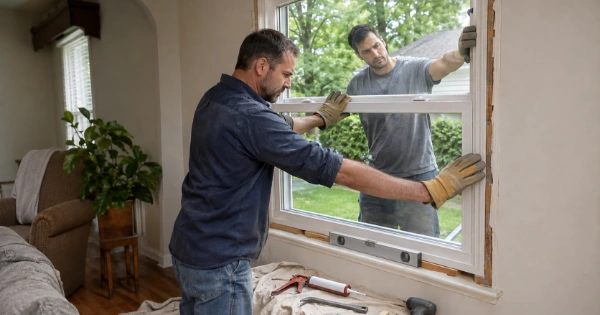
They can, if the ads show your own work. A homeowner who scrolls past a clean install on a house like theirs may start to think about their own old windows.
- Use your own photos and short videos: the old window coming out, the new one going in, the finished trim, from inside and outside. Before and after from the same spot.
- Ask useful form questions: windows, entry doors or patio doors; about how many openings; roughly when the home was built; whether they own the home; and when they hope to start. These save your team a call.
- Keep the ad and the form honest. The same claim rules as in your Google ads apply (see the next sections).
Before you launch, check Meta's rules: Meta's Housing category names housing repairs, and it limits targeting, so the age and income targeting some agencies suggest may not be possible. See which Meta ad rules remodelers should check first.
What can you say about energy savings?
Energy savings is the easiest window claim to make and the easiest to get wrong. At least one 2026 marketing page for window companies suggests a dollar-per-year savings line as ad copy. That is the kind of claim the FTC challenged.
In 2012 the FTC settled with five window sellers over energy-efficiency and cost-savings claims. One of the claims it challenged was that new windows would "cut energy bills in half". The final orders "prohibit the companies from making these claims and any other deceptive energy-related claims".
The orders also show how the FTC reads the words "up to". The companies may not claim that consumers "will achieve up to, or a specified amount or percentage of energy savings" unless they have "competent and reliable scientific evidence to substantiate that all or almost all consumers" are likely to get the most savings claimed. The FTC said the orders require the companies to "substantiate savings claims that include the words 'up to.'"
So "up to" does not protect you. An "up to" savings claim needs proof that almost every buyer can get that much.
What to write instead:
- Describe the product, not the money. The window line, that it is ENERGY STAR certified for the homeowner's climate zone (if it is), the NFRC label, how you seal and finish the opening.
- No savings numbers of your own, no "save X" line, no payback promise, no savings calculator on your page.
- Have proof for every claim before the ad runs, even simple ones like "quieter" or "fewer drafts". Our guide to "free" offers and warranty claims in contractor ads covers how to back up a claim before the ad runs.
This is general information, not legal advice. Have your lawyer check claims you are not sure about.
How do you write about ENERGY STAR in ads?
ENERGY STAR certifies products, not companies. A window is certified for certain climate zones: ENERGY STAR says windows "must meet U-Factor and, where applicable, Solar Heat Gain Coefficient (SHGC) requirements based on climate zone." The current criteria have been in effect since October 23, 2023.
ENERGY STAR tells homeowners to "look for the ENERGY STAR label for your climate zone next to the NFRC label on the glass", and says certified products "Are independently tested, certified, and verified by the National Fenestration Rating Council (NFRC)". So leave the labels on the glass until the homeowner has seen them. They are the homeowner's proof. To check a product line, use the ENERGY STAR Product Finder, which ENERGY STAR says identifies "product lines certified for your climate zone".
ENERGY STAR's own writing rules list the right and wrong wording:
| Correct | Incorrect |
|---|---|
| "ENERGY STAR certified ____." | "ENERGY STAR rated/labeled/compliant ____" |
| "____ has earned the ENERGY STAR." | "____ has met ENERGY STAR standards" |
| "[Company] is an ENERGY STAR partner." (only if true) | "An ENERGY STAR company." |
| "[Company] is endorsed by the EPA." | |
| "____ is EPA approved/endorsed." |
In practice: "ENERGY STAR certified windows for our climate zone" is fine if the product you install really is certified for your area. "ENERGY STAR rated windows", "EPA approved" and "an ENERGY STAR company" are not.
The logo. ENERGY STAR says that, in most cases, "organizations must sign a Partnership Agreement and be an active partner" to use the marks. Partners are also "responsible for their own proper use of the ENERGY STAR marks, as well as use by their representatives, such as ad agencies, contractors". The marks "may never be used in any manner that would imply EPA or ENERGY STAR endorsement or approval of an organization", and "may never be associated with products, homes, or buildings that are not ENERGY STAR certified." They may not go in a company's name or logo, a product name, or a "website title or domain name".
So: use the logo only if your company is a partner or the window maker lets you under its partnership, and only next to certified products. Do not put "ENERGY STAR" in your company name or logo, your website's name or your domain.
Is there still a federal tax credit for windows and doors?
No. The federal tax credit for energy-efficient windows and doors has ended.
The IRS says the law known as the One, Big, Beautiful Bill ("Public Law 119-21, 139 Stat. 72 (July 4, 2025)") "accelerates the end" of several home energy credits, and that the "Energy Efficient Home Improvement Credit (25C)" is "Not allowed for any property placed in service after Dec. 31, 2025." The IRS instructions for Form 5695 say: "You can't claim energy efficient home improvement credits for expenditures or property placed in service after December 31, 2025." The IRS credit page says: "You must claim the credit for the tax year when the property is installed, not merely purchased."
Windows and doors installed in 2026 do not get this credit. Yet some 2026 marketing pages for window companies still call it current or tell you to promote tax credits. Check everything you publish:
- Google and Meta ads, and the landing pages behind them;
- your website, service pages and FAQ;
- Google Business Profile posts and offers;
- sales sheets, door hangers, mailers and scripts.
Take out every line that says or hints that a window or door bought now gets the federal credit. If a homeowner asks about a window installed in 2025, tell them to ask their tax adviser; you are not their tax adviser. Do not promise state, local or utility rebates either. At most, tell homeowners to check with their utility or state energy office.
This is general information, not tax advice.
Warranties, financing and offers: what to check
Window ads often add a warranty, a payment plan or an offer. Each has its own rules, covered in our other guides:
- Warranties and "lifetime" warranties. Say whose warranty it is, where the homeowner can read it, and whose lifetime "lifetime" means. Our guide to "free" offers and warranty claims in contractor ads covers the FTC rules.
- "Free" in-home estimates or measurements. The same guide covers what "free" must mean and where the conditions go.
- Financing. Financing words have their own rules; our guide to advertising financing as a roofer or remodeler covers them.
Selling at the kitchen table: the 3-day cancellation rule
Many window jobs are signed at the homeowner's kitchen table. If yours are, the FTC's Cooling-Off Rule may give the buyer three business days to cancel, and you must give the notice. Our guide to remodeling proposal follow-up explains what the rule asks of you. This is general information, not legal advice; your state may add more.
Window jobs are also sold at home shows and showroom events. Our guides on whether home shows are worth it and on showroom events for remodelers cover those.
Replacing windows in an older home? Our guide to EPA Lead-Safe certification for remodelers covers when the lead-safe rules apply.
How do you count leads, in-home visits and signed jobs for each window and door campaign?
By signed jobs, not clicks or form fills. Give every lead a source and a job type (window, entry door, patio door), then count, for each campaign:
- leads by source;
- in-home visits held;
- signed jobs;
- installed jobs;
- cost per signed job: what you spent on a source divided by the jobs you signed from it.
Home Service Direct asks the same question about every source: "which ones produced appointments? Which produced signed contracts?" (February 26, 2026)
Worked numbers in this guide show the method; they are not real client results. For example: over a quarter, the window replacement campaign brings 50 leads, 20 in-home visits and 6 signed jobs. The patio door campaign brings 30 leads, 15 visits and 5 signed jobs. The window campaign looks bigger, but the door campaign turns a larger share of its leads into contracts. Divide each campaign's spend by its signed jobs to see which one really costs less.
Send signed jobs back to Google Ads as offline conversions, so the account learns which searches turn into contracts. Our guide to cost per signed job shows how to set it up by lead source, and we set up the sources and signed-job counts as part of call and lead tracking.
Where Digital Hark fits
Digital Hark builds the growth system for window, door and remodeling companies: Google and Meta ads in your own accounts, a page for each job type, tracking of calls, forms and signed jobs, and a fast first reply and follow-up list (texts only with consent). For windows and doors, that means split campaigns, window-specific negatives, honest claim wording and numbers you can see by signed job. Your team talks to the homeowners, visits, measures, quotes and sells; we never call your leads, book visits or sell for you. You own every ad account, page and lead. What is included is confirmed in writing in your proposal.
Checklist
- ☐ Window, entry door and patio door jobs have their own ad groups or campaigns and pages.
- ☐ Window negatives are in: software, cleaning, car glass, parts and add-ons (only what you do not do).
- ☐ Ads and pages use your own photos and videos.
- ☐ No line says or hints that a window bought now gets the federal tax credit.
- ☐ No "up to" or other savings claim without proof that fits almost every buyer; no savings numbers of your own.
- ☐ ENERGY STAR wording is "ENERGY STAR certified" for the climate zone; no "rated", no "EPA approved", no logo unless you are a partner.
- ☐ If you sign jobs at the homeowner's home, you give the cancellation notice.
- ☐ Every campaign is judged by signed jobs.
Common questions
How do window companies get more leads?+
Give window replacement, entry doors and patio doors their own Google Ads campaigns or ad groups and their own pages, block searches that are not yours (software, cleaning, car glass), run Meta ads with photos of your own installs, and reply fast. Then count in-home visits and signed jobs by source, not clicks.
Is there still a federal tax credit for windows in 2026?+
No. The IRS says the Energy Efficient Home Improvement Credit is "Not allowed for any property placed in service after Dec. 31, 2025." Windows and doors installed in 2026 do not get it. Homeowners should ask their tax adviser about a 2025 installation. This is general information, not tax advice.
Can you say "save up to" on energy bills in window ads?+
Only with strong proof. In its 2012 window cases, the FTC required proof that "all or almost all consumers" are likely to get the most savings claimed, and said "up to" claims need that proof too. Safer: describe the product and its labels instead of promising money saved. Not legal advice.
Can a contractor use the ENERGY STAR logo?+
In most cases only an active ENERGY STAR partner may use the marks, and only with certified products. A contractor can write that a window is "ENERGY STAR certified" if it is, but should never say "ENERGY STAR company" or "EPA approved". Ask the window maker what its partnership allows.
Which negative keywords should window companies use?+
Block software searches ("windows 10", "windows 11", microsoft), "window cleaning", auto glass and windshield, and parts and add-ons like screens, tint and blinds, if you do not sell them. Add your general remodeling negatives, and keep window and door campaigns apart with cross-negatives.
Does the 3-day cancellation rule apply to window sales at home?+
It may. The FTC's Cooling-Off Rule can give a buyer who signs at home until midnight of the third business day to cancel, and the seller must give the notice. Check the rule and your state's rules with your lawyer. This is general information, not legal advice.


