
Guide · Tree service
Google Ads for tree service companies: search ads and Local Services Ads
For tree service owners: which Google ads fit which tree jobs, how Local Services Ads charge and verify, what changes as they move into Google Ads, which searches to pay for and block, what clicks cost, and how to see which ads bring signed jobs. Built from Google's own help pages.
The short answer
Google Ads can work for a tree service when the ads reach only your service area, match the jobs you want, and are judged by signed jobs. Local Services Ads charge per valid lead and suit urgent calls; search ads charge per click and give control over job types like stump grinding and big removals.
Key takeaways
- Local Services Ads: you pay per valid lead, there are no keywords, and you must pass Google's checks first (3–4 weeks on average).
- Search ads: you pay per click and choose the searches, so they fit the jobs you want more of, such as stump grinding, crane removals and land clearing.
- Block the searches that are not jobs: hiring, DIY, firewood, Christmas trees, family trees. Google will not block plurals and synonyms for you.
- Google is moving Local Services Ads into Google Ads. Tree services is not named in the first phase.
- Judge every campaign by cost per signed job, not by clicks or leads.
Want us to find your three biggest lead leaks?
Free Growth DiagnosisDo Google Ads work for tree service companies?
Yes, when three things are in place. First, the ads show only in the towns your crews really reach. Second, someone answers the phone, or calls back fast. Third, you know which ads bring signed jobs, not just calls.
They fail for the opposite reasons. A campaign set to a whole state pays for clicks from people two hours away. A broad keyword like "trees" pays for people who want to buy a tree, not remove one. And an owner who only sees "clicks" in the account cannot tell a good month from a bad one.
You will also hear "PPC" (pay per click). For a tree company it means the same thing: Google search ads, where you pay when someone clicks. Local Services Ads work differently, so this guide treats them on their own.
For the other campaign types and Google's general settings, see our hub guide on Google Ads for contractors. This guide is the tree-specific version.
Search ads or Local Services Ads: which fits a tree service?
The two ad types sit in different places on Google and charge in different ways:
Search vs LSA
Local Services AdTree servicesReviews and a verified badge
Search adTree removal in [your towns]Insured crew. Written estimate before we start.
Search adStump grinding in [your towns]Send a photo for a written estimate.
| Local Services Ads | Google search ads | |
|---|---|---|
| You pay | Per valid lead (a call, message or voicemail) | Per click |
| How Google matches you | Your job types and service area, no keywords | The keywords you choose |
| What helps you show | Reviews, response time, a complete and verified profile | Keywords, ad text, landing page |
| When you can start | After Google's checks, 3–4 weeks on average | Once the account, ads and tracking are set up |
Which jobs fit which ad? This is our view, based on how each ad type works. Test it on your own cost per signed job.
| Tree job | What the homeowner usually does | Better fit (our view) | Why |
|---|---|---|---|
| Emergency or fallen tree (on the house, car or driveway) | Searches and calls right away | Local Services Ads, plus a search campaign with a call button | They want to talk to someone now. Both put your phone number in front of them. |
| Tree removal near me | Compares two or three companies | Both | Local Services Ads show your reviews; search ads let you send them to a removal page. |
| Trimming and pruning | Plans ahead, often in a quiet month | Both, if trimming is a job type you can pick in your Local Services Ads account | Check which job types Google offers you before you count on it. |
| Stump grinding | Searches the exact service | Search ads | You choose the exact searches and can send them to a stump page. |
| Crane and large removals | Wants proof you can do the big job | Search ads | Your ad and page can show crane work and ask for a photo. |
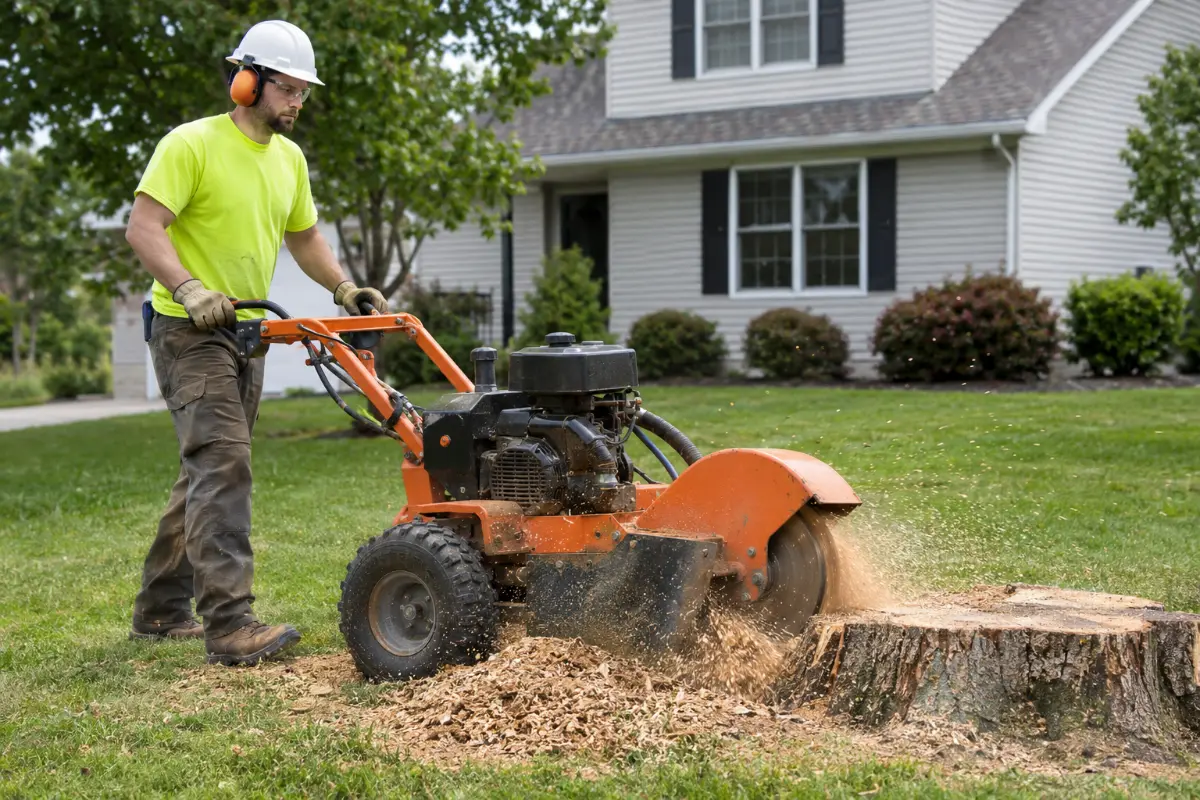
| Land or lot clearing | Searches by service and town | Search ads | Different buyer, different page, its own budget. Adding clearing? See our guide to land and cedar clearing as a service line. |
| Commercial, HOA and property managers | Searches for a contractor, often by job type | Search ads | You can write ads for managers and send them to a commercial page. |
| Your own company name | Already knows you | Search ads (a small brand campaign) | Other companies can bid on your name. A brand campaign keeps you on top. What Google allows: bidding on competitor names in Google Ads. |
Many tree companies run both and compare them on cost per signed job (see the tracking section below). Some jobs fit Facebook and Instagram better than Google, such as planned trimming in a quiet month. Our guide to Facebook ads for tree services covers those. To see how Local Services Ads charge next to lead sites, read Local Services Ads compared with Thumbtack and Angi.
How do Local Services Ads work for tree services?
Local Services Ads are the listings with reviews and a verified badge that can show at the top of Google for local service searches. Google lists "Tree services" as an eligible category in the United States.
What you pay for. Google charges per lead, not per click. Google's "How leads work" page lists what can be a charged lead:
- "You answer a phone call or you call the customer back and speak with the customer."
- "You missed a phone call during your business hours and the customer stays on the line for more than 20 seconds."
- "You receive a text message or email from the customer."
- "You receive a voicemail from the customer."
- "You receive a booking request from a customer (United States and Canada only)."
What you are not charged for. Google says "leads determined to be invalid or low quality are not charged". Follow-ups from the same customer within 15 days are not charged again, and "Google continuously assesses lead quality over a 30-day period." Google can also credit some charged leads automatically if it finds them low quality: "In most cases, credits will be applied to your account balance within 30 days." It no longer gives credits for leads marked "job type not serviced" or "geo not serviced". So set your job types and service area with care. A lead from a town you do not serve still costs you.
What moves you up the list. Google ranks Local Services Ads by your bid, how likely your ad is to bring a lead, and your profile quality. Google adds: "Missed calls may negatively affect your responsiveness." For a tree company, that means: answer during the hours you list, call back in minutes when crews are out, and keep reviews coming from finished jobs.
Getting verified. Google needs a verified Google Business Profile. Its general rule reads: "Background check requirements, business registration requirements and insurance requirements are only required for select users, unless otherwise stated below." For tree services, Google may ask some businesses for background checks, general liability insurance and a state license where local law needs one. Google says: "On average, this process takes 3–4 weeks to complete after submitting your documents." Start well before you need the calls, not the week of a storm. Licensing rules for tree work differ by state and city; this is not legal advice.
Some older articles still use an old badge name, or say you set a price per click and pick keywords. Neither is how Local Services Ads work today.
Our sister guide on Local Services Ads for roofers covers bidding modes and reviews in more depth. The rules are the same; only the trade changes.
What changes when Local Services Ads move into Google Ads?
Google is moving Local Services Ads into Google Ads as Performance Max campaigns with pay-per-lead goals. Google's timeline:
- "August 2026: The first phase of the migration begins for select home and storefront service advertisers in the United States (including plumbing, HVAC, electrical, appliance repair, house cleaning, lawn care, roofing, pest control, and moving)."
- "Late 2026: The migration expands to broader advertiser groups, including service-area businesses without physical storefronts…"
- "2027: Non-U.S. accounts, and all remaining business categories that were not migrated in 2026 will transition"
Google has not named tree services in its first phase. A tree company that works from a yard rather than a storefront may move in late 2026 or 2027. Google emails account admins before an account moves, so watch for that email.
What changes for your account:
- Budget. Before the move you set a weekly budget. After it: "Your historical average weekly budget is automatically divided by 7 to determine your daily average budget." Monthly spend is capped at that daily average times 30.4.
- Bidding. "Manual bidding (such as setting a maximum cost-per-lead) is no longer supported in Google Ads." And "Google Ads doesn't support vertical-level Target CPA bidding." In plain words: one target for the whole campaign, not one for removals and another for trimming. Compare job types yourself, by signed jobs.
- Checks and reports. "Insurance and license reverification are no longer required." Your leads move over, but old reports do not, so download them first. Google says to "allow up to two weeks for the migration process to fully complete."
- New campaigns. "You can't create new campaigns with pay-per-lead goals directly within Google Ads at this time." A tree company starting today still sets up Local Services Ads the usual way.
Which searches should a tree service bid on?
Start with searches that name a job you do, in a place you serve. These are common homeowner searches; check the volume for your own area in Google's Keyword Planner before you build:
| Campaign | Keyword ideas (volume to check) |
|---|---|
| Urgent | emergency tree removal, fallen tree removal, tree removal near me |
| Planned removals | tree removal [town], dead tree removal, crane tree removal |
| Care | tree trimming, tree pruning, tree service near me |
| Stumps | stump grinding, stump removal [town] |
| Clearing | land clearing, lot clearing [town] |
| Brand | your company name |
Four rules that keep the budget on real jobs:
- Phrase and exact match first. Start narrow, then widen only once the search terms report shows what people really type.
- Urgent work in its own campaign. Urgent calls behave differently from planned work: different hours, different ads, often a different budget. Keep them apart so one cannot eat the other's money.
- A call button on urgent ads. Add call assets so a homeowner with a tree on the house can call from the ad. Show them only during hours someone answers.
- One landing page per job type. A stump grinding click should land on a stump grinding page, not the home page.
Which searches should a tree service block?
Negative keywords stop your ads from showing for searches that will never become a job. Google's rules matter here: "Negative keywords won't match to close variants or other expansions." That means "you'll need to add synonyms and singular or plural versions if you want to exclude them." Google does handle one thing for you: "Negative keywords automatically account for casing and misspellings".
Starter negative keyword list for tree companies (our list, not Google's; these are starter examples, so add the plurals and synonyms you need):
- Work seekers: jobs, hiring, salary, arborist certification, arborist training, arborist course
- Do-it-yourself: how to, DIY, chainsaw, rental
- Free stuff: free firewood, free wood chips
- Buyers of trees: buy trees, tree nursery, Christmas tree
- Wrong meaning: tree identification, tree drawing, tree clipart, family tree
Do not block a word you might sell. If you sell firewood or chips, take those lines out.
Then open the search terms report once a week. It shows what people really typed before they clicked. Add every new "not a job" search to your list.
Should tree ads show only to people in the towns your crews reach in a day?
Google's default is "Presence or interest", which Google calls the "default and recommended option". The other choice, "Presence", targets people "likely to be located, or regularly located in the locations you've targeted."
For a local tree company, we suggest Presence. Your crews cut trees where the trees are, so you want people who live or work in your towns, not people who once looked them up.
Then set the area to the towns your crews really reach in a day, not the whole county because it looks bigger. When you are booked weeks out, shrink the area to the towns closest to your yard before you cut the budget.
What should a tree service Google ad and landing page say?
Say the job, the place and why a homeowner can trust you. Put in only what is true for your company:
- "Tree removal in [your towns]. Insured crew. Written estimate before we start."
- "Stump grinding in [your towns]. Send a photo for a written estimate."
- "Big tree near the house? Crane removal by a local team."
- "Fallen tree? Call now. Serving [towns] since [year]."
Leave out price promises, "best" or "number one" claims you cannot prove, and any promise about results. Homeowners have seen them too often to trust them.
The landing page should do one job. One service per page, real photos of your own crews, and a short form that asks what an estimator needs: what the tree is near (house, power line, fence), roughly how tall it is, and a photo upload. Add a click-to-call button for phones. If you send an automatic text reply, keep it short and say what happens next (texts only with consent). A fast first reply matters as much as the ad; our guide to speed to lead shows how to set one up.
What do Google Ads cost for a tree service?
There is no public, sourced cost benchmark for tree services alone. The closest is LocaliQ's 2026 search ad benchmarks for the Home & Home Improvement group, last updated June 1, 2026:
| Measure | Home and home improvement average |
|---|---|
| Cost per click | $8.33 |
| Click-through rate | 6.47% |
| Conversion rate | 8.05% |
| Cost per lead | $90.92 |
These are home and home improvement averages, not tree-only, and not a quote for your area.
What moves your cost: the time of year and storm weeks, your city and how many tree companies bid there, your match types and negatives, and how good your landing page is at turning clicks into calls.
Set the budget from signed jobs, not from a guess. Worked numbers in this guide show the method; they are not real client results.
- Pick a target: 8 signed jobs a month from search ads.
- Use your own close rate. If 1 in 4 good leads signs, you need 32 leads.
- Use a cost per lead to test. At $90 per lead (close to the LocaliQ average), 32 leads cost about $2,880 a month.
- Check the math: $2,880 ÷ 8 signed jobs = $360 per signed job. If your average profit per job is well above that, the test is worth running. If not, start smaller with the job types that pay most.
After the first month, replace the guesses with your own numbers.
Should a tree service run Google ads after a storm?
Yes, if your crews can take the work. Build a storm search campaign before the season and keep it paused, then switch it on only for the towns you can reach that week. Advertise the service, such as fallen tree removal, not the disaster. Our guide to storm cleanup ads for tree services covers the full plan.
For which ads to run in which season, see our page on when to run which ads.
Removals, stumps or Local Services Ads: which signed tree jobs are worth the ad spend?
Clicks and leads are not jobs. Track all the way to signed work:
- Track calls and forms. Count calls from your ads and website, and form sends, as conversions in Google Ads.
- Mark signed jobs in your CRM. Every lead gets a source (search campaign, Local Services Ads, other) and a result: signed, lost, not a job.
- Send signed jobs back to Google Ads. Importing offline conversions tells Google which clicks became work, so it can find more like them. If your CRM sends won jobs to Google automatically, note this: "Starting June 15, 2026, offline conversions import and enhanced conversions for leads uploads will be migrated to the Data Manager API". Ask your CRM provider whether its link already uses it.
- Compare cost per signed job. Spend ÷ signed jobs, for each campaign and for Local Services Ads.
Worked numbers in this guide show the method; they are not real client results.
| Source (one month) | Spend (our input) | Leads (our input) | Signed jobs (our input) | Cost per signed job |
|---|---|---|---|---|
| Search ads: removals | $2,400 | 30 | 6 | $400 |
| Search ads: stump grinding | $600 | 15 | 5 | $120 |
| Local Services Ads | $1,500 | 25 | 5 | $300 |
Cost per signed job in the worked numbers
In these numbers, stump grinding looks cheapest per job. But a stump job is usually smaller than a removal, so compare cost per signed job with the profit on that job type. Our guide to cost per signed job shows how to set this up for every lead source.
Where does Digital Hark fit?
Digital Hark sets up and runs Google Ads for home-service contractors, including tree service companies: search campaigns in your own Google Ads account, landing pages for each job type, call and form tracking, instant replies (texts only with consent) and a CRM that shows cost per signed job. We never call your leads or sell jobs for you. Your team answers the calls, gives the estimates and signs the jobs. You own every account, page and lead.
From our ad campaigns, for a tree-care company: 588 leads → 58 won jobs, and every $1 spent on ads came back as over $10 in won jobs. Those were Facebook and Instagram campaigns, not Google Ads or Local Services Ads. Every business is different; we don't promise results.
For the full picture, see how we work with tree companies.
Common questions
Do Google Ads work for tree service companies?+
They can, when the ads show only in towns your crews reach, someone answers the phone fast, and you track which ads bring signed jobs. Without those three, most of the budget goes to clicks from the wrong places or the wrong searches.
Should a tree service use Local Services Ads or search ads?+
Often both. Local Services Ads charge per valid lead and suit urgent "near me" calls. Search ads charge per click and let you choose the jobs, such as stump grinding, crane removals and land clearing. Compare the two on cost per signed job.
How much do Google Ads cost for a tree service?+
There is no public, sourced tree-only figure. LocaliQ's 2026 home and home improvement averages are a $8.33 cost per click and a $90.92 cost per lead, but your area will differ. Set the budget from the signed jobs you want and your own close rate.
Which searches should a tree company block?+
Start with searches that are never jobs: jobs and hiring, arborist training, DIY and chainsaw, free firewood, buying trees, Christmas trees, tree identification and family tree. Google does not block plurals and synonyms for you, so add them, and check the search terms report every week. Selling holiday lights too? See how to keep a lights campaign apart from that negative list.
How do tree services get verified for Local Services Ads?+
You need a verified Google Business Profile. Google may also ask some businesses for background checks, general liability insurance and a state license where local law needs one. Google says the process takes 3–4 weeks on average after you submit your documents.
When will tree services move from Local Services Ads into Google Ads?+
Google has not named tree services in its first phase. Google says service-area businesses without storefronts follow in late 2026 and all remaining categories in 2027, so a tree company may move in either. Google emails account admins before an account moves.


