
Guide · Tree service
Land and cedar clearing as a service line for Texas tree services: who buys it, ads apart from tree removal, and what to show
Many Texas tree companies already own the saws, the chipper and a compact loader. Clearing a lot, a fence line or a stand of cedar is a natural next line, but it is a different job with a different buyer. Here is who asks for it, how to give it its own ads and page, the proof buyers look for, what Texas rules say about burning the debris, and what to check before clearing cedar in the Hill Country. From the Texas Administrative Code, the Texas A&M Forest Service and Texas Parks and Wildlife.
The short answer
Residential land, lot, brush and cedar clearing is a different job from tree removal, with different buyers: rural lot and acreage owners. Give it its own ad groups and landing page, show your machines and before-and-after photos of your own jobs, state debris and burning options as Texas rules state them, and judge it by signed jobs.
Key takeaways
- List only the clearing jobs your crew really does, with your own machines. One ad group per job and one clearing landing page, not your home page.
- Show your own before-and-after photos, the machines by type and how you handle debris.
- Burning clearing debris can be allowed under a Texas rule exception, with conditions such as: outside city limits, the right wind, daylight hours, 300 feet from buildings on neighboring land, always attended, and no county burn ban.
- In the Hill Country, the owner checks with Texas Parks and Wildlife or the US Fish and Wildlife Service before tall, mature cedar comes down.
- Tag "clearing" as a lead source and count signed jobs.
Want us to find your three biggest lead leaks?
Free Growth DiagnosisWhat clearing jobs can a tree service sell?
Keep it to residential work you can do well. The common ones:
- Land or lot clearing: a lot for a new home, an overgrown back acre, a homesite on rural land.
- Brush clearing: undergrowth, mesquite, scrub and vines.
- Fence-line clearing: opening a fence line so it can be built, fixed or walked.
- Cedar clearing: in Texas, "cedar" usually means juniper. Texas Parks and Wildlife names two: "Ashe juniper, or blueberry juniper, which is found throughout the eastern and central Hill Country" and "Redberry juniper, located in western Hill Country, resprouts from the root system after the tree is cut."
- Selective clearing: taking out brush and cedar while keeping the trees the owner wants.
One note to avoid mix-ups: cedar elm is a different tree. It is an elm, not a juniper, and some Texas cities protect it.
Our method: write down the jobs you do, the machines you use for each, and the lot sizes you take. If you don't grind stumps on acreage or work steep slopes, leave them off the list. Commercial site work, builders, developers and right-of-way clearing are a different business; this guide covers homeowner and landowner jobs only.
Who searches for land clearing, and what do they want?
Mostly owners with a job in mind. In Google Keyword Planner (US, 2026), "land clearing" gets about 8,100 searches a month, "brush clearing" about 1,900 and "lot clearing" about 880. "Land clearing service" fell year on year, so don't plan on growth; plan on winning the searches that are there.
The buyers behind these searches:
- Rural lot and acreage owners who want usable land back.
- Buyers of a lot for a new home who need it cleared before building.
- Owners who want a fence line, a road in, or a view opened.
- Hill Country owners with cedar crowding out oaks and grass.
What they want to know first: can you do my size of job, will you keep the trees I like, what happens to the brush, and when can you start. Your ads and page should answer those four things.
Should clearing get its own ads and page?
Yes. A homeowner who searches "lot clearing" is not looking for a tree trim. Our Google Ads guide for tree services already says clearing is a different buyer with its own page and budget, and covers the keyword list, the location setting and the searches to block. We don't repeat those here. What clearing adds (our method):
- One ad group per job: land or lot clearing, brush clearing, cedar clearing or removal, fence-line clearing. Use the words a buyer types, plus the county or town.
- The rural counties and towns you really serve. Clearing buyers are often outside city limits, so check that your service area covers the land, not only the suburbs.
- Block the clearing searches you don't take: machine rental and sales, and "commercial" if you don't do it.
- A clearing landing page, not your home page. Clearing is a big job, so a landing page or a longer form usually fits better than a short lead form, as our Facebook lead form vs landing page guide explains.
- Google Business Profile: add "land clearing" to Services only if you do it; our Google Business Profile guide for tree services shows where.
Ad wording that fits (our wording; use only what is true):
- "Lot, brush and cedar clearing for homeowners in [counties]."
- "We keep the trees you want: tell us which oaks stay."
- "Debris hauled off, chipped or mulched in place."
What proof do clearing buyers look for?
Buyers want to see that you have done a job like theirs. The pages that show up for these searches lean on photos and machines, and few show insurance lines or many reviews. On your clearing page:
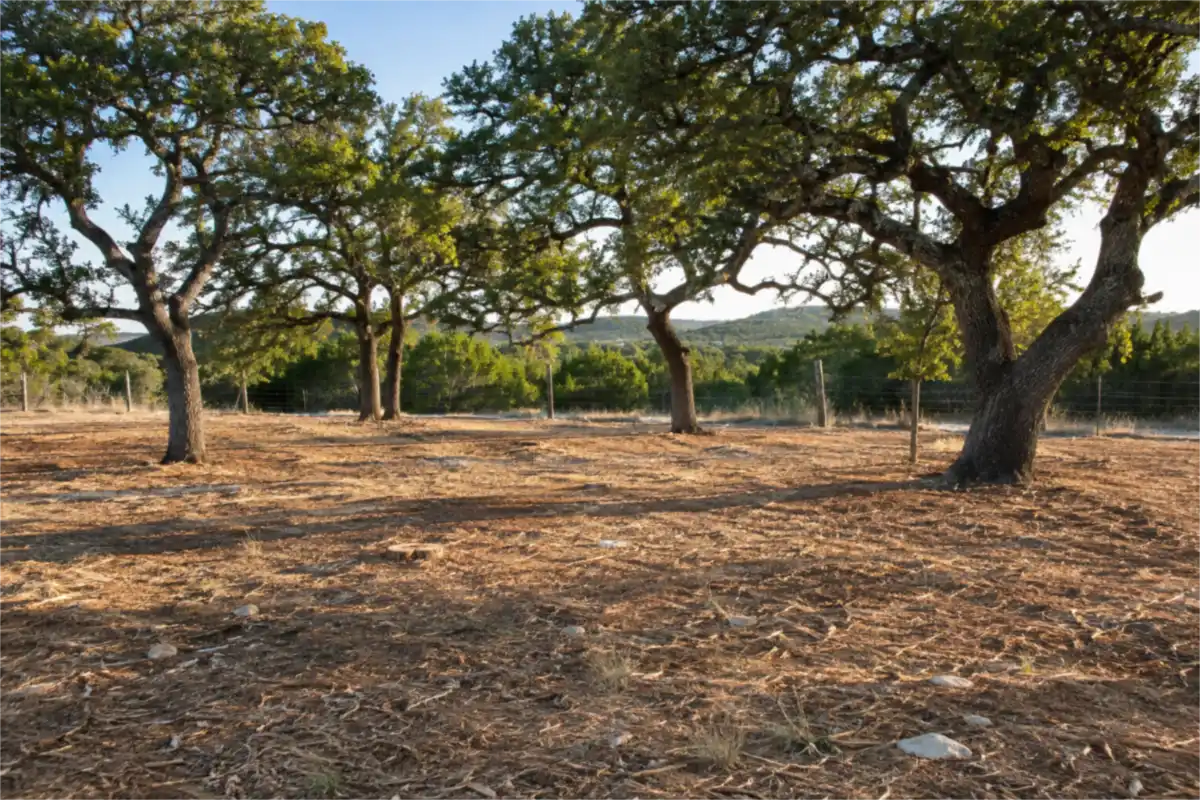
- A gallery of your own clearing jobs. Same angle before and after, with the owner's permission. No house numbers, no plates, no faces.
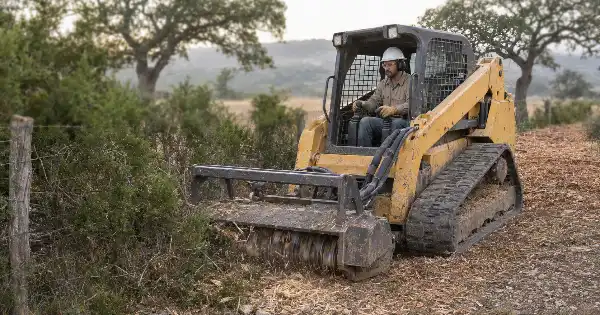
- Your machines by type: compact track loader with a mulching head, skid steer, chipper, hand crews with saws. Type, not brand.
- The trees you kept. If you clear selectively, show a cleared lot with oaks still standing. Say it only if you do it.
- How you handle debris: hauled off, chipped, mulched in place, or burned where allowed. List only the options your crew really uses.
- Insurance: write "insured" only if true and only the way our guide to bonded and insured wording explains.
- Reviews that mention clearing, asked for after each clearing job.
What can you say about burning and debris in Texas?
Burning is where clearing ads go wrong. Say only what the rules say, and say less if in doubt.
The exception for land clearing. In short, 30 TAC § 111.209 (effective November 12, 2020) allows "the burning of plant growth generated as a result of right-of-way maintenance, landclearing operations" "by the owner of the property or any other person authorized by the owner" "when the material is generated only from that property." It says "Commission notification or approval is not required", but it stays "subject to local ordinances that prohibit burning inside the corporate limits of a city or town." This guide quotes only parts of the rule; read the whole land-clearing paragraph before you burn.
Stricter rule in nonattainment counties. The words above are for most counties; in a county that is part of a designated nonattainment area for air quality (or holds part of a city that reaches into one), plant growth from land clearing may be burned only "when no practical alternative to burning exists", and "Such burning is subject to the requirements of § 111.219", all of it. Before you offer burning, check on TCEQ's site whether your county is in a nonattainment area.
What counts as land clearing. The definition (30 TAC § 111.203, as amended in 2017) includes "the clearing of vegetation to enhance property value, access, or production." "It does not include the maintenance burning of on-site property wastes such as fallen limbs, branches, or leaves". So a pile from a yard trim is not the same as a pile from clearing.
The general conditions (30 TAC § 111.219), in its words:
- "Burning must be outside the corporate limits of a city or town" unless the city has "enacted ordinances which permit burning".
- No start when wind is "predicted to be less than six miles per hour (mph) (five knots)" "or greater than 23 mph (20 knots) during the burn period".
- Start "no earlier than one hour after sunrise"; done "on the same day not later than one hour before sunset".
- "at least 300 feet (90 meters) from any structure containing sensitive receptors located on adjacent properties".
- "attended by a responsible party at all times during the active burn phase".
- Never burn "Electrical insulation, treated lumber, plastics, non-wood construction/demolition materials, heavy oils".
County burn bans. The Texas A&M Forest Service says "a burn ban can be put in place by a county judge or county commissioners court" "prohibiting or restricting outdoor burning for public safety". Check the county's status before every burn day.
Before a burn day
- Outside city limits, unless the city allows it
- Wind not under 6 mph or over 23 mph
- Start one hour after sunrise, done one hour before sunset
- 300 feet from buildings on neighboring land
- Attended at all times
- No county burn ban
What to write (our wording, only if true): "Where burning is allowed, we follow Texas outdoor burning rules and county burn bans." What not to write: "we burn anywhere", "no permit needed", or that any agency approved your company.
Oak and ash wood need extra care. In oak wilt areas, follow the Forest Service firewood advice in our oak wilt guide. In emerald ash borer quarantine counties, ash wood stays in the county; see what happens to ash wood in our EAB guide.
This is general information, not legal advice. Read the rules yourself, or ask your own lawyer, before you burn.
Clearing cedar in the Hill Country: what to check first
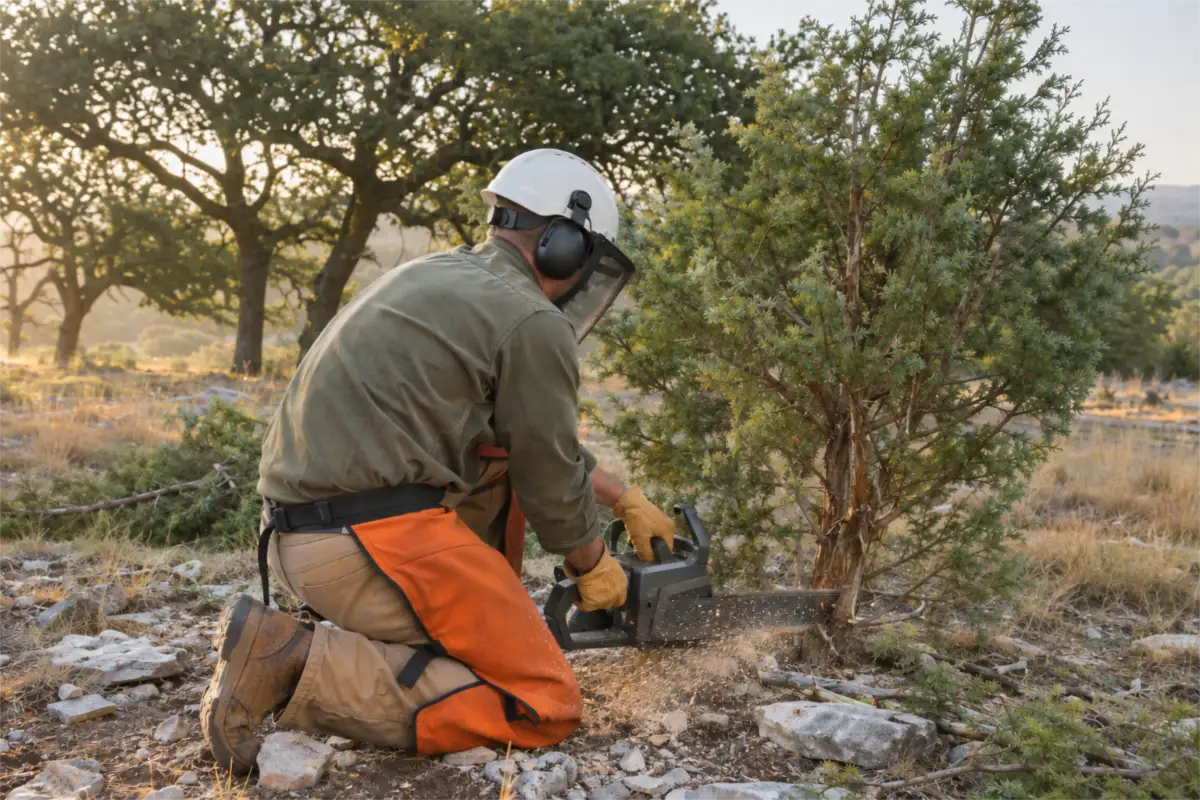
Cedar work in the Hill Country needs a lighter touch. Texas Parks and Wildlife says methods like bulldozing and chaining "can be quite destructive since this region of Texas has such shallow and rocky soils." It says "hand cutting allows for selective removal of trees, and causes little or no soil disturbance", and that "hydraulic shears … allow for selective removal, minimal soil disturbance, and efficient work." If you clear selectively with hand crews or shears, say so on the page.
Cedar comes back. TPWD says "since the soil is full of juniper seeds, the landscape is due for another treatment after 7-8 years." And redberry juniper resprouts from the roots. Offer a check-back visit and put it in your CRM.
Some cedar is bird habitat. TPWD calls mature cedar "the home of the endangered golden-cheeked warblers." Older Texas Parks and Wildlife guidance says "Typical nesting habitat is found in tall, dense, mature stands of Ashe juniper" and that work "should be done during the non-nesting period (September-February)."
Our method: on a Hill Country job with tall, dense, mature cedar mixed with oaks, the owner checks with Texas Parks and Wildlife or the US Fish and Wildlife Service before clearing. Say that on the first call, so the decision stays with the owner. This guide states no federal rule.
Keep the pitch to the job itself: usable land, open fence lines, oaks kept. Leave out claims about water, allergies or land value.
What do you ask on the first call?
The questions that save a wasted trip (our method):
- How big is the lot or acreage?
- What is growing: cedar, mesquite, brush, big trees?
- Which trees stay?
- How wide is the gate, and can a machine get in?
- Is the land inside or outside city limits? Inside, check the city's tree rules first; our guide to Texas tree removal permits shows which Texas cities have tree rules.
- What should happen to the debris: hauled, chipped, mulched or burned where allowed?
- Is it in your service area?
Ask for photos or a short video of the land and the gate: "Send us photos of the lot and the gate, and we'll tell you what we'd bring." Follow up by text only if the caller agreed to texts (texts only with consent); our speed-to-lead guide has the texting rules. For scoring the lead, use our guide to qualifying tree service leads.
How do you know clearing pays?
Count signed clearing jobs, not calls.
- Add "clearing" as a lead source in your CRM, with its own call tag on the ads and the landing page.
- Count clearing leads, leads that sent photos, site visits, quotes sent, signed clearing jobs and check-back visits the owner agreed to.
- Divide clearing ad spend by signed clearing jobs, as shown in our cost per signed job guide.
- Plan clearing money by season with the season split in our tree service budget guide.
| One fall and winter of clearing ads | Count |
|---|---|
| Clearing leads | 30 |
| Leads that sent photos | 19 |
| Site visits | 14 |
| Quotes sent | 12 |
| Signed clearing jobs | 6 |
| Check-back visits set by owners | 2 |
Worked numbers in this guide show the method; they are not real client results. In this table, 30 clearing leads gave 14 site visits and 6 signed jobs.
Where Digital Hark fits
Digital Hark builds the marketing side for Texas tree companies: clearing ad groups, a clearing landing page, a "clearing" call tag, CRM steps and reports by signed job. Your crew quotes, clears and handles the debris. We don't clear land, and we give no burning, land-management or legal advice. We never call or text your leads, book jobs or sell for you. You own every account, page and lead. More on our page for tree companies.
Clearing service-line checklist
- Clearing jobs, machines and lot sizes you really take written down.
- One ad group per clearing job, set to the counties you serve.
- A clearing landing page, not the home page.
- Own before-and-after photos, with owners' permission; machines by type.
- Debris options listed only as your crew really uses them.
- Burning only where allowed and after reading the full rule: outside city limits, right wind and hours, 300 feet, attended, no burn ban.
- Hill Country cedar: owner checks with TPWD or USFWS first; check-back visit offered.
- "Clearing" lead source in the CRM; signed jobs counted.
Common questions
Is cedar clearing the same as juniper removal?+
Mostly, yes. In Texas, "cedar" usually means juniper. Texas Parks and Wildlife names Ashe juniper in the eastern and central Hill Country and redberry juniper in the west. Cedar elm is a different tree, an elm.
Can a tree company burn brush from land clearing in Texas?+
Texas rule 30 TAC § 111.209 allows burning plant growth from land clearing by the owner "or any other person authorized by the owner", when the material comes only from that property. Burning must also meet any other conditions in the full rule, the general conditions in § 111.219, city rules and any county burn ban. This is general information, not legal advice.
Does burning clearing debris need TCEQ approval?+
For this exception, the rule says "Commission notification or approval is not required." It is still "subject to local ordinances that prohibit burning inside the corporate limits of a city or town", a county burn ban can stop it, and the full rule may set other conditions. Read it before you burn.
Should land clearing have its own ads?+
Yes. Clearing buyers search different words from tree removal buyers. Give each clearing job its own ad group and send the clicks to a clearing landing page.
Can you keep some trees when clearing a lot?+
Yes, if your crew clears selectively. Ask on the first call which trees stay and show kept oaks in your photos. Texas Parks and Wildlife says hand cutting and hydraulic shears allow selective removal.
Will cedar grow back after clearing?+
Often, yes. Texas Parks and Wildlife says juniper seeds in the soil mean the land "is due for another treatment after 7-8 years", and redberry juniper resprouts from the roots after cutting. Offer a check-back visit.
Related guides

Google Ads for tree service companies: search ads and Local Services Ads

Oak wilt season for Texas tree services: what to advertise from February to June, how to talk about oak wilt work, and the claims to avoid
