
Guide · Tree service
Tree service marketing budget: how much to spend, and when
For tree service owners: why there is no trusted tree-only percent, how to set the year from the crew days and jobs in last year's job log, how to split it into a base, seasonal layers and a storm reserve, and what Google does with a budget you change by season.
The short answer
There is no sourced figure for what a tree service should spend. Start from the jobs your crews can still take each month, per job type, and work back to a budget. Split the year into an always-on base, seasonal layers and a storm reserve in its own campaign. Check cost per signed job every season.
Key takeaways
- Percent-of-revenue rules for tree companies come from marketing vendors. None of the tree pages we read names a study behind them. Use a percent only as a rough ceiling check.
- Set the budget from open crew days and jobs, using last year's job log by month and by job type: removals, pruning, stump grinding and emergency work.
- Split the year into three parts: an always-on base, seasonal layers that follow the tree year, and a storm reserve kept in its own campaign.
- In Google Ads, plan each season in monthly amounts and enter them as a daily average (monthly amount ÷ 30.4). Google's seasonality adjustments are for short events, not whole seasons.
- Judge each season by cost per signed job per job type, and compare a season with the same season last year.
Want us to find your three biggest lead leaks?
Free Growth DiagnosisHow much should a tree service spend on marketing?
No study we could find gives a tree-only figure. So start from your crews, not from a percent:
- How many crew days can you still sell? Take last year's job log, month by month. Count the crew days you could work and the crew days that were already filled by repeat customers and referrals. The gap is what marketing has to fill.
- Which jobs fill that gap? Removals, pruning, stump grinding and emergency work take different crew time, bring different tickets and come in different seasons. Give each its own line.
- Work back to money. Turn the jobs you need into a budget with your own numbers (see the next sections).
- Split the year. An always-on base, seasonal layers on top, and a storm reserve kept apart.
- Check every season. Cost per signed job, per job type, per season.
The Small Business Administration says it in general terms: "Marketing takes time, money, and preparation." This guide is the preparation part, for a tree company.
Where do the "5 to 10 percent" rules for tree companies come from?
If you search for a tree service budget, you will see "5 to 10 percent of revenue" again and again. Here is where we found it:
- A marketing and web agency's tree removal page says: "A reasonable marketing budget for a tree company is 5 to 10 percent of revenue, weighted toward visibility while you're building it." No study is named.
- A marketing agency's tree service statistics page (September 2025) says: "Most landscaping and tree care companies allocate between 5–10% of revenue to marketing." No source is given for the figure, and it mixes landscaping and tree care.
No study is named on either page, and none of the other tree pages we read names one. We also checked the Small Business Administration's own marketing page. It gives no percent of revenue. What it does say is: "Include a complete breakdown of the costs of your marketing plan. Try to be as accurate as possible." and "Plan to compare your marketing and sales costs to the revenue it generates."
That is the useful part. Build the budget from the bottom up, then compare it with your revenue. If your bottom-up number lands far above a percent like that, ask why before you spend it. If it lands far below, that can be fine when your crews are already full. Our contractor budget guide explains why a percent of revenue works only as a rough limit.
A vendor blog on tree service marketing makes the same point from another side: "Lead cost varies by market. Do not copy another city's number into your budget."
How do you set a yearly marketing budget for a tree company?
The method is the same as for any contractor: pick the jobs you want, then work back through your own close rate and lead cost. Our contractor budget guide has the step-by-step formula and a budget calculator. We do not repeat them here.
What changes for a tree company is the input. Three things matter:
- Use crew days, not only revenue. Ken Almstead of Almstead Tree, Shrub & Lawn Care in New Rochelle, New York, told Vermeer's Pro Tips in 2018: "You have to run a certain amount of billable hours at a certain billable rate to meet your budgetary demands." That is one company's view from 2018, not a benchmark. But it is the right starting point: your marketing has to fill the billable days your crews still have open.
- One budget line per job type. A removal, a pruning job, a stump grinding visit and an emergency call differ in crew time, ticket size, how often they sign and when people ask for them. One blended budget hides all of that. Give each its own campaign or ad group, its own tracking tag in your CRM, and its own line in the plan.
- Use last year's job log by month. For each month, write down the crew days you could work, the crew days already filled without paid marketing (repeat customers, referrals, contracts), and the jobs you did by type. The open crew days per month and per job type are what the budget has to buy.
Then, per job type and season: jobs you need × your own cost per signed job for that job type = the money for that line. If you do not yet know your cost per signed job, use the formula and calculator in the contractor guide with your own close rate and lead cost until you do.
How do you split a tree company's marketing budget by season?
There is no sourced percent split by season for tree companies, and we do not give one. Use three parts instead, each tied to your own job log.
1. The always-on base. It runs all year at a steady level: your Google Business Profile, reviews, search ads for your company name and your core searches, and your past-customer list. The base keeps you findable in every month. Cutting it in a slow month saves little and makes the next busy month harder.
2. Seasonal layers. On top of the base, add a layer where your job log shows open crew days and the right jobs are in season. The tree year gives you four natural layers. Which ads to run in each season is on the season planner on our tree service page; here is only the budget side:
- Winter: book dormant-season pruning and plan removals, mostly from your past-customer list. Almstead's team started "planning as early as August for the coming winter with the goal of having enough of a backlog of work to ensure consistent revenue year-round", and its winter promotions started "around Thanksgiving". So the winter layer is planned in late summer and starts spending in late fall.
- Spring: planned removals and stump grinding. In Texas, oak work is timed around the oak-wilt months. Size it by the open crew days your job log shows for spring.
- Summer: keep a smaller layer and get the storm reserve ready. The National Severe Storms Laboratory notes that "Thunderstorms are most likely in the spring and summer months and during the afternoon and evening hours, but they can occur year-round and at all hours."
- Fall: cleanup work, plus the first winter bookings. On hurricane coasts this is also the busy part of the season (see the storm section).
3. The storm reserve. Money you set aside for storm work, kept in its own campaign. See the next section.
A two-crew tree company's year in crew days
Worked numbers in this guide show the method; they are not real client results.
The table uses crew days and job counts only, no dollars and no percent shares. The numbers are our inputs, chosen only to show the method. They are illustrative only, not real results. In this company's job log, a planned removal takes about one crew day and a pruning job about half a crew day. Stump grinding is done by one person with a grinder, so it is counted in grinder visits, not crew days.
| Season | Crew days the two crews can work | Crew days filled last year without paid ads (repeat, referrals) | Crew days held as movable work for storms | Open crew days to fill | Jobs to aim for |
|---|---|---|---|---|---|
| Winter (Dec–Feb) | 100 | 55 | 0 | 45 | 50 pruning jobs + 20 removals |
| Spring (Mar–May) | 130 | 90 | 0 | 40 | 25 removals + 30 pruning jobs + 30 stump grinding visits |
| Summer (Jun–Aug) | 130 | 105 | 10 | 15 | 15 removals |
| Fall (Sep–Nov) | 120 | 85 | 10 | 25 | 15 removals + 20 pruning jobs |
What the table shows:
- The biggest layers go where the open crew days are, here winter and spring, not where the work feels busiest. Summer has the fewest open days, so its layer is small.
- Winter is not a dead season in this plan. It has the most open crew days, so the winter layer, booked from the past-customer list from late summer on, matters as much as spring.
- The storm reserve is planned in crew days. In summer and fall the owner keeps 10 crew days a season as movable work: planned jobs that can wait a week if a storm hits.
- Money comes last. For each row, the owner multiplies the jobs to aim for by their own cost per signed job for that job type. That gives the seasonal layer per job type.
How much should a tree company keep for storms?
Size the storm reserve by your crews, not by a percent. The question is: how many storm jobs could your crews take in the first week after a storm, if you moved the planned work? In the table above that is 10 crew days. If a storm job in your log takes about half a crew day, that is about 20 storm jobs. Your reserve is those jobs × your own cost per signed storm job from the last storm. If you have no storm history yet, start small and raise it in steps.
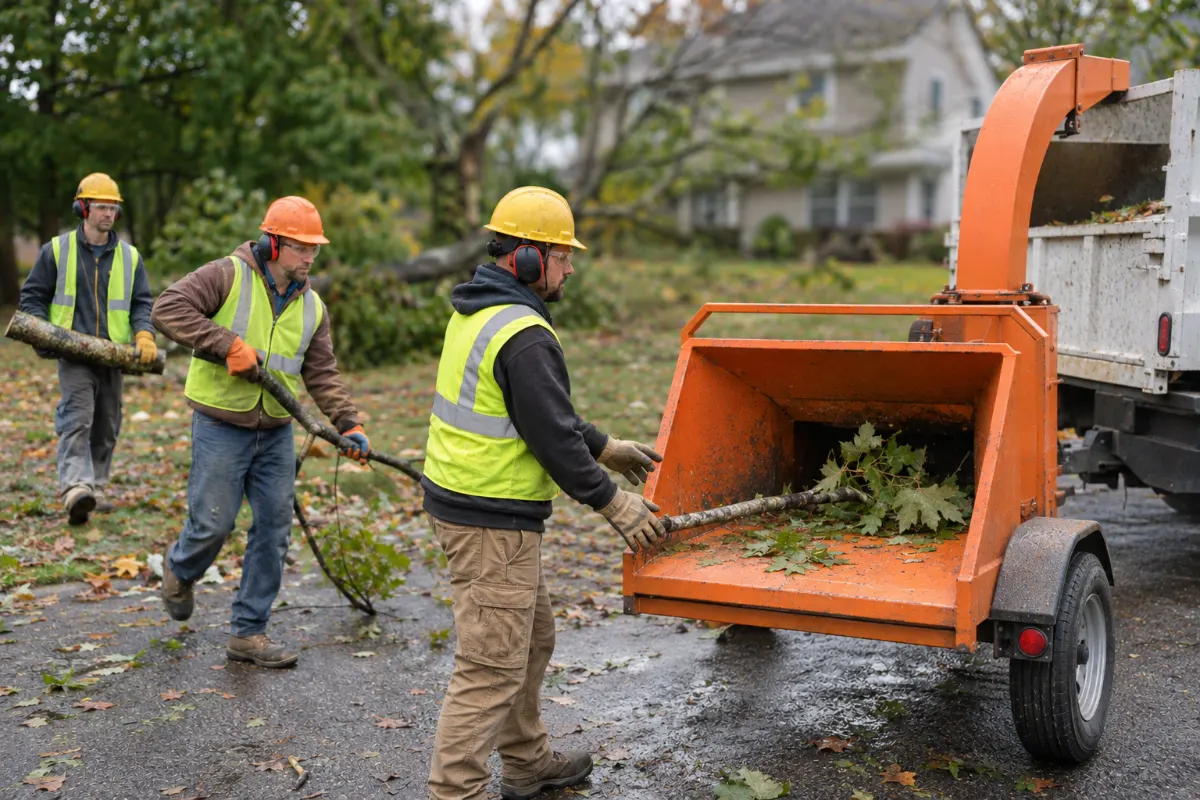
Keep the reserve in its own campaign, apart from the base and the seasonal layers. Then a storm does not throw off the numbers you use the rest of the year, and you can see exactly what each storm cost. If no storm comes, the reserve stays unspent. Do not pour it into the everyday campaigns at the end of the season just because it is there.
When does the reserve matter most?
- On hurricane coasts: the National Hurricane Center says "The Atlantic hurricane season runs from June 1 to November 30." and "The peak of the Atlantic hurricane season is September 10, with most activity occurring between mid-August and mid-October."
- Inland too: the National Severe Storms Laboratory notes that "Strong (up to more than 120 mph) straight-line winds associated with thunderstorms knock down trees, power lines and mobile homes." So a storm reserve is not only a coastal question. Thunderstorms are most likely in spring and summer.
What to do when the storm hits, and how to stop booking more work than your crews can do, is in our storm cleanup ads guide, in the section on how to set storm budgets by crew capacity. Our Google Ads guide for tree companies has a short section on running Google ads after a storm.
What happens in Google Ads when a tree company changes the budget by season?
In Google Ads, most campaigns run on an average daily budget. Google: "Your average daily budget is the average amount that you set for each ad campaign on a per-day basis." Our contractor budget guide explains how Google and Meta spend your ad budget; here is what matters when you change it by season.
- Plan each season per month, then enter a daily average. Google: "If you're working with a monthly budget, divide that number by 30.4." So when your spring layer for removals is a monthly amount, the daily budget you enter is that amount ÷ 30.4.
- One day can spend more than the daily average. Google: "On a given day, your campaign might spend up to twice your average daily budget to take advantage of fluctuations of traffic. At the end of the month, you will have spent no more than 30.4 times your average daily budget." On a busy storm day, a campaign can spend up to twice its daily average. That is one more reason to keep storm spend in its own campaign.
- The monthly limit follows the daily average. Google lists "Your monthly spending limit (30.4 times your average daily budget for most campaigns) in any particular month." Change budgets at the start of each season, and then give them time, instead of moving them up and down every few days.
- Local Services Ads work differently. If you run them, their budget setting changes as Google moves them into Google Ads. Our Google Ads guide for tree companies explains what changes when Local Services Ads move into Google Ads.
Seasonality adjustments are not for seasons. Google Ads has a tool with a confusing name. Google says: "Seasonality adjustments are an advanced tool that can be used to inform Smart Bidding of expected changes in conversion rates for future events like promotions or sales." It works only with Smart Bidding (Target CPA and Target ROAS on Search, plus Performance Max and some other campaign types). And: "Seasonality adjustments are ideal for short events of 1–7 days. They may not work as well if you use them for extended periods, such as more than 14 days at a time." Google also says: "Use seasonality adjustments only if you expect major changes to conversion rates, because Smart Bidding already manages seasonal events."
For a tree company, that means: a spring or a fall is not a seasonality adjustment. Change the budget per season instead.
Which channels get the tree service base, and which get the seasonal money?
No study shows that one channel is cheaper for every tree company, so this is about roles, not rankings. Your own cost per signed job decides the mix.
The base (all year):
- Your Google Business Profile, kept current, including storm and winter hours on your profile.
- Reviews from finished jobs.
- Search ads for your company name and your core searches in your service area.
- Your past-customer list: email, and texts only with consent. Almstead's team "sent emails to existing customers before a recent major winter storm to let them know of services his company could provide in the storm's aftermath." Uploading that list to your ads has its own rules; see customer list rules for Google and Meta ads.
The seasonal layers:
- Search ads per job type, so each layer can push the job your log says you need (removals in spring, pruning bookings for winter). Our Google Ads guide for tree companies compares search ads and Local Services Ads.
- Local Services Ads in the months when you can take more calls.
- Facebook and Instagram ads for planned work. Our Facebook guide explains which tree jobs fit Facebook, and which fit Google.
Shared lead sites: if they are in your budget, give them their own line too, and judge them the same way. Our guide on shared and own leads shows how to compare lead sources by cost per signed job.
What else belongs in a tree service budget besides ads?
Ad spend is only part of it. Our contractor budget guide lists what a budget should include besides ad spend. For a tree company, plan these as their own lines:
- Crew photos and short videos of real jobs: removals, crane work, stump grinding, cleanups.
- A landing page per main job type, so a removal ad does not land on a pruning page.
- Call tracking, so phone calls from each campaign are counted.
- A CRM where every lead gets its source and job type.
How does a tree company check each season whether the budget worked?
Use one number per line: cost per signed job, per job type, per season. Our guide to cost per signed job shows the method, and the signed-job calculator on our tree service page does the math.
- Tag every lead with its source, job type and season in your CRM.
- At the end of each season, count signed jobs per line and divide that line's spend by them.
- Compare like with like. Compare this spring with last spring, not winter with fall. The jobs, the weather and the competition are different in each season.
- Count the storm campaign apart, per storm.
- Decide per line: raise, hold or fix. Our contractor budget guide explains when to raise or cut your budget.
- Update next year's plan with this year's job log. After one full year, your own numbers replace every guess in this guide.
Where does Digital Hark fit for a tree company?
Digital Hark runs Google and Meta ads, landing pages, tracking and follow-up systems for home-service contractors, including tree companies. Where we can help with a budget is the setup behind it: one campaign or ad group per job type, a separate storm campaign, and tracking that tags every lead by source and job type, so you can see cost per signed job each season. We never call your leads, book jobs or sell for you; your team does that. You own every ad account, page and lead.
Common questions
Should a tree service cut marketing in winter?+
Not to zero. Keep the always-on base running and use winter to book dormant-season pruning and planned removals, mostly from your past-customer list. Plan the winter layer in late summer, as Almstead's team did. See the season planner on our tree service page for which ads fit winter.
Is 10 percent of revenue too much for a tree company?+
It depends on your open crew days and your jobs, not on the percent. The "5 to 10 percent" rule is published by marketing vendors, and none of the tree pages we read names a study behind it. The Small Business Administration's marketing page gives no percent; it says to compare marketing costs with the revenue they bring. Build the budget from jobs first, then use a percent only as a rough ceiling check.
How much should a tree service raise its ads after a storm?+
Only as far as your crews can take the work. Size the storm reserve in crew days before the season, keep it in its own campaign, and raise it in steps. Our storm cleanup ads guide shows how to set storm budgets by crew capacity.
Do Google's seasonality adjustments help a tree service?+
Rarely. Google says they are "ideal for short events of 1–7 days", work only with Smart Bidding, and that "Smart Bidding already manages seasonal events." A whole spring or storm season is not a short event. Change the daily budget per season instead.
Should a new tree company spend more on marketing than an established one?+
Often, yes, because a new company has fewer repeat customers and referrals filling its crew days. A marketing agency's tree page puts it as "weighted toward visibility while you're building it". The method stays the same: count the open crew days, set the jobs to aim for, and check cost per signed job each season.
What do Google Ads cost a tree service?+
It depends on your area, the job type and the season, and we do not give a figure here. Our Google Ads guide for tree companies covers what Google Ads cost for a tree service. Judge the cost by signed jobs, not by clicks.


