
Guide · Tree service
Tree removal permits in Texas cities: what should a tree service know, check and say about protected trees?
Homeowners search "do I need a permit to cut my tree?" and find city lists that disagree with each other. Here is what a Texas tree company should know: what the 2017 state law limits, which city rules we could read on the cities' own pages, who applies, the permit check for the first call, what to say on the estimate, and how to show it in your ads without promising anything.
The short answer
Texas has no statewide tree permit; each city sets its own rules. Austin, for example, regulates trees of 19 inches and up on residential lots. A 2017 state law limits city bans and fees for dead or dangerous trees and small trees at a home. Check the city on the first call, say who files, and never promise approval.
Key takeaways
- Tree removal rules in Texas are city by city. Ask for the address and check that city before you quote.
- In Austin, a tree of 19 inches or more, measured 4.5 feet above the ground, needs a permit to remove on residential property, even when it is dead or dangerous (the city code sets some exceptions).
- The 2017 state law (H.B. 7) limits city bans and mitigation fees. It does not say a city cannot ask for a permit or a review first.
- Say on every estimate who files the permit and what your team provides.
- In ads, promise only the check you really do; the city decides.
Want us to find your three biggest lead leaks?
Free Growth DiagnosisDo you need a permit to remove a tree in Texas?
It depends on the city. Texas cities set their own tree rules, and they differ. In Austin, protected trees are set by trunk size, measured 4.5 feet above the ground, and the city still reviews dead and hazard trees. Trees on public property or a street right-of-way are a matter for the city.
So for each job, the question is not "Texas or not" but "which city, which tree":
- The city. Is the address inside city limits? In Austin, "The ordinance does not apply in the Extra-territorial Jurisdiction (ETJ)."
- The size. Trunk diameter at 4.5 feet.
- The species. In Austin, some species get extra protection as heritage trees.
- The condition. Dead, diseased or an imminent danger.
- Where it stands. In the yard, or on a street or parkway strip that may be the city's.
- The HOA. Your HOA or deed restrictions may have their own tree rules, on top of the city's.
Not legal advice. This is general information for tree companies, from city and state pages. Rules change. Check the city's current page, and ask a lawyer when you are unsure.
What does the 2017 Texas tree law limit?
A 2017 state law limits what Texas cities can do about trees on private property. It is H.B. 7, passed in the 85th Legislature, 1st Called Session, signed on August 16, 2017, and in effect since December 1, 2017. It added Local Government Code §212.905, "Regulation of Tree Removal".
In plain words (our reading, not legal advice):
- Dead, diseased or dangerous trees. A city "may not prohibit the removal of or impose a tree mitigation fee for the removal of a tree that" is "diseased or dead" or "poses an imminent or immediate threat to persons or property."
- Small trees at the owner's home. A city may not charge a tree mitigation fee for a tree that is on "an existing one-family or two-family dwelling that is the person's residence" and is "less than 10 inches in diameter at the point on the trunk 4.5 feet above the ground."
- A planting credit. Where a city does charge the fee, it "must allow that person to apply for a credit for tree planting". At the owner's own one- or two-family home, the credit is "equal to the amount of the tree mitigation fee assessed against the person". Want to plant the new tree yourself? See tree planting as a service line.
- One exception. The section "does not apply to property within five miles of a federal military base in active use as of December 1, 2017."
What it does not do. The law limits bans and fees. It does not say a city cannot ask for a permit or a review first. Austin, for example, still reviews dead and hazard trees of 19 inches and up. So even for a dead tree, check the city first.
We found no later change to §212.905. Three other tree bills, from 2017 to 2025, did not become law. The current text is from a secondary copy until it is checked on the state's statutes site.
Not legal advice. This is our plain-words reading of the state law. Ask a lawyer how it applies to a job.
Which Texas cities regulate tree removal, and above what size?
The Austin and San Antonio lines, and the Houston ordinance line, are from the cities' own pages. Fort Worth is from the city's page. Dallas: check the city. No fees or fines are listed here; they are on the cities' pages. For other city rules Texas contractors work under, see our page for Texas contractors.
| City | What its page says |
|---|---|
| Austin | "A Protected tree has a diameter of 19 inches or more, at a point measured 4.5 feet above the ground." "All species are protected." A heritage tree is 24 inches or more and one of the listed species, which include "All Oaks," "Pecan," "Elm, Cedar" (cedar elm). "Removal of a heritage tree is prohibited, except as provided under Section 25-8-641 of the City Code." "Trees less than 19 inches in diameter are not regulated on residential property." Dead and dangerous trees of 19 inches or more are regulated too: "An approved permit is required before removing a tree." |
| San Antonio | "Before any development of property, a tree application must be submitted." The city also has its own Tree Maintenance License for tree companies; the page lists ID and liability insurance, and a fee reduction for ISA Certified Arborists. |
| Dallas | Dallas has its own tree rules (Article X of its development code). Check with the city arborist's office. |
| Houston | The city's Tree and Shrub Ordinance page is about planting and keeping trees and says nothing about removal. For a tree on city property or a street right-of-way, check the Houston Permitting Center first. |
Fort Worth: Fort Worth's Urban Forestry page says you need a tree removal permit for dying or hazardous trees, or for one healthy tree. Its list of work that needs an Urban Forestry Permit includes removing trees 6 inches or more in diameter at 4.5 feet, with exemptions tied to lot size. Check the current ordinance for your lot.
San Antonio crews: check whether your crew needs the Tree Maintenance License before you advertise there. How to show an ISA credential honestly is in our guide on ISA Certified Arborist and TCIA Accreditation.
Pruning counts too in Austin: "no more than 25% of the canopy may be removed without a permit".
Not legal advice. City pages change. Check the city's current page before you quote.
Who applies: the homeowner or the tree company?
In Austin, the city's arborist page says: "The property owner is responsible for tree removal or required maintenance unless the tree is located on public property." When the tree is not part of a development, "a Tree Ordinance Review Application (TORA) is required", and to apply, "You must be a registered AB+C Portal user." The Tree Reviewer "may also request access to the site to assess the tree(s) in person."
In other cities, ask the city who may apply. Then, our advice (not a city rule):
- Say it on the estimate. "Permit: filed by [the homeowner / our office with your written okay]." Never leave it blank.
- List what your team provides: trunk measure at 4.5 feet, species, photos, and the tree's spot on a simple sketch of the lot.
- Never sign or file as the owner without the owner's written okay.
- No dates you cannot keep. The city sets the review time, not you.
What should you check on the first call?
Add one question to your first call, before anyone drives out: "Which city is the house in, and how big is the trunk?" Then run the list:
- City or not. Inside city limits, or outside (in Austin, the ETJ is not covered). Clearing a whole lot or acreage, not one tree? See the first-call questions for lot clearing in our Texas clearing guide.
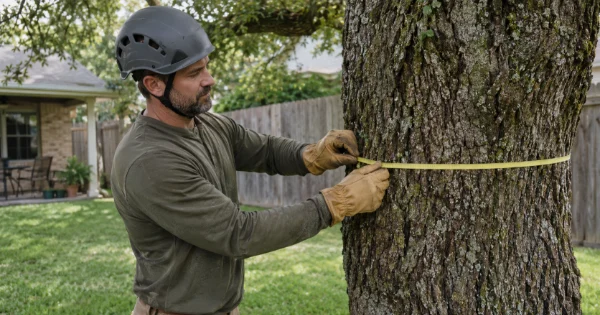
- Trunk size at 4.5 feet. Austin's way: "Use a flexible tape measure to measure the circumference (around the tree) at 4.5 feet above the ground. Divide the circumference by 3.14 to get the diameter." Ask the homeowner for a photo of a tape around the trunk (texts only with consent).
- Species. Oak, pecan, cedar elm? In Austin those can be heritage trees at 24 inches. For oak jobs, also see the oak line on our page for tree companies.
- Dead, diseased or dangerous. Still check the city: Austin regulates them at 19 inches and up.
- Street or parkway tree. If it may be the city's, the homeowner checks with the city first.
- HOA. One question: "Does your HOA need to approve tree work?"
Worked numbers in this guide show the method; they are not real client results. For example: the tape around an oak in an Austin backyard reads 66 inches. 66 ÷ 3.14 = about 21 inches. That is above Austin's 19-inch line, so it is a protected tree: check Austin's permit rule before removal. It is under 24 inches, so it is not a heritage tree.
The rest of the first call (whose tree, power lines, access, who decides) is in our guide to qualifying tree service leads, sections "What should you know about the tree before anyone drives out?" and "Whose tree is it?". Storm job and the tree is big? Safety first, then check the permit and the insurer separately; what you may say about insurance claims is in our tree removal insurance claims guide.
What do you say when a permit is needed?
Say it early, plainly, and without promising the outcome.
- On the call: "Thanks. A tree that size in Austin needs a city review before anyone removes it. We'll measure it at the visit and explain what the city asks for."
- On the estimate: "This tree is about [size] inches at 4.5 feet. In [city] that means a city permit or review before removal. Here is what we will send you: the measurement, the species and photos. [Who] files the application."
- While you wait: check in on the date you agreed, not every day. Ask: "Has the city replied yet?" A permit is one of the stalls in our tree estimate follow-up guide, in "What's still in the way?". Texts only with consent.
- If the city says no: "That's the city's call. We can still help: a trim within the city's limits, cleanup, or a new tree somewhere better." No pressure, and no talk of getting around the city.
Never promise approval, a date or a way around the city. You don't decide, and you don't know.
How do you show permit know-how in ads and on your landing page?
Show that you check, not that you can get a yes.
| Say (only while true) | Do not say |
|---|---|
| "We check your city's tree rules before we quote." | "No permit needed" |
| "Austin protected-tree removals: we measure and explain the city review." | "Permit approved" or "fast approval" |
| "We tell you on the estimate who files the permit." | "We handle every permit" (unless you really file them all) |
| "San Antonio Tree Maintenance License [number]" (only if you hold it) | "Licensed in every Texas city" |
Where to put it:
- Ads. One line in the ad text or a callout for city jobs. Our guide to writing Google Ads for tree service covers the rest of the ad. For the format of license lines, see our guide on contractor license numbers in ads.
- Landing page. A short "City tree rules" block for each city you serve, with the date you last checked it. Our page on landing pages for contractors shows how we build them.
- Google Business Profile. Say it in your services and description only while it is true: "We check your city's tree rules before we quote." Our Business Profile guide for tree services covers the rest.
- The estimate. The permit line from the section above, every time.
How do you know it helps? Track permit jobs
Count it, so you know whether the permit check wins jobs or slows them. This is our method, not a published study:
- Tag each lead in your CRM: "permit check: yes", "permit check: no" or "permit needed".
- Note the date of the estimate and the date it signed.
- Mark jobs lost to a permit (city said no, or the homeowner gave up).
- After 90 days, compare permit jobs with the others: how many signed, and how long it took. Judge by signed jobs, not calls. Our cost per signed job guide shows how to track it.
Worked numbers in this guide show the method; they are not real client results. For example: in 90 days you give 40 removal estimates. 9 need a permit; 5 of those sign, on average three weeks later than the rest. 2 are lost to the city's answer, and 2 are still waiting. That tells you to quote permit jobs early and set the check-in date on the estimate.
Where Digital Hark fits
Digital Hark builds the growth system for tree companies: landing pages that answer the permit question for each city you serve, Google and Meta ads in your own accounts, and tracking of calls, forms and signed jobs, including the "permit needed" tag. We write the permit lines from what your team really does. We never file permits, give legal advice, or call, text, book or sell for you. You own every ad account, page and lead. What is included is confirmed in writing in your proposal.
Permit checklist
- ☐ A list of the cities you serve, each with its tree page and the date you last checked it.
- ☐ One first-call question: "Which city, and how big is the trunk?"
- ☐ A tape and the 4.5-foot measure in every estimator's kit.
- ☐ Species and condition noted on every removal estimate.
- ☐ Dead and dangerous trees still checked against the city's rules.
- ☐ Street, parkway and HOA questions asked.
- ☐ "Who files the permit" written on every estimate.
- ☐ Owner's written okay before anyone files for them.
- ☐ Ads, pages and profiles checked against the do-not-say table.
- ☐ A "permit needed" tag in the CRM, checked every 90 days.
Common questions
Do you need a permit to remove a tree in Texas?+
It depends on the city. Texas has no statewide tree permit; each city sets its own rules. Austin, for example, requires a permit to remove a tree of 19 inches or more, measured 4.5 feet above the ground, on residential property, with some exceptions in its city code. Check the city's current page for each address.
Which trees are protected in Austin?+
Austin's page says a protected tree is 19 inches or more in diameter, measured 4.5 feet above the ground, and all species are protected. A heritage tree is 24 inches or more and one of the listed species, such as oaks, pecan and cedar elm. Trees under 19 inches are not regulated on residential property.
Do dead or dangerous trees need a permit in Texas?+
Sometimes. The 2017 state law says a city may not ban removing a dead, diseased or imminently dangerous tree, or charge a mitigation fee for it. It does not stop a city from asking for a permit or review first: Austin still regulates dead and hazard trees of 19 inches and up.
Who applies for the permit, the homeowner or the tree company?+
In Austin, the city's page says the property owner is responsible for tree removal unless the tree is on public property. In other cities, ask the city. Either way, write on the estimate who files, and never file for the owner without their written okay.
How do you measure a tree for a city permit?+
Austin's way: wrap a flexible tape around the trunk 4.5 feet above the ground and divide the circumference by 3.14. A 66-inch circumference is about 21 inches across.
Can a tree service say "we handle permits" in its ads?+
Only if you really file them, and never "permit approved" or "no permit needed". The city decides. Safer: "We check your city's tree rules before we quote", and on the estimate, who files.


