
Guide · Tree service
Tree service estimate follow-up: what to do after the quote so the job doesn't go to the next company
A plain plan for tree companies for the time after the quote: when photos are enough and when to walk the site, how to write an estimate that passes the homeowner's checklist, how fast to follow up on each kind of job, what to say about a cheaper quote, what to do with a trim that can wait, and when to close the file.
The short answer
Give a price range from photos only on small, simple tree jobs. Walk the site before a firm estimate near the house or wires. Send the written estimate the same day. Follow up a hazard tree within hours, tie a planned removal to its permit, HOA or start date, and offer a "not now" trim a dormant-season slot.
Key takeaways
- The written estimate is your first follow-up. Send it the same day, and write it so it answers the checklist homeowners are given by extension services.
- Photos are fine for a price range on small, simple jobs. Walk the site before a firm estimate on anything near the house, wires or other buildings.
- Timing depends on the job: hours for a hazard tree, about two weeks for a planned removal, a winter slot for a trim that can wait.
- When a homeowner has a cheaper quote, compare like with like. No price cut on the spot, no fake deadline, no knocking the other company.
- Close every file with a reason, and track estimate-to-signed rate by job type and lead source.
Want us to find your three biggest lead leaks?
Free Growth DiagnosisHow do you follow up on a hazard tree, a planned removal and a "not now" trim?
With a plan your team owns, in four parts:
- A same-day written estimate that spells out each tree, the stump, the haul-away and the cleanup.
- Follow-up timing by job type. A hanging limb over the roof and a hedge trim for next spring do not get the same schedule.
- A marked photo, a stump answer or two start dates in every touch. Each one gives the homeowner something to reply to. "Just checking in" gives them nothing to answer.
- A clear end. A polite close-out message, the file marked won, lost or later with a reason, and a check-in later only if they agreed.
This guide starts after the quote. For the first reply to a brand-new lead, see why reply speed matters more with shared leads. Before the estimate, see our guide to qualifying tree service leads on the first call. Roofer? See our roofing estimate follow-up guide. Remodeler? See our remodeling estimate follow-up guide.
Photo quote or site visit: which jobs need the walk-through?
Many tree leads arrive with photos. Photos are great for sorting the lead and for a price range on a simple job. They are not enough for a firm estimate on a risky one.
| Photos are usually enough for a price range | Walk the site before a firm estimate |
|---|---|
| A small trim on a young tree well away from the house | A tree near the house, garage, fence, wires or other structures |
| Grinding a stump with open, ground-level access | Lean, decay, cracks or dead limbs over the roof |
| Picking up a brush or limb pile | Tight access, a backyard behind a fence, or a job that may need a crane |
| An add-on to a job you already walked | The homeowner needs a written assessment of the tree's risk |
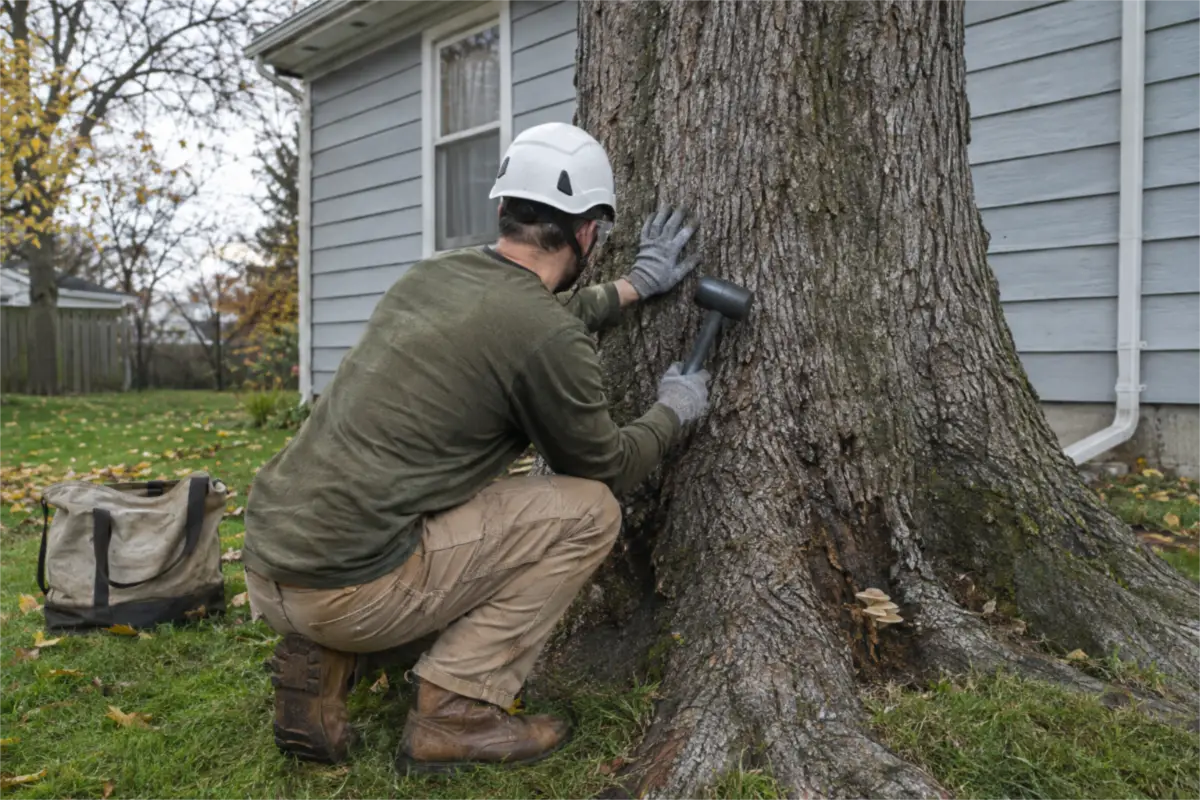
TreelineLocal, a homeowner matching service paid by listed tree companies, tells homeowners the same thing: "Photos can help, but they do not always show lean, decay, tight access, overhead lines", and "a truly accurate tree-removal estimate usually needs an on-site visit." GoTreeQuotes, a tree lead marketplace, advises companies to "get there to quote it within 24 – 48 hours."
How to use photos well:
- Ask for them in the first reply. Our guide to Facebook ads for tree service shows the photo request line "Can you text me a photo of the tree?" (texts only with consent).
- If you quote from photos, say so in writing: "Based on photos, confirmed on site." Then book the visit in the same message.
- Never firm up a risky job from photos alone. A wrong price on a tree over the house costs you the job or the margin.
What should a written tree estimate include?
Everything the homeowner is told to check before they hire. University extension services and county offices give homeowners a checklist. NC State Extension tells them to "Obtain estimates from more than one arborist." UGA Extension says: "Have more than one company look at the job and give written estimates." So your estimate will sit next to others. Write it so it answers every question on that list:
| Put this on your estimate | What homeowners are told to check |
|---|---|
| Each tree and limb, marked on a photo or a map of the yard | Fairfax County: "Does the contract cover everything promised?" |
| The work per tree: remove, prune (what and how much), or both | UGA: a contract "including all costs and tasks associated with the work and when it will be done" |
| Stump grinding as its own line, with how deep and what happens to the hole | NC State: "Clarify if tree removal includes grinding out the stump and surface roots to one foot below grade, filling with topsoil, and planting grass." Fairfax: "Will the stump be removed?" |
| Haul-away as its own line: wood and limbs hauled, chipped, or left (and where) | Fairfax: "Find out who is responsible for disposing of the entire tree, including limbs and debris." UGA: "The contract should include the responsibility for cleanup and disposal of tree wood residue." |
| Cleanup: what you clean up, and when | NC State: "Specify what clean-up work will be done and when." |
| Dates: the start window and how long the job takes | Arizona: "The date that work is to begin and end." |
| The total, in one clear line | NC State tells homeowners to ask for the absolute total to be charged. |
| Your certificate of insurance, attached | UGA: "ask for certificates of insurance, including proof of liability for personal and property damage and worker's compensation." Arizona: "Request proof of insurance from the arborist and confirm with the insurance company (free for both parties) that insurance is still current." |
| Your ISA Certified Arborist by name, only if you have one | UGA: "Ask if the company employs ISA Certified Arborists or ASCA Registered Consulting Arborists." |

Three habits make the estimate work harder:
- Send it the same day. GoTreeQuotes says to "write one out on the spot (never just write it on the back of a card)" and to send insurance papers with the quote. Tree software vendor Arborgold says: "Faster estimates mean faster decisions."
- Attach site photos with each item marked. Arborgold: "A few site photos attached to the estimate show that the job was properly evaluated." One tree company's estimate page describes "an aerial image on your property marking the location of each line item."
- Show only credentials you really have. The section "Which trust signals help a tree company win the job?" on our marketing page for tree companies covers insurance, ISA and TCIA on your ads and landing page.
As Arborgold puts it, "Estimating does not end when the quote is sent."
How soon and how often should you follow up? It depends on the job
Generic advice gives one schedule for every quote. Jobber, a field-service software vendor, says the first follow-up email "should land in their inbox within two days after sending the quote", the next "one week after sending your initial quote", and the last "24–48 hours before the quote expires." Fieldproxy, another software vendor, says to "Follow up 3-4 times over a 10-14 day period", starting "2 days after sending the estimate, then at 5 days and 10 days." That is common advice, and it fits a planned removal. It does not fit a tree on the roof or a trim for next winter.
The table below is our recommended method. Adapt it to the homeowner's own dates.
| Job type | Estimate | Follow-up | When it ends |
|---|---|---|---|
| Hazard or storm-damaged tree on or near the house | Same day, often on the visit | Within hours: a call, then a text if they agreed to texts (texts only with consent) | Within days. They will hire someone this week. |
| Planned removal | Written, same day or next | About day 2, about day 7, and before the estimate's end date. Tie each touch to their permit, HOA approval, neighbor or start window. | About two weeks, or the date the homeowner gave you |
| Trim or pruning that can wait | Same day or next | Day 2 or 3. If the answer is "not now", offer a dormant-season slot (section below) and set the check-in by that date. | When the slot is booked or declined |
| Stump grinding, cleanup and other add-ons | Separate lines on the main estimate | Together with the main job. Never a separate chase. | With the main job |
Planned removal
- About day 2 and about day 7
Storm waves are different. After a storm, the follow-up list is about crews and order, not sales. Our storm cleanup guide shows how to handle the call wave and keep a dated list of the cleanup jobs you cannot reach this week.
What's still in the way? Permits, HOA, neighbors and power lines
Many planned removals do not stall on price. They stall on something the homeowner still has to do. Ask it plainly in your follow-up: "Is anything still waiting on the city, the HOA or a neighbor?"
- A permit. Some cities and counties may require one for certain trees. UGA's guide also tells homeowners to check with their local government about permits. Say who handles it on your estimate.
- HOA approval. Ask when the board meets, and check in the day after.
- A neighbor. For a shared or boundary tree, the homeowner may want the neighbor's agreement first. Offer to send the neighbor a copy of the estimate if the homeowner asks.
- Power lines. If the tree is near a line, the homeowner or your team may need to talk to the utility first. Your crew follows your company's own safety rules.
Rules differ by city, county and state. This is general information, not legal advice. Check your local rules.
What do you say when they got a cheaper quote?
That it is fair to compare, and that you will help them compare like with like. Homeowners have already been told that price is not the only thing. NC State: "The arborist's skill, reputation, and professionalism may be more important than a low bid." Fairfax County: "Get more than one estimate and do not always accept the lowest bid." TreelineLocal tells homeowners: "If one estimate is far below the others, ask what is missing," and "Sometimes the cheap price excludes haul-away, stump work, permit handling, or protection for your property."
Offer to go through the other estimate line by line, using the same checklist:
- The same trees and the same work? Removal to the ground, or just the top? How much pruning?
- Stump: included, how deep, and what happens to the hole?
- Haul-away and cleanup: wood, limbs and chips taken away, or left?
- Insurance: liability and workers' compensation, with a certificate?
- Who does the work, and is there an ISA Certified Arborist on the job (only if that matters to them)?
- Dates: when would each company start?
Compare like with like
- The same trees and the same work
- Stump: included, how deep, and what happens to the hole
- Haul-away and cleanup: wood, limbs and chips taken away, or left
- Insurance: liability and workers' compensation, with a certificate
- Who does the work
- Dates: when would each company start
What not to do: cut your price on the spot, invent a deadline ("this price is only good until Friday" when it is not), or talk down the other company. If your price changes, it is because the scope changed, in writing. If the other estimate covers the same work, say so, thank them, and close the file politely.
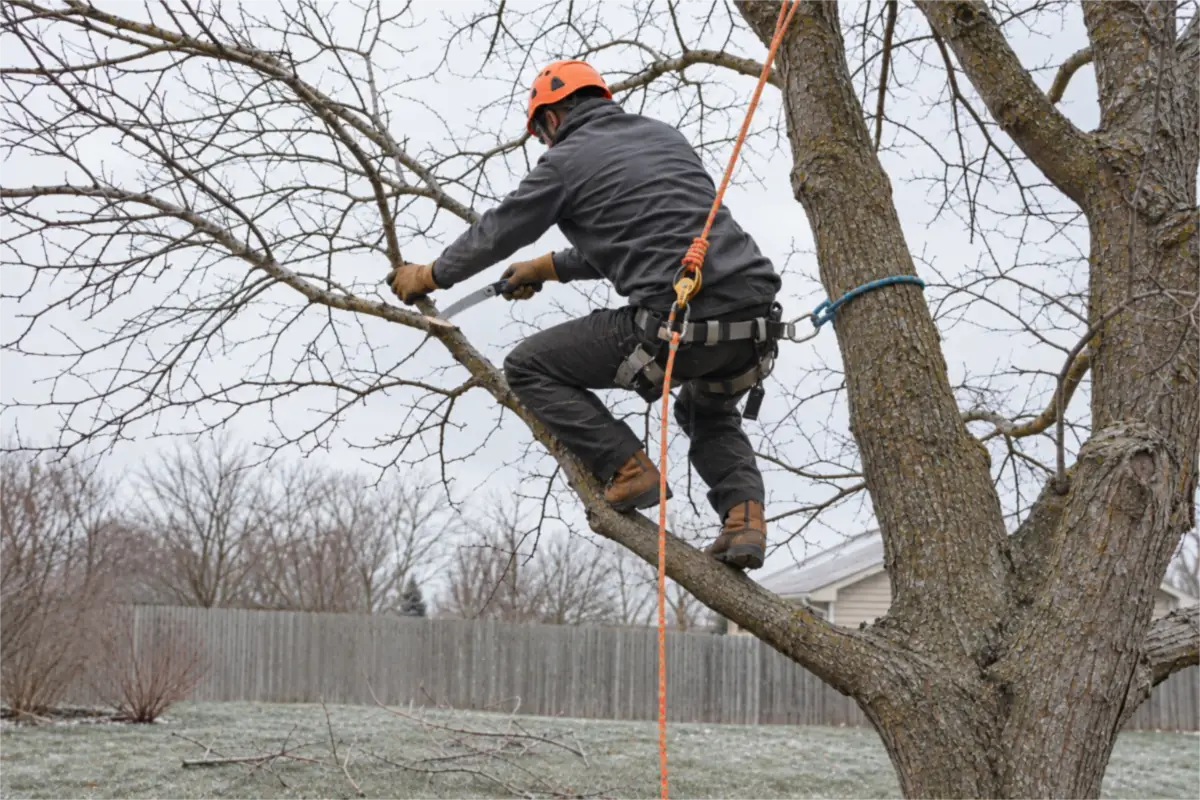
What do you do with a trim that can wait? Book the dormant season
A pruning lead that says "not now" is often a winter job, not a lost one.
- Offer a winter slot in the follow-up. "Would a slot in {month} work? Many trees are pruned while they are dormant." Give two dates.
- Put the date in your CRM with the reason ("trim, offered {month} slot").
- Send one reminder before winter by email, or by text if they agreed to texts (texts only with consent).
- No winter discount talk. Book the slot on timing, not on price.
The season planner "When should a tree service run which ads?" on the same tree page shows the dormant pruning months and, for Texas, the oak months to avoid. To plan the winter ad spend around those slots, see how to split a tree company's budget by season.
Which scripts fit a photo quote, a permit or HOA wait, and a winter trim?
One script for each tree job moment: the estimate sent, a photo quote that needs a visit, a removal waiting on the HOA or city, a cheaper quote, a winter slot and the close-out. Keep each one short, with their name and who you are. Texts only with consent, and every text says how to stop. For what to check before you text (consent, opt-outs, sending hours), see what texting rules to check first.
1. Estimate sent (text, same day; texts only with consent)
"Hi {name}, {rep} from {Company}. Your estimate for the {oak by the driveway} is in your email: each tree is marked on the photo, with stump grinding and haul-away on their own lines. Questions? Just reply. Reply STOP to opt out."
2. Photo-based estimate + site visit (text; texts only with consent)
"Hi {name}, {rep} from {Company}. Thanks for the photos. Your estimate range is in your email. It is based on photos, so we confirm it on site. Can our arborist stop by {day} at {time} or {day} at {time}? Reply STOP to opt out."
3. Planned removal check-in (voicemail, about day 7)
"Hi {name}, {rep} from {Company} about the {maple in the backyard}. You mentioned the HOA meets on {date}. Did you hear back, or is anything still waiting on the city or your neighbor? If it helps, I can send a copy of the estimate for them. Call me at {number}. Thanks."
4. Cheaper quote (email)
Subject: Comparing your tree estimates
"Hi {name},
Thanks for telling me. Comparing is smart. If it helps, send me the other estimate or go through it with me on the phone. I'll check it against ours line by line: the same trees, stump grinding, haul-away, cleanup, insurance and start date. If they cover the same work, I'll tell you.
{rep}, {Company}, {number}"
5. Winter slot (text; texts only with consent)
"Hi {name}, {rep} from {Company}. Your {crepe myrtle trim} can wait for winter. I can hold {date} or {date} for you. Which works? Reply STOP to opt out."
6. Close-out (text; texts only with consent)
"Hi {name}, {rep} from {Company}. I don't want to keep chasing you. Should I close your tree estimate for now, or check back before winter? Any answer is fine. Reply STOP to opt out."
When should you close the file?
Stop the active follow-up when:
- the homeowner says no, or replies STOP;
- they tell you they hired another company or did the job themselves;
- your close-out message gets no answer;
- for a hazard tree, a few days have passed with no answer. They have most likely hired someone.
Common advice says the same: Jobber says "If you haven't heard back after your third follow-up, it's OK to close the file and move on," and Fieldproxy suggests a final message "acknowledging that the customer may have chosen another provider or postponed the project."
Then:
- Mark the estimate won, lost or later, with a reason: price, scope, timing, chose another company, did it themselves, waiting on a permit or HOA, no reply.
- Ask a lost homeowner one question: "What made you choose the other company?" Then do not follow up again.
- Set one later check-in only if they agreed, for the season they named (texts only with consent).
Which numbers show whether your hazard, removal and trim estimates sign?
Track a few numbers every month, by job type and by lead source:
- Estimate-to-signed rate: signed jobs ÷ estimates sent.
- Days to sign: from the estimate to the signature.
- Lost reasons: how many you lost to price, timing, another company or no reply.
- Winter slots held: "not now" trims with a date in the calendar.
For example: in one month your team sends 40 estimates. Of 8 hazard trees, 6 sign (75%). Of 20 planned removals, 7 sign (35%). Of 12 trims, 3 sign now and 4 take a winter slot. If most lost removals say "no reply" and none of them got a day-7 check-in, that check-in is the habit to fix first. Worked numbers in this guide show the method; they are not real client results.
Do the same split by lead source: Google, Facebook, referrals, shared lead sites. Then connect it to money with cost per signed job: what you spent on a source ÷ the jobs you signed from it. Our guide to cost per signed job shows how, and the calculator "What does a signed tree job really cost you?" on our tree page runs the numbers for tree work.
Arborist or office: who follows up on which tree estimate, and where does Digital Hark fit?
Your team. The arborist or estimator who walked the site should make the calls on big removals; your office can send the estimate, the reminders and the close-out. A system makes sure no estimate is forgotten:
- an instant first reply to every new lead (texts only with consent);
- follow-up reminders set by job type when an estimate is marked as sent;
- a stop when the homeowner replies, signs or opts out;
- won, lost and later reasons in one place;
- reports on estimate-to-signed rate and cost per signed job by lead source.
This is part of the growth system Digital Hark builds for tree companies: ads in your own accounts, landing pages, tracking, a fast first reply and a CRM with follow-up reminders. We never call your leads, give estimates or sell jobs for you; your team does that. You own every ad account, page and lead.
Campaigns our team has run for one tree-care company brought 588 leads; the company's own team called them, gave the estimates and won 58 jobs. Every business is different; we don't promise results.
Common questions
How soon should you follow up on a tree service estimate?+
It depends on the job. For a hazard or storm-damaged tree near the house, follow up within hours. For a planned removal, make the first touch in about two days, then tie the next ones to the homeowner's permit, HOA or start date. For a trim that can wait, offer a winter slot. In a Texas city? See what to say on the estimate when a tree needs a permit.
What if a tree removal is waiting on a permit, the HOA or a neighbor?+
Ask it plainly in your follow-up: "Is anything still waiting on the city, the HOA or a neighbor?" Say on the estimate who handles the permit. For the HOA, ask when the board meets and check in the day after. For a shared or boundary tree, offer to send the neighbor a copy of the estimate if the homeowner asks. Rules differ by city, county and state; check your local rules. A check-in can be a short video; see how long a follow-up video should be.
Can a tree service give an estimate from photos?+
For a price range on simple jobs, yes: a small trim, a stump with open access, a brush pile. For a tree near the house, wires or other structures, with lean, decay or tight access, walk the site before a firm estimate. Write "based on photos, confirmed on site" on any photo quote.
What should a written tree removal estimate include?+
Each tree marked on a photo or map, the work per tree, stump grinding and haul-away as separate lines, what cleanup is done and when, the start window, the total, your insurance certificate, and your ISA Certified Arborist only if you have one. These match what extension services tell homeowners to check. To name the arborist the way ISA asks, see our guide to ISA Certified Arborist and TCIA credentials.
Should a tree company book a "not now" trim for winter?+
Often, yes. A pruning lead that says "not now" is often a winter job, not a lost one. Offer a dormant-season slot with two dates, put the date and the reason in your CRM, and send one reminder before winter by email, or by text if they agreed to texts (texts only with consent). Book the slot on timing, not on price. If they ask about your cover before they book, see how to show proof of insurance.
When should you stop following up on a tree estimate?+
When the homeowner says no, replies STOP, hires another company or does the job themselves, or when your close-out message gets no answer. Mark the estimate won, lost or later with a reason, ask a lost homeowner one question, and check in later only if they agreed.


