Guide · Roofing
Roof maintenance programs for residential roofers: do yearly check plans bring repeat work, and what should you put in writing?
A re-roof can be the last time a homeowner hears from you. A yearly check plan gives you a planned reason to go back. Here is what a residential plan usually includes, what to write down, the Texas and Florida service contract rules to check, how to word the shingle warranty part, when to offer it, how to remind members, and how to judge it by signed jobs.
The short answer
A roof maintenance plan is a scheduled yearly check, with photos, small fixes and a look after big storms. It gives you a reason to visit past customers, which can lead to repairs, re-roofs and referrals. Write down what is included and what is billed. Check your state's service contract rules before you charge. Judge it by signed jobs.
Key takeaways
- NRCA recommends homeowners "inspect their roof systems at least twice per year, preferably in the spring and fall", and again after severe weather, but not by walking on the roof themselves. A plan puts that on your calendar, not the homeowner's.
- Put the plan on one page: visits, what is included, what is billed as a repair, what is not covered, how to cancel, and what happens when the home sells.
- A paid plan can fall under state service contract or home warranty laws. Texas and Florida both have them. Have a lawyer in your state read your plan before you charge for it.
- Never tell a homeowner the plan keeps a shingle warranty valid unless that warranty says so.
- No source we read gives numbers for repeat work from plans. Count signed jobs from plan members for 12 months.
Want us to find your three biggest lead leaks?
Free Growth DiagnosisDo roof maintenance plans bring roofers repeat work?
They can. But no source we read gives repeat-job or revenue numbers for residential plans, so treat it as something to test.
Our view: a plan helps because it puts you back at homes that already trust you, on a date you set. A visit can turn up a repair. A roof near the end of its life can become a re-roof estimate for a roof you already know. A happy member is someone you can ask for a referral. And plan visits can fill slow months. If a visit finds a stain by the chimney, check where a chimney leak starts before you quote the flashing.
One trade source says to make the offer to everyone. RoofersCoffeeShop wrote in 2020: "Offer every one of your new service or re-roof customers a standard service agreement".
The test is in the section "How do you know the plan pays?" below. For the rest of a roofing growth system, see our roofing marketing page.
Commercial plans are a different product; this guide is about homes.
What does a residential roof maintenance plan usually include?
NRCIA, an inspection-certification association (not NRCA), puts it simply: "A residential roof maintenance program is a scheduled service agreement."
How often. NRCA recommends homeowners "inspect their roof systems at least twice per year, preferably in the spring and fall", and says "Additional inspections are suggested after any severe weather events, such as a hurricane, tornado or hailstorm." (Professional Roofing, 2013.) ServiceM8, a job-software company, describes plan visits as "Typically once or twice a year, depending on regional needs". One Tulsa roofer tells homeowners: "For older roofs, after severe weather, or if you notice visible damage, consider more frequent inspections."
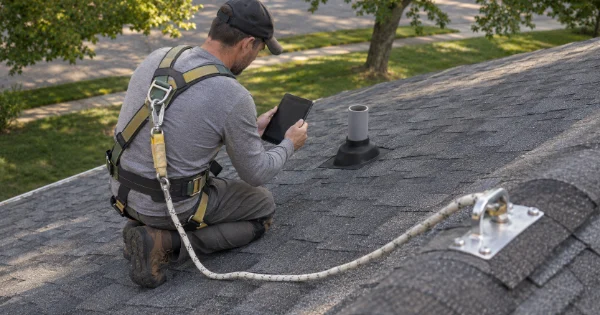
NRCA also "does not recommend homeowners or inexperienced property management personnel access or walk on roofs". That is a good reason for the homeowner to let a roofer do the looking.
What a visit usually covers (from the plans described by NRCIA and ServiceM8):
- Clear debris from the roof and check the gutters.
- Check flashing, pipe boots, vents and sealant.
- Small fixes on the spot, up to a limit you set in writing.
- A written report with dated photos.
- A written estimate for anything bigger, billed as a repair.
- Optional: a look after a big hail or wind storm, and priority booking for members.
The roof record. NRCA "recommends a homeowner start and maintain a historical record of his or her roof system", and says "Subsequent inspections, maintenance and emergencies affecting the roof should be recorded." Your photo report each visit is that record. Give the homeowner a copy and keep one.
Free or paid. A plan can be a first-year check you include with every re-roof, or a yearly plan you sell. A paid plan raises the state-law question in the section "Is a paid plan a service contract under state law?" below. If you advertise the first visit as free, our guide on free roof inspection ad rules covers the wording. Set what you charge, if anything, and say in writing what it covers.
Roofs you did not install. One Missouri roofer tells homeowners: "Whether your roof is brand new or decades old, we'll start maintaining it at any point". If you do the same, check the roof first and write down its condition on day one.
What should you put in writing?
One plain page the homeowner signs and keeps. NRCIA tells homeowners to "Ask for the quote in writing, and confirm what counts as included maintenance and what will be billed as a repair." Answer that before they ask.
| Line on the plan sheet | What to write |
|---|---|
| Who and where | Homeowner name, property address, roof type and age if known. |
| Visits | How many visits a year, in which season, and how you set the date. |
| Included | The visit list from the section above, in plain words. |
| Small-fix limit | In words, for example "up to [N] minutes of minor repair work per visit". You fill in the limit. |
| Billed separately | Anything past the limit. Say you will give a written estimate first and do no billed work without the homeowner's yes. |
| Not covered | Storm damage and insurance-claim work, interior damage, structural work, and anything that needs a new roof. |
| What the plan is and is not | A plain line, worded with your lawyer, on whether the plan is insurance and whether it changes any shingle or workmanship warranty. |
| Cancel | How to cancel, and that the homeowner can cancel at any time. |
| Home sale | What happens to the plan when the house sells. |
| Reminders | How you will remind them of visits, and that texts go only to people who agreed (texts only with consent). |
| The report | That they get a dated photo report after each visit, and that you keep a copy. |
Storm and insurance work. Keep it out of the plan and quote it as its own job. Insurance-claim rules differ by state; our guide to roofing deductible law by state covers the contract rules in Florida, Georgia, North Carolina and Missouri.
Cancel any time. RoofersCoffeeShop suggested a service agreement that "never expires but your customer can cancel at any time". Whether a plan with no end date fits your state's law is a question for your lawyer (next section).
Keep it short. One clear page is easier to say yes to.
Match what you say. What your crew says at the door, on the phone and in ads must match the sheet. No promise wording, and no response time you cannot keep.
Is a paid plan a "service contract" under state law?
Not legal advice. This section quotes the law. It does not say whether your plan is covered. A lawyer in your state must read your plan before you sell it.
Texas. The Service Contract Regulatory Act (Texas Occupations Code chapter 1304, run by TDLR) defines a service contract as an "agreement that is entered into for a separately stated consideration and for a specified term" under which a provider agrees to "repair, replace, or maintain a product" … "for operational or structural failure or damage caused by a defect in materials or workmanship or by normal wear". It also defines a "residential service contract" as "a service contract of any duration under which a provider agrees to, in the event of the operational or structural failure of" … "a structural component, an appliance, or an electrical, plumbing, heating, cooling, or air-conditioning system" of a residential property.
Section 1304.004 lists what the chapter does not apply to, including "a maintenance agreement". It defines that as "an agreement that provides only for scheduled maintenance for a limited period." Section 1304.0041 lists more agreements the chapter does not apply to, including a warranty or similar promise for the repair or service of an appliance, system or component of a home, when it is given by the person who sells, services, repairs or replaces that item at the time or before it is given.
In plain words: Texas has one definition for a service contract and a separate one for a maintenance agreement. Which one fits your plan, if either, is a question for your lawyer. Texas also has a separate law for residential service companies (chapter 1303), not quoted here. Have a Texas lawyer read your plan before you sell it.
Florida. Chapter 634 of the Florida Statutes covers home warranties and service warranties. Its Part II defines a home warranty as "any contract or agreement whereby a person undertakes to indemnify the warranty holder [...] of any structural component or appliance of a home", and says "'Structural component' means the roof, plumbing system, electrical system, foundation, basement, walls, ceilings, or floors of a home." Part II "does not apply to a contract or agreement offered by a warranty association in compliance with part III".
Part III defines a service warranty. It includes a "maintenance service contract equal to or greater than 1 year in length" … "or other written promise for a specific duration to perform the repair, replacement, or maintenance of a consumer product" … "in return for the payment of a segregated charge by the consumer".
Whether your plan fits either definition is a question for your lawyer. If you work in Florida, ask a Florida lawyer, or the state's insurance regulator, whether your plan needs a license before you sell it.
Other states have their own service contract or home warranty laws; check yours before you charge for a plan.
Does a maintenance plan keep the shingle warranty valid?
Only if that warranty says so. Do not say it does unless you have read the line.
NRCA wrote in 2013: "Most warranties also require roof systems to be properly maintained." That is NRCA's general view, not the wording of any one warranty. Each warranty has its own wording.
So, for each roof:
- Read the exact warranty you register for that roof.
- Find its lines on upkeep and on transfer.
- Quote those lines, word for word, in the plan papers, with the warranty's name and date.
- If the warranty says nothing about upkeep, say nothing about it in your plan or ads.
Transfer is a good example of why. Owens Corning's roofing warranty page says "the second owner of the roof must contact Owens Corning within 60 days after the date of the real estate transfer." (Other makers set their own rules.) A plan that tells the homeowner this at the right time is useful. A plan that claims to "protect" the warranty is a claim you may not be able to back.
Our guide on whether roofing manufacturer certifications are worth it covers maker warranty tiers. Our guide on free roof inspection ad rules covers how to word warranty and transfer lines in ads.
How do you offer the plan at job hand-off?
Offer it once, plainly, at the final walk-through of a new roof or a big repair. The homeowner is happy, you are standing at the house, and the warranty papers are in their hand.
- Hand over the job papers: the warranty registration details, the photo report of the finished roof, and the plan sheet.
- Make one plain offer. "We offer a yearly check plan for the roofs we put on. Here is what it covers." No pressure, no deadline.
- Set the first visit date in writing if they say yes. A first check about a year after the job is a simple start. A 2026 RoofersCoffeeShop piece on commercial maintenance agreements calls "a systematic 12-month post-repair inspection" a low-friction touchpoint.
- Ask for the review the same day. See when and how to ask for a review.
- Ask for consent to visit reminders by email, and by text only if they agree (texts only with consent).
Each plan visit is a second chance to ask for a referral; our roofing referral program guide covers when to ask and the reward rules.
How do you remind plan members?
Put every member's visit month in your CRM as soon as they sign up, and send the reminder they agreed to.
- Visit reminders vs offers. Keep the visit reminder about the visit, and send offers to renew, upgrade or add work as separate emails. Our guide to email marketing for contractors explains how the email rules treat each kind.
- Texts. Texts only with consent. For the rules on business texts, see our 10DLC registration guide for contractors.
- After a big storm. Contact plan members who agreed to reminders first, then look at their roofs. Follow the after-storm rules where you work; in Texas, see what Texas law allows roofers to say and do after a storm.
- Winter slots. Plan visits can fill the slow months; our winter roofing marketing plan has the rest.
How do you know the plan pays?
Judge it by signed jobs, not by sign-ups. This is our method, not a published study:
- Tag every plan member in your CRM on the day they join.
- Log every visit and what it found.
- Count for 12 months: visits done, repairs signed from visits, re-roofs signed from members, referrals signed from members, and cancels.
- Compare with past customers from the same period who did not join. Count the same signed jobs.
- Check cost per signed job for plan work. See what to track for cost per signed job.
It is the same test format as in our guide on roofing manufacturer certifications.
Worked numbers in this guide show the method; they are not real client results. For example: in one year you finish 50 re-roofs and offer the plan at every hand-off. 20 homeowners join; 30 do not. Over the next 12 months you do 18 plan visits. Those visits lead to 6 signed repairs and 1 signed re-roof, and members send 3 referrals that sign. From the 30 who did not join, 2 repairs and 1 referral sign. 2 members cancel. The example only shows what to count. Members may differ from non-members, so compare for at least a full year before you decide.
Where Digital Hark fits
Digital Hark builds the growth system for roofing companies: the plan page and sign-up form with clear consent wording (see landing pages for contractors), the CRM tags for plan members, reminder templates in your own CRM, and tracking of which visits turn into signed jobs. You and your crew do the visits and run the plan. We do not inspect roofs or run the plan, and we never call or text your customers, book visits or sell for you. We write no legal terms; your lawyer does. You own every account, page and lead. What is included is confirmed in writing in your proposal.
Plan checklist
- ☐ A one-page plan sheet the homeowner signs and keeps.
- ☐ Included work and billed repairs written in plain words, with the small-fix limit.
- ☐ Storm and insurance-claim work listed as not covered, and why.
- ☐ A plain line, worded with your lawyer, on whether the plan is insurance and whether it changes any warranty.
- ☐ How to cancel, at any time.
- ☐ What happens when the home sells.
- ☐ Your state's service contract and home warranty rules checked with a lawyer (Texas, Florida or your state) before you charge.
- ☐ Warranty upkeep and transfer lines quoted from the real warranty, or left out.
- ☐ Consent recorded for reminders (texts only with consent).
- ☐ Plan members tagged in the CRM, with a 12-month count of signed jobs.
Common questions
Do roof maintenance plans bring roofers repeat work?+
They can, because they put you back at homes that already trust you. No source we read gives numbers. Tag plan members in your CRM and count repairs, re-roofs and referrals they sign over 12 months, compared with past customers who did not join.
What does a residential roof maintenance plan include?+
Usually a yearly or twice-yearly visit: clear debris, check gutters, flashing, pipe boots and vents, small fixes up to a set limit, a dated photo report, and a written estimate for bigger work. Some plans add a look after big storms.
How often should a home's roof be checked?+
NRCA recommends inspections at least twice a year, preferably in the spring and fall, plus after severe weather such as a hurricane, tornado or hailstorm. NRCA does not recommend homeowners walk on roofs.
Is a paid roof maintenance plan a service contract in Texas or Florida?+
It depends on what the plan promises, and only a lawyer can tell you for your plan. Texas chapter 1304 does not apply to a maintenance agreement that "provides only for scheduled maintenance for a limited period." Florida chapter 634 names the roof as a "structural component" of a home, and its service warranty definition includes a "maintenance service contract equal to or greater than 1 year in length" … "in return for the payment of a segregated charge by the consumer". Not legal advice.
Does a maintenance plan keep the shingle warranty valid?+
Only if that warranty says so. NRCA said in 2013 that most warranties require roofs to be properly maintained, but wording differs. Read the warranty you register, quote its upkeep and transfer lines, and never claim more.
What happens to a roof maintenance plan when the house sells?+
Whatever your plan sheet says, so write it down. Also tell the seller about the shingle warranty's transfer rule. Owens Corning's warranty page, for example, says the second owner must contact Owens Corning within 60 days after the date of the real estate transfer.