
Guide · Roofing
Winter roofing marketing: a month-by-month plan for the slow season
What to advertise, what to change in your Google and Facebook ads, and what to do each month from November to March so the phone keeps ringing in winter and spring starts full. Google rules are quoted from Google's own help pages.
The short answer
Keep marketing in winter, but change what you sell and how much you spend. Advertise repairs, leaks, ice-dam and inspection work, lower your daily ad budget instead of switching ads off, go back to open estimates and past customers, and use quiet weeks to get pages, tracking and spring campaigns ready.
Key takeaways
- Find your own slow months from last year's leads, estimates and signed jobs. "Winter" means different months in Minnesota and in Texas.
- Do not switch ads off and on. Lower the daily budget. Google says a campaign can spend "up to twice your average daily budget" on a day, but "no more than 30.4 times" it in a month.
- Move your ad money to winter work: leaks, repairs, ice dams, emergency tarps, inspections.
- A Google "seasonality adjustment" is for short events of "1–7 days", not a whole winter.
- Use the quiet weeks to work the leads you already paid for, and to build your spring and storm campaigns before you need them.
Want us to find your three biggest lead leaks?
Free Growth DiagnosisWhen is the slow season for roofing?
For most roofers in cold states, the slow months fall somewhere between November and March. ServiceTitan puts the roofing slow season "between November and March"; Hook Agency names "Winter (December – February)". Those are opinions, not data. Warm states such as Texas, Florida and the Southwest usually see a smaller winter drop, and storms can break any pattern.
Your own numbers beat any general rule. Pull last year's leads, estimates and signed jobs by month from your CRM, your job list or your invoices. The months where signed jobs drop are your slow season.
Example numbers, not real results. Worked numbers in this guide show the method; they are not real client results. Here is what a roofer in a cold state might see:
| Month | Leads | Estimates | Signed jobs |
|---|---|---|---|
| September | 40 | 27 | 9 |
| October | 35 | 23 | 8 |
| November | 20 | 13 | 4 |
| December | 12 | 8 | 2 |
| January | 14 | 9 | 3 |
| February | 16 | 10 | 3 |
| March | 30 | 20 | 7 |
| April | 42 | 28 | 10 |
This roofer's slow season is November to February, and calls start to rise in March. That tells you when to cut back, and when spring campaigns must be ready: before March, not in March.
Should roofers stop marketing in winter?
No. Fewer homeowners replace roofs in winter, but leaks, ice dams and storm damage do not wait for spring. Those homeowners still search, and someone gets their call.
Switching everything off has a cost too:
- Your competitors stay visible. The roofer who is still there in January is the name a homeowner remembers in April.
- Ad accounts restart slowly. A campaign that has been paused for months has less recent data to work with when you switch it back on, so the first weeks of spring can be bumpy.
- Your pipeline goes cold. Open estimates and past customers are cheaper to win back than new leads, and winter is the time to work them.
Cutting back is still right if your marketing is not bringing signed jobs, or if cash is tight. Our budget guide explains when to raise or cut your budget. This guide covers what is different in winter.
What should roofers advertise in winter?
Sell the work homeowners need in winter, and plant the seed for spring:
- Roof leak repair and emergency calls, including chimney leak repair if your crew does the flashing
- Ice dam removal and ice-dam damage repair
- Emergency roof tarping after wind or snow damage
- Roof inspections after a storm, heavy snow or before a home sale
- Gutter repair and gutter checks
- Attic ventilation and insulation checks, if you do that work
- Commercial roof maintenance, if you have commercial clients
- "Book your spring replacement now": inspect and quote in winter, install when the weather allows
Keep the offer simple and true: a free roof check after a storm, a spring booking slot, a fast reply. No prices or discounts in the ad unless you are sure you can honor them, and never promise a result.
Can you replace a roof in winter? In many areas, yes, with extra steps. Owens Corning's installation instructions for its Duration shingles, for example, include a "Cold Weather Installation (Below 40F)" note: shingles on the perimeter of the roof "must be hand-sealed with four 1 inch dabs of ASTM D4586-compliant asphalt cement," which "protects against wind uplift which may occur when the temperature is too low for the adhesive strip of the shingles to activate". That is one maker and one product line. Other shingles have their own instructions, so follow the instructions for the product you install. This is a marketing guide, not installation advice.
What should you change in Google Ads in winter?
Keep a baseline running, and change what you pay for. Our guide to Google Ads for roofers covers the set-up: keywords, negative keywords, location settings and tracking. Here is what changes in winter.
1. Move the budget to winter searches. Put most of your winter money behind the searches that match winter work. Keyword groups to try, for example:
- Leaks: "roof leak repair", "roof leaking", "emergency roof repair"
- Ice dams: "ice dam removal", "ice dam roof repair"
- Tarps and storms: "emergency roof tarp", "storm damage roof repair"
- Inspections: "roof inspection", "roof inspection after snow"
- Gutters: "gutter repair"
Check your search terms report every week in winter. Fewer searches means each wrong click costs a bigger share of your budget.
2. Lower the daily budget instead of pausing. Google says: "On a given day, your campaign might spend up to twice your average daily budget to take advantage of fluctuations of traffic. At the end of the month, you will have spent no more than 30.4 times your average daily budget."
Example numbers, not real results. Say you ran $80 a day in October and drop to $40 a day for winter. On a busy day after a storm, the campaign can spend up to $80. Over the month, it spends no more than $40 × 30.4 = $1,216. You keep showing up for leak and ice-dam searches, and the monthly cost stays under control. That is steadier than pausing and restarting every week.
3. Show ads when someone answers the phone. Winter office hours are often shorter. Google's ad schedule lets you "Specify certain hours or days of the week when you want your ads to show," and you can "Set bid adjustments to increase or decrease your bids for specific days and times." Google also says that with ad schedules, "your campaigns pace toward a monthly spend of 30.4 times your average daily budget, regardless of how many days your campaign is active in a given month." So a shorter schedule does not lower the monthly spend by itself; lower the daily budget too. If calls come in after hours, a fast reply still matters: see our speed to lead guide (texts only with consent).
4. Do not use a seasonality adjustment for the whole winter. Google describes seasonality adjustments as "an advanced tool that can be used to inform Smart Bidding of expected changes in conversion rates for future events like promotions or sales." Google says they "are ideal for short events of 1–7 days. They may not work as well if you use them for extended periods, such as more than 14 days at a time," and to use them "only if you expect major changes to conversion rates, because Smart Bidding already manages seasonal events." They are available for campaigns using Target CPA or Target ROAS bidding (and Performance Max), so they do not apply to every account. For a whole winter, change the budget and the searches you pay for. Keep a seasonality adjustment for a short event, such as a short promotion.
Local Services Ads have their own budget settings. If you run them, our guide to Local Services Ads for roofers covers how they work.
What about the cost per click in winter? You will read that clicks get cheaper in winter. We found no sourced winter cost figure for roofing, so we do not give one. Measure your own: see "How do you know your winter marketing works?" below.
What should you change in Facebook and Instagram ads in winter?
Facebook and Instagram ads reach homeowners who are not searching yet. In winter, that makes them good for two jobs: keeping your name in front of homeowners nearby, and filling your spring calendar early. Our guide to Facebook ads for roofers covers the set-up, the lead form and the targeting rules.
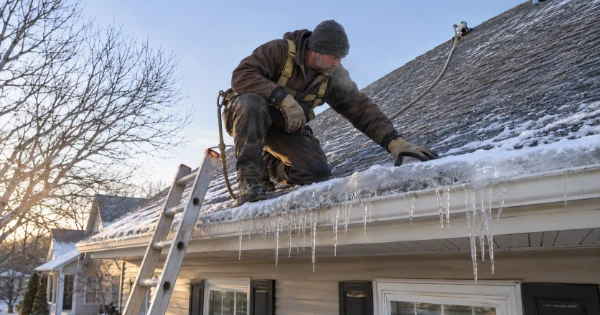
- Use winter photos of your own jobs. A crew clearing an ice dam or tarping a roof in the snow looks local and real. Stock photos of summer roofs do not.
- Run winter offers, without prices. For example: a free roof check after heavy snow, a gutter and ice-dam check, or "book your spring roof now and get a spot on the schedule".
- Keep the lead form short and clear. Ask what the homeowner needs (repair, replacement, inspection) and add a clear consent line if you plan to text leads.
- Mind the targeting rules. If your ads fall under Meta's Housing category, Meta limits how narrowly you can target, so the ad's words and photos do more of the work. Our Facebook guide explains those limits and links Meta's own help page.
How do you get roofing leads in winter without more ad spend?
Winter is the best time to work the leads you already paid for.
- Go back to this year's open estimates. List every estimate that did not sign and follow up on them. Some homeowners waited for a better time; spring may be it.
- Contact past customers. Send an email to past customers with a winter roof check or a spring booking reminder. Text only people who agreed to get texts from you (texts only with consent).
- Ask last season's customers for reviews. A homeowner who got a new roof in the summer is a good review to ask for now. Our guide to Google reviews for contractors covers how to ask and what is allowed.
- Update your Google Business Profile for winter. Add photos of winter jobs and list winter services such as leak repair, ice dam removal and inspections.
- Ask for referrals. Happy customers, real estate agents and home inspectors all meet homeowners with roof problems in winter.
A month-by-month winter marketing plan for roofers
This plan follows a roofer in a cold state whose slow months run November to February. Shift the plan a month earlier or later for your area. In warm states the slow weeks are shorter, so you may squeeze November to February into a few weeks, or skip the budget cut.
| Month | Ads | Pipeline | Get ready |
|---|---|---|---|
| November | Switch keywords and ads to winter work (leaks, repairs, ice dams, inspections). Lower the daily budget. | List this year's open estimates and start following up. | Check that calls and forms are tracked. |
| December | Keep the winter baseline running. Check search terms weekly. | Email past customers. Ask summer and fall customers for reviews. | Update your Google Business Profile with winter photos and services. |
| January | Keep the baseline. Adjust after storms. | Keep working open estimates. Ask for referrals. | Look back at last year: signed jobs by month and by source. Plan the spring budget from your cost per signed job. |
| February | Build spring campaigns and a storm campaign, get them approved, keep them paused. | Book spring inspections and quotes. | Update landing pages for spring replacement. Test forms and tracking. |
| March | Switch spring campaigns on in steps as calls rise. Warm states start earlier. | Call back every spring booking fast. | Compare March with last March, not with summer. |

November: switch to winter. Change your ads and keywords to winter work, lower the daily budget, and list every estimate from this year that did not sign.
December: work your customer list. Email past customers, ask for reviews from last season's jobs, and update your Google Business Profile with winter photos and services. To reach the same list with ads, see how to use a customer list in Google and Meta ads.
January: look back and plan. Count last year's signed jobs by month and by lead source, then set your spring budget from what a signed job really cost you. Our guide to cost per signed job shows the method.
February: build spring before spring. Build your spring campaigns and a storm campaign, get the ads approved, and keep them paused until you need them. Our guide to Texas hail storm roofing marketing covers storm-season timing.
March: switch on in steps. Raise budgets as calls rise, not all at once. Answer every spring call fast; the homeowners you met in winter are now ready to sign. For April onward, see our yearly plan for roofers.
How do you know your winter marketing works?
Count signed jobs, not leads. In winter, fewer leads is normal; what matters is what each signed job cost you.
- Track cost per signed job by month and by source. Ad spend for the month divided by the jobs you signed from those ads.
- Compare winter months with each other, and with last winter, not with July.
- Count the spring jobs that started in winter. An inspection in January that signs in March is a winter lead.
Example numbers, not real results. Say you spent $1,216 on Google Ads in December and signed 2 jobs from them: $608 per signed job. In January you spent the same and signed 3: about $405 per signed job. Neither month looks like summer, and that is fine. The question is whether those jobs were worth more than they cost. Our guide to cost per signed job shows how to set this up.
Where Digital Hark fits
Digital Hark builds growth systems for roofers and other home-service contractors: Google and Facebook ads in your own accounts, ad videos and images, landing pages, tracking, fast replies (texts only with consent) and a CRM with a follow-up plan. We never call your leads or sell jobs for you; your team does that. You own every ad account, page and lead.
Our ad campaigns brought the leads. Six service businesses won over $740,000 in jobs. These are not roofing or winter results. Every business is different; we don't promise results. More on our roofing marketing page.
Winter checklist for roofers
- ☐ Slow months found from last year's signed jobs by month
- ☐ Ads and keywords switched to winter work
- ☐ Daily budget lowered, campaigns not paused
- ☐ Ad schedule matches the hours someone answers the phone
- ☐ Search terms report checked every week
- ☐ Open estimates from this year listed and followed up
- ☐ Past customers emailed (texts only with consent)
- ☐ Reviews asked from last season's customers
- ☐ Google Business Profile updated with winter photos and services
- ☐ Spring and storm campaigns built, approved and paused by the end of February
- ☐ Landing pages, forms and tracking tested before spring
Common questions
When is the slow season for roofing?+
For most roofers in cold states, the slow months fall somewhere between November and March. Warm states usually see a smaller winter drop. Check your own numbers: the months where your signed jobs drop last year are your slow season.
Should roofers stop marketing in winter?+
No. Homeowners still need leak, ice-dam and storm repairs in winter, and the roofer who stays visible is the one they remember in spring. Lower the budget and change what you advertise instead of switching everything off.
Should you cut your Google Ads budget in winter?+
Usually lower it, but do not pause. Lower the daily budget and move it to winter searches such as leak repair and ice dams. Google says a campaign can spend up to twice the daily budget on a day, but no more than 30.4 times it in a month.
What should roofers advertise in winter?+
Roof leak repair, ice dam removal, emergency tarping, inspections after storms or heavy snow, gutter repair, and "book your spring replacement now". Use photos of your own winter jobs and keep offers simple, with no prices or promises. Adding holiday lights as a winter line? See whether holiday light installation fits your crew.
Can you replace a roof in cold weather?+
In many areas, yes, with extra steps. Owens Corning's Duration instructions, for example, ask for hand-sealing perimeter shingles when installing below 40F. Other shingles have their own rules, so follow the instructions for the product you install. This is not installation advice.
How do you fill the spring schedule early?+
Inspect and quote in winter, follow up on this year's open estimates, email past customers, and build your spring and storm campaigns in February so they are ready to switch on when calls rise. For a planned reason to visit past customers every year, see how roof maintenance plans work.


