
Guide · Remodeling
Showroom events for remodelers: do they bring leads? (and how to run one)
A plain guide for kitchen and bath remodelers with a showroom: which event to run, who to invite, how to promote it under today's ad rules, what to collect at the door, and how to judge it by the jobs it signs.
The short answer
They can. A showroom event brings leads when the room holds the right people (past clients, open leads not ready yet, and partners), the evening teaches instead of pitching, every guest signs in (texts only with consent), design consults are set on the night, and you count signed jobs from each event over the following months.
Key takeaways
- Pick one kind of event: a design night, a product demo or a planning workshop. Smaller and focused is often easier to follow up than big and open.
- Invite by stage: past clients, open leads who are not ready yet, clients with a design agreement in progress, and trade partners.
- Use an RSVP page with one call to action, and a sign-in at the door with a separate, unticked box for texts (texts only with consent).
- Our reading of Meta's rules: an event ad still promotes your remodeling service, so plan it as a Housing ad.
- Judge each event by signed jobs, counted over months, not by how full the room was.
Want us to find your three biggest lead leaks?
Free Growth DiagnosisDo showroom events bring leads for remodelers?
They can, but not on their own. An event is one evening. What turns it into jobs is the work around it:
- The right people come. Homeowners who already know you or are planning a project, plus partners who send work your way.
- You teach, you do not pitch. People come to learn how a kitchen or bath project works.
- Every guest is signed in, with a source tag for the event.
- The next step is set on the night: a design consult on the calendar.
- You follow up and count signed jobs from that event for months after.
Remodelers have run their own events for a long time. A 2006 JLC article described remodelers "putting on their own events, holding open houses, receptions, workshops, and seminars". A remodeler quoted in a 2008 JLC article put it this way: "It's as much public relations as direct marketing or an advertising piece." That is a fair way to see it. An event builds trust with people who are not ready to sign today, so judge it over months, not on the night.
These trade articles are old. Their advice on formats, invites and sign-in still holds; we do not use their result figures, because they were one company's results many years ago. The only way to know what an event does for your company is your own count.
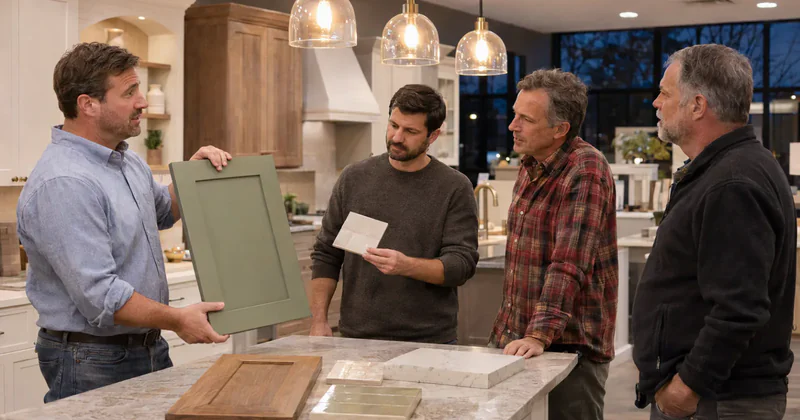
Which event fits your showroom: design night, product demo or planning workshop?
Three kinds of showroom event work for kitchen and bath remodelers. Pick one per evening.
Design night
- What it is: a social evening in the showroom. Guests look at the displays and talk with your designers.
- Who it suits: past clients, open leads, partners.
- Next step: a design consult. Sea Pointe Design & Remodel, an Irvine, California remodeler, invites guests on its showroom open house page to "Mingle with our experienced designers" and to "Schedule your complimentary consultation with our design team during the event."
Product demo
- What it is: a supplier or a cook shows appliances, surfaces or materials in use.
- Who it suits: homeowners deciding on finishes, and people who like to see things work.
- Next step: a design consult, or a visit with the supplier's samples. A 2010 JLC article described a Rhode Island kitchen and bath company that "increased showroom traffic with a Visiting Chefs series".
Planning workshop
- What it is: a short talk on how to plan a remodel, followed by questions.
- Who it suits: homeowners early in planning, including open leads who are not ready yet.
- Next step: a design consult when they are ready. Lars Remodeling & Design, a San Diego remodeler, lists "free, in-person seminars" on its events page with topics such as "Is Remodeling Right for You?", "How Do You Plan a Realistic Remodeling Budget?", "Which Permits and Property Impacts Could Affect Your Project?" and "What Should You Look for in a Remodeling Contract?" A 2010 JLC article described a Minnesota design-build firm whose workshops are "usually hosted in local showrooms" and "walk them through a PowerPoint of before, during, and after photos", on topics such as "kitchens, baths, basements, green building, and universal design".
How design-build firms market the design step: see our design-build remodeler guide.
For a bath-focused showroom, the same three formats work; a planning workshop on bath layouts or easier-to-use bathrooms fits well. See how we think about bathroom remodeling marketing as a whole.
A second family: project open houses and tours. Instead of the showroom, you invite people to a finished client home, or to a project in progress. A 2012 JLC article described "invitation-only mid-construction house tours for strong prospects", where "attendees are asked to sign a release form". A 2018 Remodelers Advantage article suggested a party mid-project, with past clients and neighbors invited. These need the client's written permission (see who to invite, below).
Talks outside the showroom. NARI of San Jose, quoted in a 2007 JLC article, said: "They're always looking for speakers at libraries and home shows." Our aging-in-place guide covers short talks at a library or community center.
Smaller is often easier. A remodeler quoted in the 2008 JLC article found that after very large events, "hardly any leads from the event turned into jobs", and smaller seminars worked better for him. That is one remodeler's experience, not a rule. But a smaller room means your designers can talk with every guest, and every guest gets a real follow-up.
Greenbrook Design, a cabinet showroom in Shelby, North Carolina, runs a monthly "First Friday" gathering, one of them as a community snack drive, to "share our passion for design with our neighbors". A community evening like that builds goodwill. In our view, an evening with no design talk and no clear next step does little for leads on its own, so if you run one, add a short talk or a consult sign-up.
Who should you invite?
Invite by stage, and know why each group comes. A 2006 JLC article described one remodeler inviting "past and current clients, prospects, and trade and design partners". A 2025 post on the Sandler Training blog, a sales-training firm, puts it simply: "Forget mass invitations. For remodeling open houses, quality over quantity is key."
| Group | Why they come | What you want from it |
|---|---|---|
| Past clients | To see what is new, and to see you again | Referrals, and repeat work (a bath after the kitchen) |
| Open leads who are not ready yet | To learn, with no pressure | A design consult when they are ready |
| Clients with a design agreement in progress | To pick finishes and see the displays | A smooth project, and a guest they may bring along |
| Trade and design partners (interior designers, architects, realtors, suppliers) | To see your work and meet your team | Referrals |
| Neighbors (project open house only) | To see a real project on their street | New leads near a job |
A few notes:
- Open leads are the big group for kitchens. Kitchen projects can take months from first call to signed contract. An event gives those leads a reason to come back without a sales call. Our kitchen remodeling page explains why kitchen leads take months and how your team keeps them warm.
- Clients with a design agreement. A 2010 JLC article described a showroom owner who invites "clients who have a design agreement in progress, previous clients, and friends", along with e-mail addresses captured through his website.
- Neighbors and a client's home. For a project open house, a 2006 JLC article advised: "Get the client's written permission to use their name and address". A 2018 Remodelers Advantage article added a fair warning: "Not every client is going to be comfortable with opening their house for your marketing purposes." The Sandler post says: "Always secure their permission to invite prospective clients."
How do you promote a showroom event?
Most of the promotion goes to people who already know you, so it can be simple. A timeline that follows the 2016 and 2018 Remodelers Advantage advice:
- About three weeks ahead: the RSVP page. "It's a good idea to start promoting the Open House three weeks in advance of the event," and on the landing page, "make sure there is only ONE call to action on the page", which is usually the RSVP form.
- Email invites, by group, with "a minimum of two reminders" before the night.
- Mail, if you use it. "The first postcard should arrive up to two weeks before the event".
- A Facebook event on your page, shared across your social channels.
- A Google Business Profile post about the event, if the showroom is staffed that evening. Our Google Business Profile guide for remodelers covers posts.
- Signs. For a project open house, a lawn sign in the week before. A remodeler in a 2007 JLC article promoted an open house "in the local paper, through direct mail, and by e-mailing past clients" and "hung street signs inviting neighbors". At the showroom, a street sign on the night for walk-ins, as the showroom owner in the 2010 JLC article did.
- Pick the time with care. For a mid-project party, the 2018 article advised: "don't do it on a Sunday. Better to go for a Saturday afternoon." For a design night, a weeknight evening lets people come after work; test what your guests prefer.
- Texts only with consent. Send invites or reminders by text only to people who agreed to texts from you.
Paid ads for the event. An ad for your showroom event still promotes your remodeling service. Meta's Housing category covers housing repairs, so our advice is to plan event ads as Housing ads. That is our reading: none of the Meta pages we read mentions events. Meta's Ad Standards say advertisers "must self-identify as a Special Ad Category", and the category is set for each campaign. Our Facebook guide explains which Meta ad rules remodelers should check first.
Watch out for old advice. Older open-house guides suggest targeting event ads by ZIP code and age. A 2016 article, for example, said remodelers "can target an audience by zip codes, age, home value and household income". For remodeling ads on Meta, that no longer works: Meta's developer page says ZIP codes are not supported for these campaigns and ages are "generally fixed to include ages 18 through 65+".
What should you collect at the door?
Collect the same basics twice: once on the RSVP form, once at sign-in.
On the RSVP form. Keep it short. Lars Remodeling & Design's RSVP form asks for name, email, phone, number of people, ZIP code, event date, project type and "How did you hear about our event?", and it has a consent checkbox for texts and email. Use the same fields as a home show lead card, and add only the event fields:
- the event and date they RSVP'd for,
- how many guests they are bringing,
- the partner who invited them, if any.
A separate box for texts, left unticked. The guest ticks it only if they want texts from you. Texts only with consent. A phone number on a form is not the same as agreeing to texts. Keep the consent wording with the record. Our speed-to-lead guide lists what texting rules to check first.
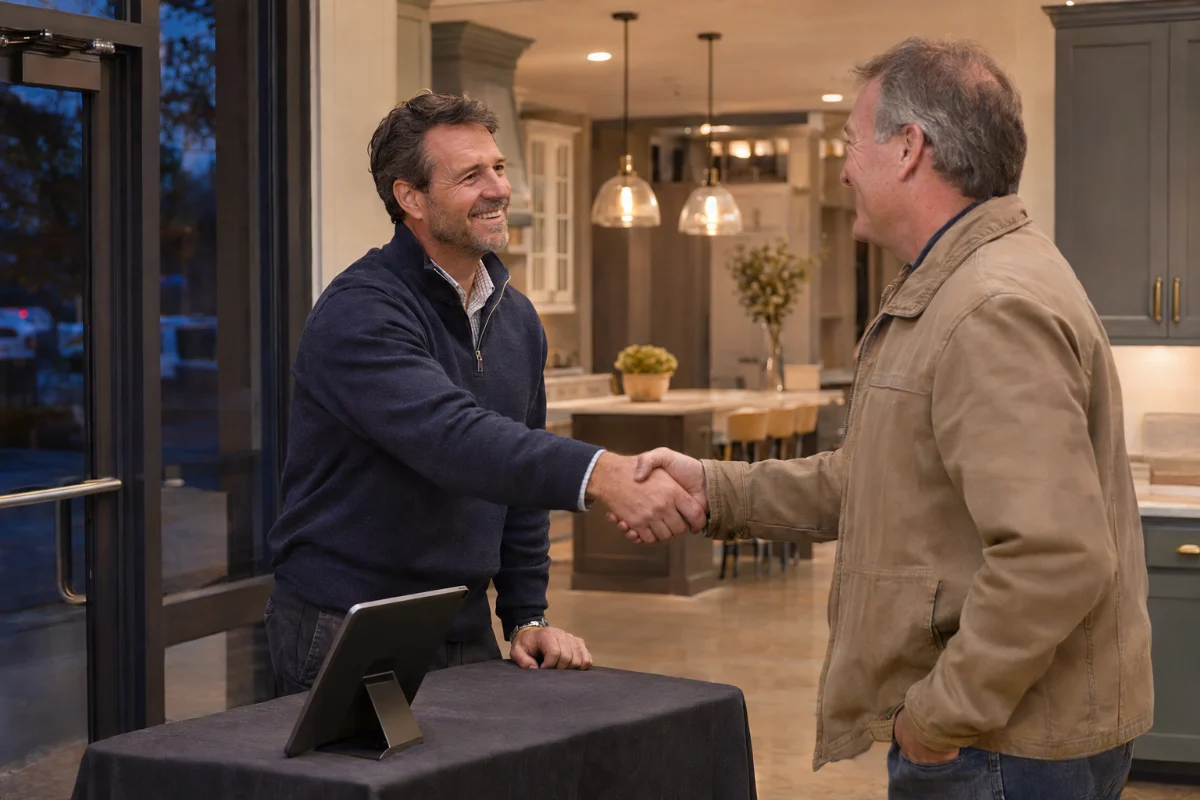
At the door: a greeter and a sign-in. A 2008 JLC article advised: "Designate a person to greet guests, and only greet guests." and "Provide easily accessible sign-up sheets to let guests request more information." The same article admits: "Many didn't sign the guest book." A tablet sign-in with the greeter standing next to it works better than a book left on a table. Check in RSVP guests by name and sign in walk-ins with the same short form.
For a client's home: add the release form the 2012 article mentions.
The same evening: enter every guest into your CRM, each tagged with the event name and date.
What should happen on the night?
- Teach, don't pitch. NARI National, quoted in a 2007 JLC article: "They don't want you positioning yourself as Joe Remodeler selling your product". A 2012 article on home tours said: "Be careful not to come off as too sales-pitchy".
- Staff it. For a mid-project party, the 2018 Remodelers Advantage article named "at least the Salesperson, the Designer, and the Project Manager". For a design night, have enough designers that every guest can talk with one.
- Show finished work honestly. Display kitchens are displays. Say so, and show photos of finished client kitchens, with permission, next to them. Our kitchen page covers letting your best kitchens do the talking.
- Set design consults on the night. Bring a calendar with open consult slots for the weeks after the event. A guest who wants a consult should leave with a date.
- Give them something to take home. A 2010 JLC article quoted a buying-group head: "Give away information-based booklets on topics like good lighting or closet organization." A one-page planning checklist works too.
- End with questions and a short survey. In the 2007 JLC article, two California remodelers "conclude their presentations with Q&As and surveys." Ask what project they are planning, when, and whether they want you to contact them.
What should the follow-up look like?
The follow-up is where most events fall short. A remodeler in the 2008 JLC article admitted: "We could be more diligent about following up, but it's soft marketing." Plan the follow-up before the night.
- Next day: thank every guest. The Sandler post advises: "Send a personalized thank-you note to all attendees, including a link to a survey for their feedback."
- Contact only those who asked. In the 2007 JLC article: "Attendees are contacted only if they indicate that they want to be." Use the survey answer or the sign-in box.
- Sort every guest into ready, later or not a fit, as in our guide on how to qualify remodeling leads. The week after a show in our home shows guide follows the same steps.
- Ready guests: confirm the consults set on the night. For anyone who did not book, the Sandler post suggests you "Offer to schedule a one-on-one consultation". After the consult, see what should happen at the end of the design consult in our remodeling proposal follow-up guide.
- Later guests: keep them warm, the same way as other long kitchen and bath leads (see the kitchen page linked above), and invite them to the next event.
- Partners: a short thank-you, and ask who they would bring next time.
How do you judge an event by signed jobs?
Judge each event by signed jobs, not by how full the room was.
- One lead-source tag per event, for example "Design night — March 2027". Use it on every RSVP, every sign-in and every job that came from the event.
- Count these: people invited, RSVPs, guests who came, consults set, consults held, signed jobs, and staff hours for planning, the night and the follow-up.
- Use the invite list as the starting point. Your invite list shows how many people you reached; the counts after it show where they dropped off.
- Give it time. Kitchens and baths often take months to sign. Count for 6 to 12 months after the event before you decide.
- Compare with your other sources on the same terms. Our guide to cost per signed job shows how. Our home shows guide explains how to tell if a show paid off with the same method.
- Decide: run the event again, change it (format, size, invite list, follow-up), or stop.
Judge each event on its own count. Do not assume events beat ads or other sources, or that they lose to them. Your numbers will tell you.
Showroom event mistakes to avoid
- A big open party with no sign-in. You meet people and cannot follow up.
- Pitching instead of teaching. Guests came to learn; a hard sell sends them home.
- No consult slots on the night. A guest who is ready should leave with a date.
- Old targeting advice. ZIP code and age targeting from older guides no longer works for remodeling ads on Meta.
- Texting without consent. Text only guests who ticked the text box.
- Passing off a display as a client's home. Say what is a display and what is a finished job.
- No follow-up plan. If nobody owns the week after, the sign-ins go cold.
Where Digital Hark fits
Digital Hark runs Google and Meta ads, landing pages, tracking and follow-up systems for home-service contractors. We do not host or staff events, and we never call your guests, set consults or sell jobs for you; your team does that. Where we can help is around the event: an RSVP landing page with one call to action, event ads set up under Meta's Housing rules, and lead-source tags in your CRM so each event's signed jobs can be compared with your other sources. You own every ad account, page and lead.
Common questions
Do showroom events work for small remodelers?+
They can, and a small company may do better with small events. A small, focused evening with past clients, open leads and a few partners lets your designer talk with every guest and follow up with every one. Keep the format simple, set consults on the night, and count signed jobs per event.
What is a good topic for a homeowner workshop?+
Topics that help people plan: how a remodel works from start to finish, how to plan a realistic budget, which permits may apply, and what to look for in a remodeling contract. Those are the topics one San Diego remodeler lists for its seminars. Teach first, and offer a design consult at the end.
How far ahead should you promote a showroom event?+
About three weeks ahead, as a 2016 Remodelers Advantage article advised: put up the RSVP page, send email invites with at least two reminders, and time any mail to arrive up to two weeks before the event. Text reminders only to guests who agreed to texts (texts only with consent).
Are showroom event ads on Facebook Housing ads?+
In our reading, yes: an event ad still promotes your remodeling service, and Meta's Housing category covers housing repairs, so plan event ads as Housing ads. No Meta page we read mentions events. Our Facebook guide explains which Meta ad rules remodelers should check first.
Can you text people who RSVP'd?+
Only if they agreed to texts. Put a separate, unticked box for texts on the RSVP form and the sign-in, and text only the guests who ticked it. Keep the consent wording with the record. An RSVP with a phone number is not consent to texts.
How do you know if a showroom event paid off?+
Tag every RSVP, guest and job with the event name, then count signed jobs from that tag for 6 to 12 months. Put the staff hours next to the signed jobs and compare with your other sources, as our guide to cost per signed job shows.


