
Guide · Leads
Truck wraps and lettering for tree services and roofers: what to put on the truck
What a tree service or roofing truck should say, what to leave off, the USDOT and city parking rules to check before the lettering goes on, and how to see which calls and signed jobs the trucks bring in.
The short answer
Put your real business name on the truck, exactly as it appears on your Google Business Profile, plus one phone number, your website, your main service and the towns you serve. Skip claims you can't prove. Before you letter a big truck or one that pulls a trailer, check the USDOT and state rules. General information, not legal advice.
Key takeaways
- The name on the truck, the name on Google and the name on your invoices should be the same name, word for word.
- One phone number on the truck, big and clear. If you want to measure the trucks, make it a number used only on the trucks that rings your normal phone.
- Bigger trucks and trucks that pull trailers may need a USDOT number by law. Check before you letter, and leave room for it.
- Lettering can change how your city treats the truck when it is parked on a street overnight. Check your city's rules and your HOA.
- Judge the trucks by signed jobs, not by how many people say they saw them.
Want us to find your three biggest lead leaks?
Free Growth DiagnosisWhat should a tree service or roofing truck say?
A truck is read in a few seconds, from a car, at a stop light or across a street. In that time a homeowner should get four things: who you are, what you do, where you work and how to reach you.
One wrap company puts the list this way: a contractor wrap should include "company name, primary service, service area or city, and a phone number". We add your website, and one rule on top: the name must be the same name customers find when they search for you.
The short checklist:
- Your real business name, spelled the same as on your Google Business Profile, your website and your invoices.
- One phone number.
- Your website, short and easy to read.
- Your main service, in plain words: "Tree removal and trimming", "Roof replacement and repair".
- The towns you serve, if they fit in one short line.
- Room for any number the law asks for, such as a USDOT number on a bigger truck or a license number where your state requires it.
Why should the name on the truck match your name on Google?
Because some people who see your truck won't call the number from the road. They may remember the name and search for it later. If the name on the truck and the name on Google don't match, they may not find you, or they find a company with a similar name.
Google's guidelines say the name on your profile "should reflect your business's real-world name, as used consistently on your storefront, website, stationery, and as known to customers." They also warn: "Including unnecessary information in your business name isn't permitted, and could result in the suspension of your Business Profile." Google does not mention trucks. Our advice: for a contractor, the trucks are part of that real world, so the name on your trucks should be that same real-world name. No "Tree Removal" or a city added on the truck that is not part of your name, and nothing on the profile that is not on the truck.
Once they find you, they read your reviews. Our guide to Google reviews for contractors covers how to get more of them the right way.
For tree companies, a truck with the business name on the door is also one of the things you can show if Google asks for a video to verify the business. Our guide to setting up a tree company's profile on Google covers the name rules and the verification steps; we don't repeat them here.
What goes on the truck, and what stays off?
What goes on. The name, the one number, the website, the main service and the towns. Make the name the biggest thing on the truck and the number the second. Our test: park the truck across the street and read it from the other curb. If you can't read the number there, it is too small or the colors are too close.
What stays off.
- A list of every service you offer. Pick the main one or two. The website holds the rest.
- More than one phone number. Two numbers on one truck make people choose, and they split your tracking.
- Ranking claims and promises of results, such as "best in town" or a promise about how fast a job will be done. If you can't prove it, it doesn't go on the truck.
- "Licensed and insured" only if it is true and you can show the papers today. Our guide on free inspection and warranty ads shows how to back up a claim before it runs.
- "Text us" only if someone on your team will answer, and follow-up texts only to people who agreed to them (texts only with consent). Our guide to missed call text back for roofers and other contractors covers the consent part.
License numbers. Some states have their own rule. In Florida, for example, if a truck shows your company name or contracting artwork, your license number must be shown with it; our license number guide covers the Florida rule. Check your own state.
Where the text goes on each truck (our layout notes):
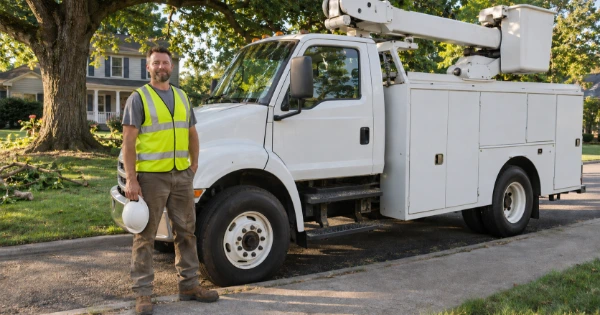
- Tree service bucket truck. The boom and bucket move and are hard to read, so the doors and the side boxes of the utility body carry the name and number. Keep the number on the doors, where people walking past a job can read it.
- Chip truck with a chipper behind it. The chip box sides are large and flat: name, main service and number there. The chipper itself can carry the name and website. Leave a clear spot on each door for any required number.
- Roofing pickup pulling a dump trailer. The doors carry the name and number. The trailer sides and back are large and are what drivers behind you see, so put the name, the main service and the number there too, the same as on the truck.
Check the rules before you letter the truck
Before the lettering goes on, check:
- Do you need a USDOT number? Bigger work trucks, and trucks that pull trailers, may have to show your company name and a USDOT number by law. Whether yours must depends on its weight, what it pulls and where it drives. Check FMCSA's "Do I need a USDOT number?" page.
- In Texas, check TxDMV too. TxDMV says: "Motor carriers operating INTRAstate commercial motor vehicles on a road or highway in Texas must be registered with the TxDMV Motor Carrier Division." You must register when you "Operate a commercial motor vehicle (or a combination of vehicles)" "with a gross weight, registered weight or gross-weight rating exceeding 26,000 pounds". And: "Please note that before you begin you must have a valid USDOT Number."
- Texas-only work? TxDMV: "If your operations are conducted exclusively within Texas, register with USDOT as INTRAstate, not INTERstate."
- Keep the cab card in the truck. TxDMV: "A current copy of the insurance Cab Card must be kept in the commercial vehicle at all times."
- Trucks worth checking (our examples, not TxDMV's): a tree company's bucket truck, a chip truck towing a chipper, a roofing truck pulling a loaded dump trailer.
- What must be lettered on the truck is a separate question. The TxDMV page we read covers registration, not lettering. Ask FMCSA or your state's motor carrier office before you order.
- Leave room in the design for a USDOT number, so you don't redo the lettering later.
- Other states have their own motor carrier office and rules. Check yours.
This is general information, not legal advice.
Full wrap, lettering or magnets: which fits a tree or roofing crew?
There are five common ways to put your name on a truck:
| Option | What it is | When it fits a tree or roofing crew |
|---|---|---|
| Full wrap | Printed vinyl over most of the truck | One main truck that drives the most, or a new fleet you want to look the same from day one |
| Partial wrap | Printed vinyl over part of the truck, such as the doors and back half | Most of the look of a full wrap on the panels people read |
| Cut vinyl lettering | Letters and a logo cut from vinyl, on the truck's own paint | Bucket trucks, chip trucks and pickups where the name, number and service are what matter |
| Spot graphics | A logo or one panel in a few places | Adding to trucks that already have lettering |
| Magnets | Removable door signs | Leased trucks, a crew member's own pickup used for work, or a truck you are about to sell |
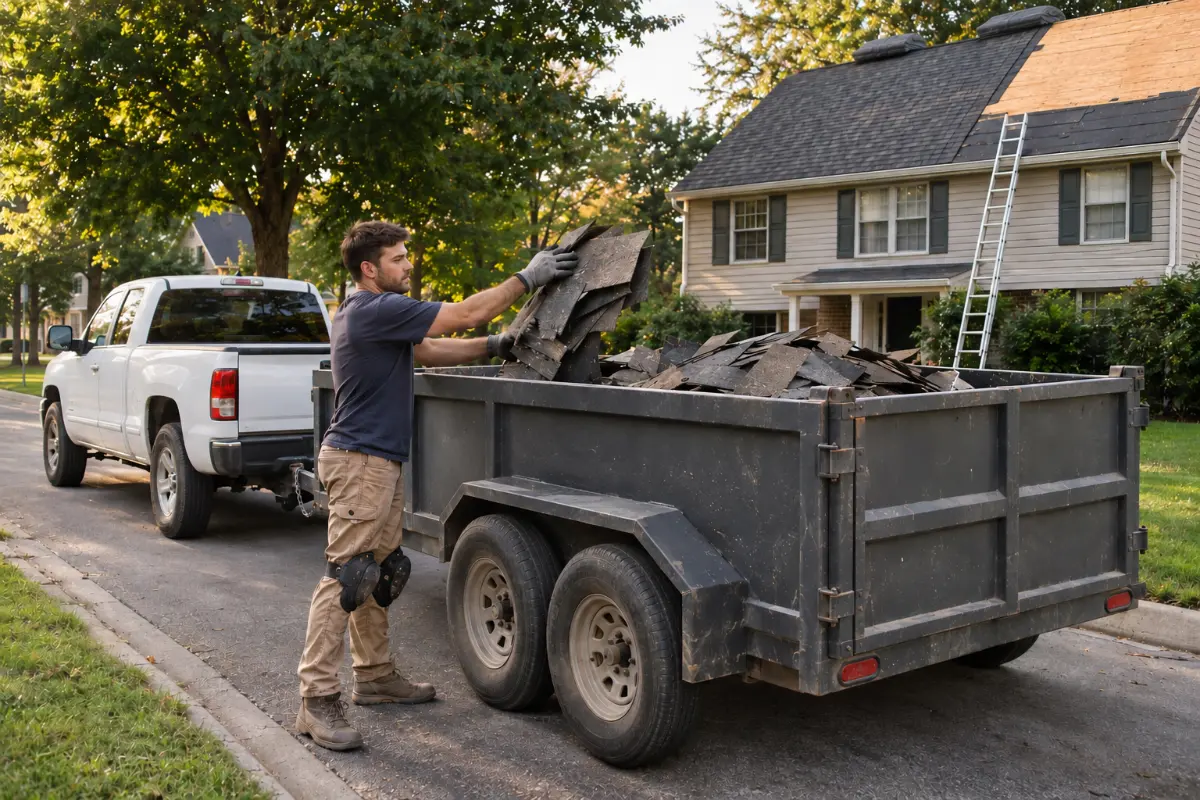
Our advice for most tree and roofing crews: clear lettering on every truck before a full wrap on one, and the same name, colors and number on every truck and trailer.
Ask your wrap shop for a written quote for each option and how the film comes off later, and read your lease if the truck is leased.
A note on magnets: in Houston, a vehicle with "one or more magnetic signs or decals" counts as a commercial vehicle for parking. A magnet is still lettering. See the next section.
Where can a lettered truck park at night?
Many crew leads take a truck home. Lettering, size and trailers can change where that truck may park. Two city examples:
Houston (ParkHouston, "Large and Commercial Vehicles"). A commercial vehicle is one that "Has one or more magnetic signs or decals. Does not include taxis, limousines and buses". The page lists: "Parking commercial and large vehicles on a public street is prohibited between 2 AM - 6 AM." and "Large vehicles may not park on any street in a residential district except for active loading and unloading." A large vehicle is one over "8 feet in height" or "in excess of 22 feet in length". Exemptions include "Vehicles in the act of service" and "Vehicles actively loading and unloading". So in Houston, lettering alone can make a pickup a commercial vehicle for these rules.
San Antonio ("Oversized Commercial Vehicle Parking"). "The City of San Antonio restricts parking of oversized vehicles in residential areas and where signs are posted." Oversized means over "24 feet in length", "8 feet in width" or "8 feet in height", with a trailer counted together with the vehicle. The page's list includes "Box trucks" and "Construction vehicles (e.g., dump trucks, cement mixers)". Exceptions: "Active loading and unloading of goods or materials" and "Emergency repairs that prevent immediate movement." Here the rule is about size, not lettering, but a pickup and trailer together can pass the length line.
These are two examples, not the rule. Your city may differ. Before a lettered truck, or a truck with a trailer, goes home with a crew member, check your city's rules and your HOA. This is general information, not legal advice.
How do you track calls and jobs from the truck?
The advice differs. Hook Agency suggests you "give the truck its own phone number or a short URL so you can track it". PipelineOn says: "Use the same number you advertise on Google." (and adds that you should track it with call tracking if you can). Both have a point.
Our setup:
- Your main local number stays on your Google Business Profile, your website and directories. Google says: "The phone number must be under the direct control of the business."
- If you want to measure the trucks, put a separate forwarding number only on the trucks. It rings your normal phone, so nobody misses a call. It never goes on your profile or in directories. Our tracking service page explains how forwarding numbers work and why the main number stays put (see "Does call tracking hurt local SEO?" there); we don't repeat it here.
- Ask every new caller "Where did you see us?", and pick the answer from a fixed list that includes "Saw the truck". Some people see the truck, then search your name and call the main number. The truck number alone misses them.
- Log the source and the result in your CRM: lead, estimate or inspection, signed job.
- If someone texts the truck number, reply, and send follow-up texts only to people who agreed to them (texts only with consent).
- Judge the trucks by signed jobs, once a quarter. Our guide to cost per signed job shows the math. Our yard sign guide uses the same method for signs, door hangers and postcards.
Worked numbers in this guide show the method; they are not real client results. One quarter, three lettered trucks with a truck-only number:
| Source logged in the CRM | Calls | Estimates or inspections | Signed jobs |
|---|---|---|---|
| Truck number | 7 | 5 | 2 |
| Main number, caller says "Saw the truck" | 5 | 4 | 2 |
| Trucks, total | 12 | 9 | 4 |
The truck number alone shows two signed jobs. The question on the main line shows two more. Count both, then divide what the lettering cost by the four signed jobs, and you know what the trucks really bring.
Mistakes to avoid
- A name on the truck that differs from the name on Google and your invoices.
- Two or three phone numbers on one truck.
- A truck-only number that nobody logs in the CRM.
- Text too small to read from across the street.
- Claims you can't prove, or "licensed and insured" without the papers.
- Lettering a big truck, or one that pulls a trailer, before checking the USDOT and state rules.
- Sending a lettered truck home with a crew member before checking the city's parking rules and the HOA.
- Texting people who did not agree to it (texts only with consent).
- Judging the trucks by "everyone says they saw it" instead of signed jobs.
Where Digital Hark fits
Your wrap shop designs, prints and installs the lettering, and your team drives the trucks, answers the calls and sells the jobs. Digital Hark builds the part behind it: the truck-only forwarding number that rings your normal phone, the "Where did you see us?" source list and CRM fields, the ads that run in your own accounts, and a monthly view of signed jobs by source. Our tracking service sets this up. We never call your leads, book inspections or sell jobs, and we don't design, print or install wraps. Every account, number and lead is yours. More on how we work with tree companies and how we work with roofing companies.
Common questions
Does my truck need a USDOT number?+
It depends on the truck's weight, what it pulls and where it drives. Check FMCSA's "Do I need a USDOT number?" page. In Texas, TxDMV says you must register with its Motor Carrier Division if you operate a commercial motor vehicle, or a combination, over 26,000 pounds, and that you need a valid USDOT number before you begin. General information, not legal advice.
Should the truck have its own phone number?+
Only if you will track it. Keep your main local number on Google, your website and directories. If you want to measure the trucks, put a separate forwarding number only on the trucks, have it ring your normal phone, and log every call in your CRM. Also ask every caller where they saw you.
Does the name on my truck have to match my name on Google?+
Google does not mention trucks, but it says your profile name should be your real-world name as used on your storefront, website and stationery, and as known to customers. Your trucks are part of that, so use the same name, word for word, on the truck, on Google and on your invoices.
Can I park my lettered truck at home overnight?+
Check your city's rules and your HOA. In Houston, for example, a vehicle with magnetic signs or decals counts as a commercial vehicle, and the city's page says commercial and large vehicles may not park on a public street from 2 AM to 6 AM. Other cities differ. General information, not legal advice.
Does my license number have to be on my truck?+
It depends on your state. In Florida, if a truck shows your company name or contracting artwork, the license number must be shown with it. Our license number guide covers the Florida rule. Check your own state's licensing board. General information, not legal advice.
Should I wrap the truck or just letter it?+
Our view: for most tree and roofing crews, clear lettering on every truck comes before a full wrap on one. A full or partial wrap fits a main truck or a new fleet; magnets fit leased trucks. Whatever you choose, use the same name, colors and number on every truck and trailer.


