
Guide · Tree service
Tree cabling and bracing as a service line for tree services: what to say, inspections as repeat work, and how to market it
Homeowners with a V-shaped trunk or a heavy limb over the roof ask about cabling. Here is how a tree company can offer cabling and bracing honestly: what the service does and does not do, which trees fit, when removal is the better answer, how the install turns into a yearly inspection, what ads and pages may say, and how to count signed jobs. From ISA, TCIA and TCI Magazine.
The short answer
Cabling and bracing add support to a tree with a weak union or a heavy limb. They lower the risk; they do not make a tree safe. Offer them on estimates and storm-ready checks, explain the limits, put a yearly inspection plan with every install, give the service its own ad group and page, and judge it by signed jobs.
Key takeaways
- Cabling and bracing support a tree. TCIA's page says they "do not provide primary support to a tree."
- Sell it with its limits said out loud: it lowers the risk, it does not remove it.
- Some trees are better taken down. Show the homeowner both options, without pressure.
- Every install needs inspections. Put a yearly inspection plan on the same estimate, and send the reminder.
- Give support work its own ad group in your Care campaign, its own page, and DIY and zip-line negatives.
Want us to find your three biggest lead leaks?
Free Growth DiagnosisWhat are cabling and bracing, in plain words?
They are hardware that helps a weak part of a tree carry its load. The International Society of Arboriculture (ISA) lists "Cable and brace the tree." as one way to manage tree risk on its homeowner site, and says the aim is to "Provide physical support for weak branches and stems to increase their strength and stability."
TCIA, which publishes the ANSI A300 tree care standards, puts it this way on its page for Part 3, Supplemental Support Systems: "Supplemental support systems are used to provide additional support or limit movement of a tree or tree part." The next line is the one to remember: "They do not provide primary support to a tree."
In words a homeowner understands:
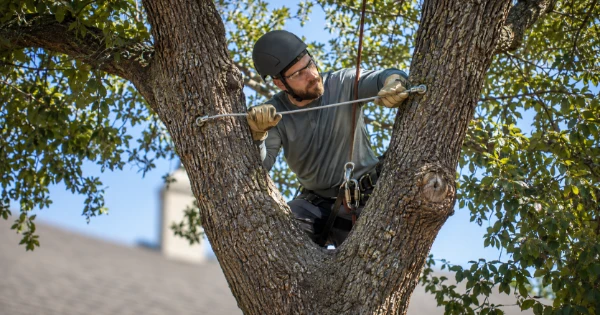
- Cabling links two parts of the tree, up in the crown. Elite Tree Care, a Pennsylvania tree company, writes: "Cabling is when heavy-duty cables are installed in the canopy to reinforce weak spots." TCIA's page says: "Direct cabling consists of a single cable between two tree parts, e.g., two limbs, two stems, or a trunk and a limb."
- Bracing puts steel rods through a weak union or a split trunk or main limb. ISA notes that "a professional arborist may be able to install cables or bracing rods".
And the limit, said the same way every time. ISA: "The amount of added security offered by the installation of support hardware is limited." ISA also says support hardware does not rule out failure. So the honest short version is: support, not a fix. It lowers the risk; it does not take the risk away.
This guide is about selling the service, not doing it. We do not teach installation. Guying and staking young trees is a different job; our tree planting guide keeps that.
Which trees and situations do homeowners ask about?
Most questions start with something the homeowner can see:
- A V-shaped trunk. "Trees with co-dominant stems that create a V-shaped trunk are prone to splitting." (Elite Tree Care) TCI Magazine adds that "Multi-leader trees often display poor growth habit and may be encumbered by bark inclusions" (June 4, 2024).
- A heavy limb over the roof, the driveway or the deck.
- A split or crack that is already there.
- A big tree the owner wants to keep. Davey, a national tree company, describes the fit as a tree that is "overall stable and healthy, but has a codominant stem or significant branch that could use some support". Elite Tree Care adds: "It's not only young trees that need support."
- Wind, ice and weight. Davey says cabling and bracing is "commonly used to reduce stress damage on your tree from high winds, weight of ice or snow, and heavy foliage."
Not every one of these trees is a candidate. ISA says so plainly: "Not all weak limbs are candidates for these measures." TCI Magazine's 2020 article on the basics says "there is no special sauce, no magical system to solve all our problems and no one-size-fits-all approach", and "each and every situation is completely different". On your page and your estimate, that becomes: every tree is looked at on its own.
In Texas, two trees come up often. Neil Sperry's GARDENS (2026, notes from Arborilogical Services of DFW arborists) says: "Pecans have a habit of developing co-dominant branches and trunks." On live oaks: "An ice storm coating the evergreen canopy could spell havoc." The same page explains why cabling is chosen over pruning here: "You usually can't prune to remove one of the branches because that would cause the tree to be completely misshapen." And: "Certified arborists, however, will use cabling and bracing to reduce the risk of trunk splits."
When is removal the honest answer?
When the tree's risk is too high to keep it. ISA: "Some trees with unacceptable levels of risk are best removed."
TCI Magazine's 2024 series on tree support draws the line between two kinds of work. "Proactive installations are an excellent way to lower the risk for trees that may otherwise be considered for removal." Reactive systems, on a tree that is already failing, "can be installed to halt further mechanical failure when any remaining risk is deemed acceptable for the situation". The authors tell arborists to "present all the potential risks associated with reactive installations". They also note: "Despite our best efforts, we often cannot mitigate enough risk by pruning alone."
What it means for your sales talk:
- Deciding whether a tree is too risky to keep is a trained judgment. It belongs to the qualified person on your team, not the salesperson and not the crew member who spotted it. Our tree service upselling guide (the section on who may judge a tree's risk) covers this; we do not repeat it here.
- Give both options on paper. A line your team can use: "We can support this tree, or we can take it down. Here is what each one means, and what each one costs." Then let the homeowner choose.
- No pressure either way. Do not push removal to make the bigger ticket, and do not push support to keep a tree that should come down.
Where do you offer cabling and bracing?
Where you already stand next to the tree:
- On the trim or removal estimate. Add support as its own optional line, with the inspection plan under it. Our guide to what a written tree estimate should include shows the line-by-line format.
- At the summer storm-ready check. Our Business Profile guide suggests a summer post about storm-ready checks for limbs over the house. A cabling question fits that visit. Offer it as planning ahead, not as fear.
- On plant health care visits. TCI Magazine (May 6, 2025) has a section on bundling tree support with plant health care. Keep the two apart in your words: plant health care is for the tree's health; cabling is for its structure. Our guide to plant health care marketing for tree services covers how to sell that service.
- When a crew notices a V-shaped union. The crew notes it with a photo; the qualified person follows up. Our upselling guide (the section on what crews notice) covers that hand-off.
A support line on the estimate could read:
Optional: tree support. Tree: [species, where in the yard]. Work: [cable / brace, as your qualified person writes it]. What it does: adds support and limits movement; it lowers the risk, it does not remove it. Inspection plan: see below. Other option: removal, priced on line [x].
How do inspections become repeat work?
The install is the first job; the inspection is the one that comes back. Every neutral source says the hardware needs checking:
- ISA: "If cables or braces are installed, they must be inspected regularly."
- TCIA: "Supplemental Support Systems need periodic inspections by an arborist." And: "Scheduling inspections shall be the responsibility of the tree owner."
- TCI Magazine (2025): support work "isn't a one-and-done service – it requires periodic evaluation to ensure its effectiveness", because "Over time, cables may loosen, attachment points can weaken and trees will continue to grow and change". And: "Without regular monitoring, a failing or neglected system could become a liability rather than an asset."
The business side is in the same article: "Annual inspections create a dependable revenue stream similar to plant-health-care (PHC) programs." "By formalizing this into an annual or biannual service, you turn a single job into an ongoing relationship".
How to set it up:
- Sell the inspection plan with the install, on the same estimate. TCIA's page puts scheduling on the tree owner. Your reminder makes that easy for them.
- Pick your interval and write it down. Davey, as one company's practice, says cabled trees "should be inspected from the ground annually" and "inspected up close to assess the tree by climbing or with an aerial lift every 3-5 years". That is Davey's schedule, not a rule from the standard; your qualified person sets yours.
- Time the visits. TCI Magazine suggests "Scheduling inspections before storm seasons or during high-growth periods".
- Show what you found. Paraphrasing TCI Magazine: each visit looks at the tree's structure and the hardware's wear, ends with recommendations, and comes with photos. Davey adds: "The integrity of the wood which anchors the hardware must also be assessed." TCI Magazine: "Clients are more likely to approve work when they can see the need for it."
- Send the reminder. One email a month before the visit is due. Texts only with consent. Our guide to email for past customers covers the rules; we do not repeat them here.
An inspection plan line could read:
Inspection plan for your supported tree. Visit: [the interval your qualified person sets, for example once a year], [month]. Covers: the tree's structure, the cable or brace hardware, written notes and photos. Reminder: by email a month ahead (texts only with consent). Any work we recommend is quoted on its own; you decide.
What may your ads and page say about cabling?
Use the words the sources use. Leave out every promise.
| Say | Avoid |
|---|---|
| "adds support to a weak union" | "stops it breaking" |
| "limits movement" | "storm-proof" |
| "reduces stress on the trunk" | "saves your tree" |
| "lowers the risk" | "it won't split" |
| "needs regular inspections" | any promise word about the result |
| "removal may be the better choice" | "before it crushes your house" |
Three more rules:
- No soft promises. Some tree company pages tell readers that support spares a tree from removal. Do not write that; nobody can promise how a tree will do in the next storm.
- Credentials only if you hold them, and say who holds them: the person or the company. Several sources tell homeowners to look for an ISA Certified Arborist; Neil Sperry's page says "be sure you're dealing with an ISA-certified arborist". Our guide to ISA and TCIA credentials (the section on what you can claim) covers the wording; we do not repeat it here.
- Name the standard only as TCIA does. If your team works to it, you may say "ANSI A300 (TCIA), Part 3, Supplemental Support Systems". Do not add an edition year you have not checked on TCIA's site.
How do you set up ads and your Business Profile for it?
Keep support work apart from removals, so you can see what it brings in.
- A support ad group in your Care campaign. The campaign table in our Google Ads guide for tree service companies has a Care campaign for trimming and pruning. Add an ad group "Tree support (cabling and bracing)" there. Keyword ideas, volume to check in Keyword Planner for your area: tree cabling and bracing service, tree cabling service, tree bracing [town], cabling a tree with co-dominant trunks. Start with phrase and exact match.
- Its own landing page. What cabling and bracing do and do not do, which trees fit, the inspection plan, the removal option, who on your team is qualified, your photos, and a form.
- Negatives for do-it-yourself and zip-line searches. Our advice: add "kit", "DIY", "how to" and "zip line" as negatives to this ad group. Many "cable kit" searches are for zip lines, not trees. See the negatives for tree companies and our guide to negative keywords for how match types work.
- Plain ad text. Headlines like "Tree Cabling and Bracing", "Support for V-Shaped Trunks" and "Yearly Inspection Plans". No storm fear.
- Business Profile. Add "Tree cabling and bracing" to Services only if you sell it. The Services section of the same Business Profile guide has the set-up.
- Before the storm, not after. Support work is planned work. Storm cleanup is a different campaign with different rules; our guide to storm cleanup ads for tree services covers it.
Is cabling worth adding?
It can be, if your team is ready for it. TCI Magazine calls tree support "a specialized service that fewer and fewer companies provide" and says it can "help generate a new revenue stream".
Before you add it, ArboStar, a tree software maker, tells companies thinking about any new service to "be cautious of the extra work it may bring in regards to reach, application and practicality" and to "Know the required increase in equipment costs related to new services." Our advice, on top of that:
- Who on your team is qualified to judge the tree and do the work, and which credentials they hold (our credentials guide covers the claim).
- Training and climbing or lift time for the installs and the yearly visits.
- Check that your insurance covers the work. Ask your insurer, not us.
- A plan for the inspections, or the install is a one-off job with an open risk.
How do you know cabling pays?
Count signed jobs, not interest.
- Set up two job types in your CRM: "Support install" and "Support inspection". Tag where each support lead came from: estimate line, storm-ready check, plant health care visit, support page, ad.
- Count five numbers each year: support offers made, support installs signed, inspection plans signed, inspections done, and follow-up jobs signed from inspections.
- Divide what you spent on each source by the support jobs it signed. Our guide to cost per signed job shows the method; use "signed support job" as the job.
| One year | Count |
|---|---|
| Support offers made (estimates, storm-ready checks, PHC visits) | 40 |
| Support installs signed | 8 |
| Inspection plans signed with an install | 6 |
| Inspections done (this year's and earlier installs) | 11 |
| Follow-up jobs signed from inspections | 4 |
Worked numbers in this guide show the method; they are not real client results. In this table, the 6 inspection plans are the repeat work: they come back next year without a new ad click.
Where Digital Hark fits
Digital Hark builds the growth system for tree companies: a support page, a support ad group in your own Google Ads account, the Business Profile service line, the inspection reminder email, the CRM job types and source fields, and reports by signed support job. Our landing pages for contractors and our page on how we work with tree companies show how. We do not climb, install, inspect or judge a tree's risk, and we never call or text your leads, book jobs or sell for you; your team takes the calls, quotes and does the tree work. You own every account, page and lead. What is included is confirmed in writing in your proposal.
Cabling and bracing checklist
- ☐ You decided who on your team is qualified to judge the tree and do the work.
- ☐ An optional support line on trim and removal estimates, with removal priced as the other option.
- ☐ The limits in writing: adds support, lowers the risk, does not remove it.
- ☐ The risk call made by your qualified person, never by sales or the crew.
- ☐ An inspection plan sold with every install, with your interval written down.
- ☐ A reminder email before each inspection; texts only with consent.
- ☐ Photos and written notes from every inspection.
- ☐ Ads and page use support, limit movement, reduce stress, lower the risk, inspect; no promise words, no storm fear.
- ☐ Credentials named only if held, and by whom.
- ☐ A support ad group in the Care campaign with its own page and DIY and zip-line negatives.
- ☐ "Tree cabling and bracing" in Business Profile Services only if you sell it.
- ☐ Support install and support inspection as job types; signed jobs counted.
Common questions
Does cabling a tree really work?+
It can lower the risk; it does not remove it. Neil Sperry's page says cabling and bracing work by "reducing movement, lessen stress at weak unions, and lower the risk of failure". ISA says the added security is limited and that support hardware does not rule out failure, so say it that way.
Which trees need cabling and bracing?+
Most often trees with co-dominant stems in a V shape, included bark, or a heavy limb over a house or drive. In Texas, Neil Sperry's GARDENS notes that pecans often develop co-dominant trunks. ISA notes that "Not all weak limbs are candidates for these measures." A qualified person looks at each tree.
How often should a cabled tree be inspected?+
Regularly. TCIA's page says support systems "need periodic inspections by an arborist" and that scheduling them is the tree owner's job. Davey, as one company's practice, checks from the ground each year and up close every 3-5 years. A yearly inspection plan with a reminder makes it easy.
Should a tree service offer cabling or recommend removal?+
Show both when both are real options. ISA says "Some trees with unacceptable levels of risk are best removed." TCI Magazine says reactive support fits when "any remaining risk is deemed acceptable for the situation". Your qualified person makes that call, and the homeowner chooses without pressure.
Can a homeowner cable a tree themselves?+
We say hire a qualified arborist, and we do not teach installation. Neil Sperry's page says "be sure you're dealing with an ISA-certified arborist". Many "cable kit" products online are zip-line kits, not tree hardware.
Should cabling have its own Google Ads ad group?+
Yes. Put it in your Care campaign as its own ad group, send it to its own support page, and add negatives such as "kit", "DIY", "how to" and "zip line" (our advice). Then you can see which signed support jobs the ads brought in.


