
Guide · Tree service
Insurance-paid tree jobs: what homeowner policies usually cover after a storm, and how to word your ads
A guide for tree service owners: what homeowner policies usually cover when a tree falls, what to tell a caller who asks "will my insurance pay?", what your company may do in a claim and what needs a public adjuster license, and ad wording that never promises a payout. Built from the Insurance Information Institute, three state insurance regulators and state public adjuster laws.
The short answer
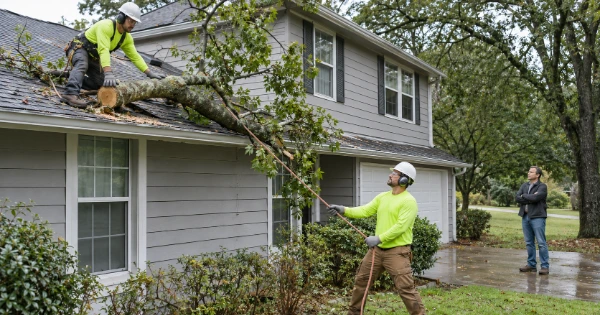
Many homeowner policies give some coverage when a storm drops a tree on the house or another insured structure, and sometimes when it blocks the driveway. A tree in the yard that hits nothing is usually not covered. A tree service never promises a payout: it documents the job, writes an estimate and leaves the claim to the homeowner.
Key takeaways
- Where the tree landed matters most: on the house or another insured structure, often some coverage; in the yard hitting nothing, usually none. The homeowner's policy decides.
- Never tell a caller "yes, insurance will pay". Say what usually happens, then "your policy and your insurer decide".
- Photos, a written itemized estimate and explaining your own bid are fine. Negotiating the claim, interpreting the policy or filing it for the homeowner is public adjuster work in Florida, Georgia and Texas.
- Photograph everything before anything is moved, and keep emergency work apart from later work on the estimate.
- On your ads and website, offer photos and a written estimate "you can send your insurer", not claim help.
Want us to find your three biggest lead leaks?
Free Growth DiagnosisWhat do homeowner policies usually cover when a tree falls?
The Insurance Information Institute and state regulators describe the same pattern. Where the tree landed decides most of it, and the homeowner's own policy decides the rest. This guide covers homes only, not commercial, HOA or rental property.
| Where the tree landed | What neutral sources say usually happens |
|---|---|
| On the house, a detached garage or a deck | Triple-I says coverage applies when a tree hits "your home or other insured structure, such as a detached garage", for trees "felled by wind, lightning or hail". "A standard homeowners policy also applies to attached structures, such as a garage or deck." The Texas Department of Insurance says "Many policies provide some coverage to remove trees or limbs that fell due to storm damage and damage your house or block your driveway." The policy decides. |
| Blocking the driveway or a ramp | Triple-I: "some insurance companies may pay for the cost of removing the felled tree if it is blocking a driveway", and it names a ramp for people with disabilities in the same passage. Also: "if a fallen tree blocks access to your home you may be covered for its removal." The policy decides. |
| In the yard, hitting nothing | "Homeowners insurance policies do not pay for the removal of trees or landscaping debris that did not cause damage to an insured structure." Texas: "Trees and limbs falling in your yard usually aren't covered." The tree itself is covered for "vandalism, theft and fire, but not wind damage." The policy decides. |
| The neighbor's tree on the homeowner's house | Texas: "If your neighbor's tree falls on your house, their homeowners policy probably won't cover the damage and tree removal, unless your neighbor was at fault." So the homeowner claims on their own policy, and "your insurance company may try to collect from the neighbor's insurance company in a process called subrogation." The policy decides. |
| The homeowner's tree on the neighbor's house | "if your tree fell on your neighbor's home, their property insurance company would pay them for damages." If the tree "was poorly maintained or diseased and you took no steps to take care of it, their insurer may seek reimbursement from you". Oklahoma gives a neighbor who "is notified that their tree is a safety concern and nothing is done" as a case of negligence. The policy decides. |
| A dead, dying or poorly kept tree | "remember that poor maintenance is not covered by homeowners insurance." Triple-I's advice: "You should cut down dead or dying trees close to your house and prune branches that are near your house." Plan this as normal work the homeowner books, unless their insurer says otherwise. The policy decides. For a weak tree the owner wants to keep, see when to cable a tree and when to remove it. |
| Flood or storm surge | Policies "do not cover flood damage, including damage from a storm surge." Flood is a separate policy. The policy decides. |
Policies often have a separate, limited amount for tree removal; the homeowner's policy shows it. Near the coast, Triple-I adds that "there may be some restrictions on your coverage for wind damage."
This is what neutral sources say usually happens, not insurance advice. Only the homeowner's policy and insurer can say what a claim pays.
Does homeowners insurance cover tree removal? What to tell a caller
Callers ask this before they ask your price. Your team should answer the same way every time, and never with a yes. A three-line script:
- What usually happens. "When a storm puts a tree on the house or another building, many policies give some coverage, removal included. A tree that lands in the yard and hits nothing usually isn't covered."
- Who decides. "Your policy and your insurance company decide what's covered. Call them and ask. We can't tell you what your policy pays."
- What you can do. "We can take photos and give you a written estimate to send them."
The Texas Department of Insurance gives homeowners the same advice: "Call your agent or company to ask if your policy will pay."
A caller who wants you to promise what insurance will do is a warning sign. Our guide to red flags on a tree lead call covers it. If the tree belongs to a neighbor, the who-owns-it questions are in the whose-tree section of the same guide.
Why should a tree service never promise insurance will pay?
Because you cannot know. The homeowner's policy, the deductible, the adjuster's inspection and the cause of the fall all decide the claim, and you see none of them on the first call.
- You can't read the policy for them. In several states, interpreting a policy for the homeowner is public adjuster work (next section).
- A broken promise costs you the job. In our view, a homeowner told "insurance will cover it" who then gets a denial or a small check blames the tree company, not the insurer, and may not pay the rest.
- Deductible offers are out. In Texas, the deductible rule covers "A person who sells goods or services" paid from property insurance proceeds and bars offers to "pay, waive, absorb, or otherwise decline to charge or collect the amount of the insured's deductible" without the insurer's consent. That is any seller, not only roofers. Never offer to cover the deductible, in any state.
"No deductible offers. Ever." is already one of our storm ad trust lines; this guide adds only the insurance wording.
This is our reading of public pages, not legal or insurance advice.
What may a tree service do in a homeowner's claim, and what needs a license?
State public adjuster laws draw the line. In Florida, a "public adjuster" is "any person, except a duly licensed attorney at law," who, among other acts, "prepares, completes, or files an insurance claim for an insured or third-party claimant." Florida also says "no person, except an attorney at law or a licensed and appointed public adjuster, may" "Offer to initiate or negotiate a claim on behalf of an insured;" or "Advertise services that require a license as a public adjuster." "Any person" includes a tree company.
The same Florida section says a licensed contractor "may discuss or explain a bid for construction or repair of covered property". Explaining your own estimate is fine; handling the claim is not.
| A tree service may (fine) | Needs a public adjuster license |
|---|---|
| Take photos of the tree and the damage | Negotiate the claim or the payout with the insurer |
| Give a written, itemized estimate | Interpret the policy for the homeowner ("this is covered") |
| Explain your own estimate or bid | Prepare, complete or file the claim for the homeowner |
| Tell the homeowner to call their insurer | Offer to start or negotiate a claim for the homeowner |
| Answer the adjuster's questions about your work | Advertise claim handling ("we handle your claim") |
State lines:
- Florida: the rules above, from § 626.854.
- Georgia: a "Public adjuster" is "any person who solicits, advertises for, or otherwise agrees to represent only a person who is insured" under a property policy, and a person who adjusts claims for pay "shall be licensed as either an independent adjuster or a public adjuster."
- Texas: "contractors can't advertise that they'll handle your insurance claim." Texas law says "A contractor may not act as a public adjuster or advertise to adjust claims for any property for which the contractor is providing or may provide contracting services". That holds even if the contractor has a public adjuster license.
- Other states: most states license public adjusters. Check your state's insurance department before you offer any help beyond your estimate.
Two more lines. Paying insurance agents for referrals has its own rules; see our referral partners guide. And don't build an offer around the homeowner signing over insurance money to you; our deductible-law guide covers what some states say about that.
A plain line on your claim page helps: "We are not public adjusters. We don't interpret insurance policies or negotiate claims. We give you photos and a written estimate."
This is our reading of the laws, not legal or insurance advice. Ask a lawyer in your state before you change how you work with homeowners' insurers.
Do the roofing storm laws apply to tree services?
Texas's rules reach tree work; the others are written for roofing or are unclear.
Texas: follow both. Texas law bars a contractor from acting as the public adjuster, or advertising to adjust claims, on property it works on. The law says "contractor", not "roofer", so a tree company should follow it too. The Texas deductible rule above also covers any seller of goods or services paid from property insurance, not only roofers. Our Texas hail guide for roofers has the roofing detail; it is not repeated here.
Florida, Georgia, North Carolina, Missouri: don't assume. Georgia's and North Carolina's storm rules are written for roofing. Florida's storm-sales rule (§ 489.147) is written for contractors licensed under chapter 489, and that chapter's list of contractor types does not name tree work. Whether any part of the Florida rule reaches your tree work is a question for a Florida lawyer. Missouri's storm rule also reaches other exterior repair work; ask a Missouri lawyer whether it covers your tree work. The public adjuster rules in the section above apply to tree services too. The roofing rules themselves are in our deductible-law guide.
This is our reading of the words, not legal advice.
What photos and written estimate should you give the homeowner?
Regulators tell homeowners to document first. Georgia's insurance office says to "take photographs or video of the damage before making temporary repairs." Oklahoma says to "take photos of the damage" and to "safely protect your property from additional damage." Your crew can make that easy. A documentation pack the homeowner can send their insurer:
- Photos before anything is moved. The whole tree, where it lies, what it hit (roof, garage, fence, driveway), the break or root plate, and wide shots that show access and hazards.
- Photos during and after. The tree coming off the structure, the cleared site, any damage found under the tree.
- Emergency work apart from later work. Georgia warns: "An insurance company may deny a claim if you make permanent repairs before the damage is inspected." So split the estimate: the emergency part (tree off the roof, make the site safe) and the later part (stump, cleanup, other trees). Tell the homeowner to tell their insurer before any non-emergency work. That is the homeowner's call with their insurer, not your rule.
- A written, itemized estimate. Each item on its own line: tree work on the structure, removal from the structure, cutting and haul-away, debris cleanup, stump work if asked. No lump sum.
- An invoice that shows the work. "The best way to communicate that is through clear photographs and a detailed explanation of the work being completed," said the CEO of HMI, a tree-claim network, quoted in TCIA's trade magazine. In our summary of that article: show crew size, hours and equipment on the invoice.
- Receipts. Georgia: "Your policy should cover the cost of these temporary repairs, so keep all receipts." Triple-I: "Be sure to save all the receipts from purchases related to your repairs so you can be reimbursed as part of the claims process." Hand the homeowner copies of yours.
On the first call, the triage question "Is the tree on the house, a car or the driveway, or is it in the yard?" (from our storm cleanup ads guide, the call-wave section) tells you which pack you need. To ask for a photo by text, see our speed-to-lead rules (texts only with consent).
How should a tree service word its ads and website?
Say what you do, never what the insurer will do.
| Say (only if true) | Never say |
|---|---|
| "Tree on your house? Photos and a written estimate you can send your insurer." | "Insurance pays for it." / "Insurance will cover it." |
| "We're not public adjusters. Your insurer decides what your policy covers." | "We handle your claim." / "Claims experts." |
| "Call your insurance company before you sign anything." | "We work directly with your insurance." |
| "Itemized estimates for storm-damaged trees." | "Insurance approved." |
| "Emergency tree removal from roofs. Written estimate first." | "No out-of-pocket cost." / "We'll cover your deductible." |
A safe headline for the claim page: "Photos and estimates for your claim" (not "Insurance claim help", which reads as claim handling). Under it, put the "not public adjusters" line and the three things you do: photos, a written estimate, safe removal.
For the rest of your storm wording (local crew, written estimate first, proof of insurance), use our storm ad trust lines; they are not repeated here. Running the same lines on Meta? Our guide to Facebook ads for tree services covers the set-up.
This is our reading of public pages, not legal advice.
A homeowner FAQ block for your own website
Copy for your own site. Adapt it to your company, and check it with your lawyer before you publish it. No dollar figures, no promises.
Does my homeowners insurance cover tree removal?
It depends on your policy. Many policies give some coverage when a storm drops a tree on your house or another insured building, and some help when a tree blocks your driveway. A tree that falls in the yard and hits nothing usually isn't covered. Your policy and your insurer decide.
Can you deal with my insurance company for me?
No. We are not public adjusters. We don't interpret policies or negotiate claims. We give you photos and a written, itemized estimate you can send your insurer, and we can explain our estimate.
Should I wait for the adjuster before you remove the tree?
Ask your insurer. Take photos first. State insurance offices tell homeowners to protect the home from more damage and keep the receipts, and to ask before permanent repairs. We split our estimate into emergency work and later work so you can check with your insurer.
My neighbor's tree fell on my house. Who do I call?
Your own insurance company first. Your policy and your insurer decide; they may try to collect from the neighbor's insurer.
Will you cover my deductible?
No. We never offer to pay or waive a deductible.
Where can I learn more?
Your state's insurance department has consumer pages on storm claims.
Where does Digital Hark fit?
Digital Hark builds the pages, ads, tracking and follow-up for tree service companies, and keeps the wording inside these limits: a claim page with a safe headline, ads that offer photos and estimates, and reply messages (texts only with consent). Your team inspects the trees, writes the estimates, talks to homeowners and sells the jobs. We never talk to insurers, never review policies or file claims, and never call, text, book or sell for you. What is included is confirmed in writing in the proposal.
For the wider picture, see our page on marketing for tree service companies.
Checklist
- ☐ No "insurance will pay" line in any ad, page, script or reply message.
- ☐ A "we are not public adjusters" line on the claim page.
- ☐ The three-line caller script printed for whoever answers the phone.
- ☐ Photo set taken before anything is moved, then during and after.
- ☐ A written, itemized estimate template with one line per item.
- ☐ Emergency work and later work on separate lines.
- ☐ No deductible offers, anywhere.
- ☐ Your state's public adjuster rule checked with the state insurance department.
- ☐ Texas: both rules followed (no claim handling ads, no deductible offers).
- ☐ Every ad headline and the claim page headline checked against the never-say list, and a reply plan for claim callers (texts only with consent).
Common questions
Does homeowners insurance cover tree removal?+
Often, when a storm drops a tree on the house or another insured structure, and sometimes when it blocks the driveway. A tree in the yard that hits nothing is usually not covered. Policies often have a separate, limited amount for removal. The homeowner's policy and insurer decide.
Can a tree service handle the homeowner's insurance claim?+
No. In Florida and Georgia, handling a homeowner's claim is public adjuster work that needs a license. In Texas, a contractor may not act as the public adjuster on property it works on, even with a license. A tree service can take photos, give a written estimate and explain its own bid. Not legal advice.
What should a tree service give the homeowner for a claim?+
Photos taken before anything is moved, during and after; a written, itemized estimate with emergency work apart from later work; an invoice that shows the work done; and copies of receipts.
Should the homeowner wait for the adjuster before the tree comes off the house?+
The homeowner should ask their insurer. Georgia's insurance office warns that a claim may be denied if permanent repairs are made before the damage is inspected. Photograph first, keep emergency work apart, and let the homeowner check with the insurer before later work.
Can a tree company cover the homeowner's deductible?+
Never offer it. In Texas, the law bars any seller of goods or services paid from property insurance from offering to pay or waive the deductible without the insurer's consent. Other states have their own rules. Not legal advice.
Who pays when a neighbor's tree falls on the house?+
Usually the homeowner claims on their own policy first. The Texas Department of Insurance says the neighbor's policy probably won't pay unless the neighbor was at fault. The homeowner's insurer may try to collect from the neighbor's insurer, which Triple-I calls subrogation.


