
Guide · Tree service
Tree service upselling without pressure: how to turn what your crew sees into estimates
Your crew spends hours on a customer's property and sees the dead limb over the garage or the old stump by the fence. Here is what to note, what a crew member should and should not say about risk, how to hand it to your estimator the same day, and how to count it by signed jobs.
The short answer
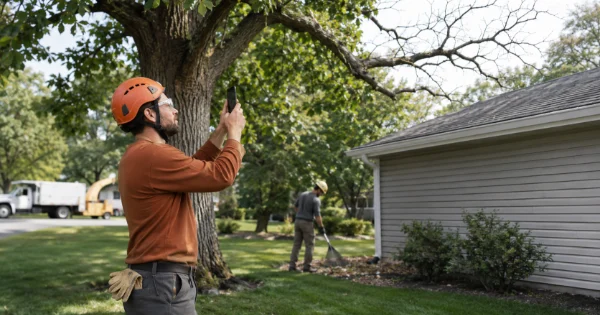
Your crew is already on the property and sees what else the trees need. Let them note it, take a photo and pass it to your estimator the same day. The crew reports, the estimator prices it in writing, and the homeowner decides. No pressure, no risk claims the crew cannot back up, and count it by signed jobs.
Key takeaways
- Crew-spotted work comes from a customer who already chose you, so there is no lead fee and no first call to win.
- What a crew sees is a reason to have someone qualified look, not a diagnosis. Judging a tree's risk takes training.
- Before leaving the property, the crew lead sends the estimator one photo and a short note. That note is internal, to your office.
- The crew does not price extra work. The estimator puts it in writing as a separate, optional line, never as a condition of today's job.
- Track "crew-spotted" as its own lead source and judge it by signed jobs. Keep the "not now" answers on a list for the dormant season.
Want us to find your three biggest lead leaks?
Free Growth DiagnosisWhy does crew-spotted work matter for a tree company?
The homeowner already picked you, let your crew into the yard and is watching you work. That is a better start than any ad. Jobber, a field-service software company, puts it simply: "Your crew is already out there face-to-face with customers every day …"
Three reasons it is worth doing well:
- No lead fee. A job your crew spots is your own lead, not a shared one. See why your own leads are worth more.
- It can fill open crew days. If your calendar has gaps, crew-spotted work is one way to fill them. The "how much" section of our tree service budget guide covers how to count the crew days you still need to sell.
- The homeowner gets a fair heads-up. A limb they never noticed from the ground is worth knowing about, as long as nobody pushes.
This is idea four on our list of marketing ideas for tree companies: your crew points out what it sees and passes it to the person who gives estimates, with no pressure on the homeowner. This guide shows how.
What do tree crews often notice on a job?
From the bucket or the ground, crews see parts of a tree the homeowner never looks at. UC IPM, the University of California's pest management program, lists warning signs that trees may be hazardous, including "dead or dying limbs", "cracks in the main trunk or at crotches (where limbs fork)", "cavities on the main trunk or at the tree base", "trunks that lean or tilt instead of growing upright", "fissures in soil near the base of trees" and "brackets, conks, mushrooms, or other fungal decay fruiting bodies on bark or around the tree base".
Things your crew might note on a job:
- A dead or hanging limb.
- A limb over the roof, the gutters, the driveway or a play area.
- A stump left from an old removal.
- Limbs weakened by a recent storm.
- Limbs near the wire to the house (see the rule below: the utility may need to come first).
Things to note, not a diagnosis. UC IPM also says: "Some hazards are difficult to detect, such as internal decay or unhealthy roots." So a sign is a reason to have someone qualified look, not proof that the tree will fail. And a tree with no sign the crew can see is not proof that it is sound.
Where the tree stands matters. UC IPM says trees "are hazardous if located where they are likely to injure people or damage property". In plain words: the same dead limb means more over a bedroom or a driveway than over an empty corner of the yard. That is why the crew's note says what is under the tree.
Only the customer's own trees. If the crew sees a problem in the neighbor's tree, they tell your customer and nobody else. The whose-tree section of our guide to qualifying tree leads covers what to do when a limb hangs over the property line.
Who may judge a tree's risk, and what should a crew member say?
Judging how risky a tree is takes training. ISA, the International Society of Arboriculture, runs the Tree Risk Assessment Qualification. ISA calls it "a voluntary qualification program designed to train and assess candidates in a specialized field of arboriculture". Candidates "must complete a training course, and pass both a comprehensive written assessment and a performance-based assessment", and holders "must retrain and retest every seven years." ISA says holders "can make reasoned judgments and recommendations for mitigating identified risk".
The qualification is voluntary, not a legal rule. But it shows the point: your crew reports what it sees, and a qualified person on your team decides what it means.
Plain crew words (say what you saw, where it is, and offer a look):
- "I noticed a dead limb over your garage. Want our estimator to take a look?"
- "There's an old stump by the fence. We can add grinding to a quote if you'd like."
- "I took a photo of that crack so our estimator can see it."
Words to avoid from a crew member:
- "That tree is dangerous."
- "It's going to fall."
- "It's dying."
- "That has to come down."
A crew member cannot back these up from the job, and they sound like pressure even when they are meant kindly. If a qualified person later judges the tree, they can say what they found in writing.
Never claim a credential the person does not hold. "Our certified arborist will look at it" is fine only if a certified arborist really will. The trust section of our tree company marketing page (linked above) covers showing only the credentials your company really has.
TCI Magazine, the Tree Care Industry Association's magazine, makes the same point for estimators: "pointing out any additional hazards you noticed during your inspection is usually worthwhile", and "It is best not to be pushy about that sort of observation".
How does the same-day hand-off to the estimator work?
Spotted work is easy to lose: the crew moves to the next job and the homeowner forgets. A same-day hand-off fixes that.
Tree Traction, a direct-mail company for tree businesses, describes the habit this way: "before the crew leaves any property, the lead texts a quick note." That note goes to your own office or estimator. It is internal, not a message to the homeowner.
What goes in the note:
- One clear photo of what the crew saw, from the ground or the bucket.
- Which tree and where (back yard oak, limb over the garage).
- What they noticed, in plain words (dead limb, old stump, crack at the fork).
- What the homeowner said ("wants a quote", "maybe next spring", "not interested").
- Customer name and address, so the estimator does not have to ask.
Ask before taking photos beyond the job. The crew has permission for the job they came to do. Before photographing other trees, the house or the yard, ask: "Mind if I take a photo of that limb for our estimator?"
The estimator takes it from there. Some extra work can be quoted from the crew's photo; some needs a visit. Our tree estimate follow-up guide covers when a photo quote is enough and when to walk the yard, and what a written tree estimate should include. We do not repeat it here.
A separate, optional line. Arborgold, a tree and landscape software company, suggests adding extra work "as an optional line item." The homeowner can say yes to it, no to it or "later", and the job they already booked does not change.
Should the crew quote a price on the spot?
Our view: no. Leave the price to the estimator, in writing. The only exception is small work that is already in the written scope of today's job. Some field software lets crew leaders add priced work on the spot; we still leave the price to the estimator, in writing.
TCI Magazine explains why a clear scope matters on the job: "If the scope isn't clear, it can be difficult for the crew leader to say no or ask for additional payment." A price agreed in the driveway, with no paper, is exactly that kind of unclear scope. It also puts the crew in a sales role it did not sign up for.
Can you text the homeowner about the extra work?
Only if they agreed to get texts from you (texts only with consent). The crew's note to your office is internal; a text to the homeowner is a different thing and follows your texting rules. See the texting rules in our speed-to-lead guide.
Let the homeowner choose how to hear back: in person from the estimator, a phone call, an email with the written estimate, or a text if they said yes to texts. Write their choice in the note.
For later notes to past customers, such as a reminder before the dormant season, our guide to emailing past customers covers what to send by trade and season.
What should your crew not do?
- No pressure. No "today only", no "we can do it now if you decide now".
- Never make it a condition of the current job. The job the homeowner booked happens at the agreed price and date, whatever they say about the extra work.
- No asking twice after a no. Write "not interested" in the note and move on.
- No neighbors. The crew does not knock on neighbors' doors from the job. Our roofing yard signs guide covers the rules around marketing near a job.
- Utility first on lines. A limb touching a power line goes to the utility first, and one over the wire to the house may need the utility first too. The crew does not offer to cut either. The power lines section of our guide to qualifying tree leads covers the rest.
- Keep the review ask separate. Asking for a review at the end of the job is a different moment from the extra-work note. See when and how to ask for a review.
Other job-day channels have their own guides: our tree service referral partners guide (work from landscapers, realtors and others) and our truck wraps guide (calls from the truck).
How do you count crew-spotted work?
If you do not count it, you cannot tell whether it is working, and crew-spotted jobs end up credited to whatever ad the homeowner clicked last year.
- Make "crew-spotted" its own lead source in your CRM, not "repeat customer" or "other". Our tracking service sets up lead-source fields like this.
- Count three things: notes passed to the estimator, estimates written and signed jobs.
- Judge it by cost per signed job, like any other lead source. The method is in our guide to cost per signed job. Crew-spotted work has no lead fee, but it still takes estimator time.
- Keep the "not now" list. Every declined or "maybe later" item goes on a list with the photo and the note. Tree Traction suggests: "Pull that list once a quarter." The dormant season section of our tree estimate follow-up guide covers booking trims that can wait.
Worked numbers in this guide show the method; they are not real client results.
The table uses notes, estimates and signed jobs, not dollars. The numbers are our own inputs, chosen only to show the method. They are illustrative only, not real results.
| One year, crew-spotted lead source | Count |
|---|---|
| Notes passed to the estimator | 24 |
| Estimates written | 15 |
| Signed jobs from those estimates | 6 |
| "Not now" items put on the dormant-season list | 9 |
| Signed jobs from that list in the dormant season | 3 |
What the table shows: tagged as its own source, crew-spotted work brought 9 signed jobs over the year from customers already on the schedule. Without the tag, 6 of them would look like repeat business and the 3 from the list might never have happened.
If you reward crews (our view, optional): reward clear notes and good photos, not pressure or signed amounts. A crew that gets paid for closing starts to sound like a salesperson, and that is what this guide is trying to avoid.
Where Digital Hark fits
Digital Hark runs Google and Meta ads, landing pages, tracking and follow-up systems for home-service contractors. For a tree company, we can set up a "crew-spotted" lead source, a short note template for the crew-to-estimator hand-off and the tracking that shows these jobs by signed jobs. Your team talks to the homeowner, gives the estimate and sells the job. We never call, text, book or sell for you, and we do not train crews or visit job sites. We confirm what is included in writing in your proposal.
Crew-spotted work checklist
- ☐ Crews know what to note: dead limbs, limbs over the house, cracks, lean, growths at the base, old stumps.
- ☐ Crews say what they saw, never "dangerous", "will fall" or "has to come down".
- ☐ Only a qualified person judges a tree's risk, and nobody claims a credential they do not hold.
- ☐ Before leaving, the crew lead sends one photo and a short note to the estimator.
- ☐ The estimator prices extra work in writing, as a separate, optional line.
- ☐ Extra work is never a condition of the current job.
- ☐ Texts to the homeowner only with consent; neighbors' trees and doors stay out; lines go to the utility first.
- ☐ "Crew-spotted" is its own lead source, judged by signed jobs, with a "not now" list for the dormant season.
Common questions
How do you upsell tree work without being pushy?+
Let the crew report, not sell. They note what they see, take a photo and pass it to the estimator the same day. The estimator puts it in writing as a separate, optional line, and the homeowner decides. No scare words, no "today only", and the booked job never depends on the answer.
Should a tree crew quote prices on the spot?+
Our view is no, except for small work already in the written scope. TCI Magazine notes that an unclear scope makes it hard for the crew leader to say no or ask for more payment. The estimator prices extra work in writing.
Can a crew member tell a homeowner a tree is dangerous?+
A crew member should say what they saw, such as "a dead limb over your garage", and offer to have the estimator look. Judging a tree's risk takes training: ISA's Tree Risk Assessment Qualification needs a course plus a written and a field test. Leave risk judgments to a qualified person. If the tree could be supported instead of removed, see when cabling and bracing fits and when removal is the honest answer.
How should the crew pass extra work to the estimator?+
Before leaving the property, the crew lead sends one photo and a short note: which tree, what they saw, where it is and what the homeowner said. The note is internal, to your office. The estimator then decides whether a photo quote is enough or a visit is needed.
Can you text the homeowner about the extra work?+
Only if they agreed to get texts from you (texts only with consent). Otherwise the estimator follows up the way the homeowner chose, in person, by phone or by email with the written estimate.
How do you track work your crew finds?+
Give it its own "crew-spotted" lead source in your CRM. Count notes passed, estimates written and signed jobs, judge it by cost per signed job, and keep a "not now" list to revisit in the dormant season.


