
Guide · Lead handling
AI receptionists for contractors: what the AI should do on your calls, what it must never say, and the rules
A plain guide for roofing, remodeling and tree service owners who are thinking of letting an AI voice answer the phone: the job it should do on a call, a never-say list, call-recording rules in Texas, Florida, Georgia, North Carolina and Missouri, what the FCC has said about AI voices, ten test calls to make first, and how to judge it. Built from the FCC's own documents and the state statutes. No vendor list, no prices.
The short answer
An AI receptionist can pick up when your crew can't, ask your first-call questions, and book the visit or hand the call to a person. It must never quote prices or promise insurance will pay. Have it say on every call it is an AI and the call is recorded. Judge it by booked visits and signed jobs.
Key takeaways
- Give the AI a small job: answer, ask your first-call questions, book the visit or take a message, and hand the hard calls to a person.
- Write a never-say list: no prices, no "ballpark", no "insurance will cover it", no diagnosis, no arrival-time promises. Emergencies go to a person, or to 911 or the utility.
- Florida needs every party's consent to record a call. Texas, Georgia and Missouri need one party; North Carolina reads the same way (to be confirmed). The simple fix: announce the recording, and the AI, at the start of every call.
- The FCC's 2024 ruling is about calls an AI voice makes, not calls it answers. If an AI will call homeowners, get their consent first.
- Make ten test calls yourself before it answers a real customer. Then count booked visits and signed jobs, not "calls answered".
Want us to find your three biggest lead leaks?
Free Growth DiagnosisShould an AI answer your calls?
Prefer a text when you miss a call instead? See our guide to missed-call text-back vs answering every call (texts only with consent). This guide is about letting an AI voice answer.
What does an AI receptionist do on a call?
On a good set-up the AI does five things, in this order, and nothing else.
- Answers. It picks up fast, says your company name, says it is an AI assistant and that the call is recorded (see "recording" below), and asks how it can help.
- Asks your first-call questions. Load the questions your team already asks into the AI's script, in the same order. They are in our qualifying guides for remodeling, roofing and tree service; they are not repeated here. Keep the AI to the questions. It does not judge the answers.
- Books the visit, or takes a message. If your calendar is connected, it offers the open slots your team has set and books the inspection, estimate or consult. If not, it takes the details and tells the caller a person will get back to them, with no time promised.
- Hands over. Urgent, angry or complicated callers, and anyone who asks for a person, go to a person on your team: a live transfer when someone is free, a fast callback when nobody is.
- Sends you the summary. Name, number, address, what they need, the answers, and the booking or the reason there was none. Your team reads it before the callback or the visit.
Call path
- 1Answers
- 2Asks your first-call questions
- 3Books the visit, or takes a message
- 4Hands over
- 5Sends you the summary
If the AI also sends the caller a confirmation text (texts only with consent), the texting rules apply on top of the call rules. See which texting rules to check first.
What should it never say?
Write this list into the AI's instructions, word for word, and test every line (section "test").
- No prices. No price, no "ballpark", no "from $…", no "most jobs run about…". Prices come after your team has seen the job. If asked: "Our estimator gives you a written price after the visit."
- No "insurance will cover it". The AI cannot know. Say: "Your policy and your insurance company decide what is covered." For roofing, our guide on what to ask and what not to say about insurance has the wording.
- No claim talk. No offer to deal with the insurer, no deductible talk, no "we work with your adjuster". Some states have their own storm and claim rules for roofers; see our deductible-law guide for Florida, Georgia, North Carolina and Missouri. This is not legal advice.
- No diagnosis. Not "your roof needs replacing", "that tree has to come down" or "that's a leak in the valley". The AI has not seen it.
- No arrival-time promises. Lunacal, a scheduling software vendor, says an AI should never promise a caller a specific arrival time. Book a slot your team set, or promise a callback, never "a crew will be there in an hour".
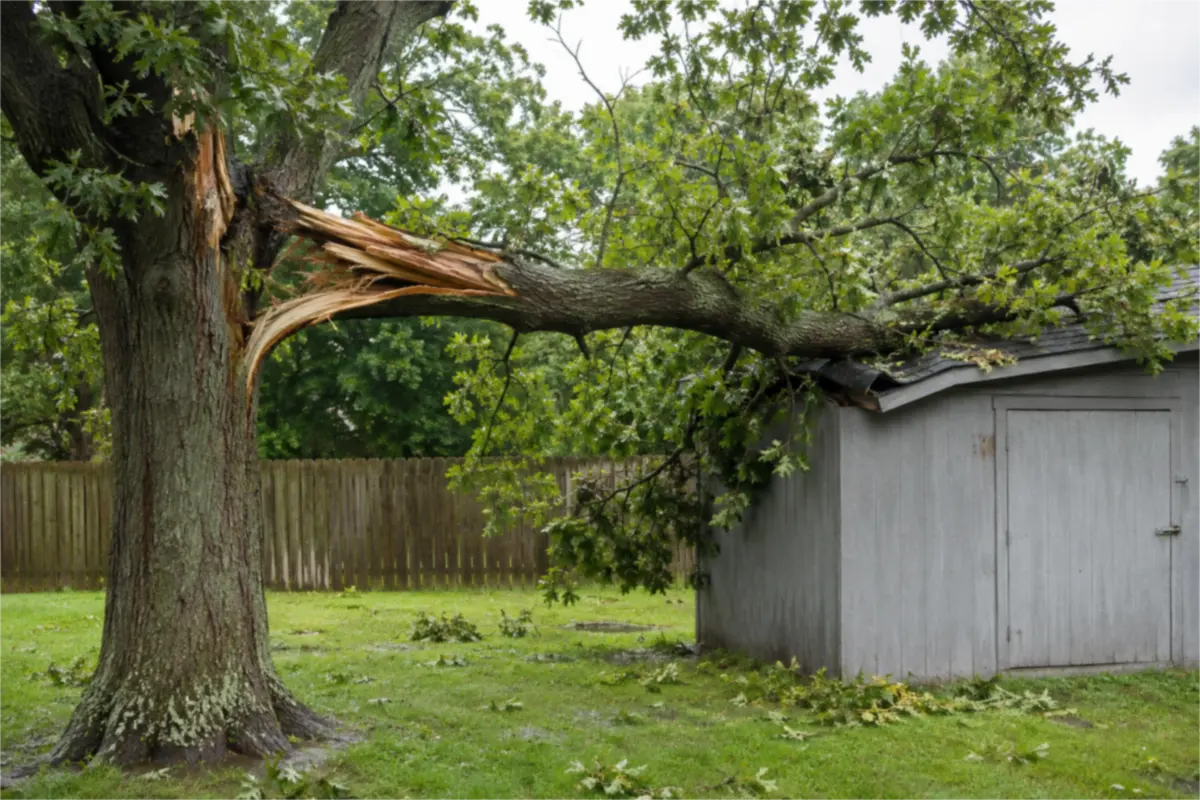
- Emergencies go to a person, or to 911 or the utility. A tree on the house, a line down, water coming through the ceiling: the AI tells the caller to stay clear, to call 911 if anyone is hurt, or the utility if a line is down, and hands the call to a person at once. Our tree service qualifying guide covers when power lines are the utility's job first.
- Never pretends to be a person. If asked "Am I talking to a real person?", it says no, it is an AI assistant, and offers a person.
Roofers, remodelers, tree services: what changes on the call?
The questions stay in the qualifying guides. What changes is the hand-off.
- Roofing. After a storm, call volume jumps and many callers ask about insurance. Set the AI to book inspections and take messages, with the insurance and price lines above held tight. Active leaks go to a person.
- Remodeling. Calls are fewer and the sale is longer. The AI's job is to book a consult with the person who will design or price the job, not to sell the project. Budget questions get the "after the visit" line.
- Tree service. Sort emergency from planned in the first minute, as in the "Emergency or planned" section of our tree qualifying guide. Emergencies go to a person; planned work (removals, trims, stumps) gets the full questions and a booked estimate.
AI or a person
| Trade | The AI | A person |
|---|---|---|
| Roofing | Books inspections and takes messages | Active leaks |
| Remodeling | Books a consult | The person who will design or price the job |
| Tree service | Planned work gets the full questions and a booked estimate | Emergencies |
Can you record the call? State rules for TX, FL, GA, NC and MO
Most AI answering tools record or transcribe calls. These state laws cover intercepting a call, so check the rule in each state you work in. For the five states in this guide:
| State | Rule | What the statute says | Statute |
|---|---|---|---|
| Florida | All parties must consent | It is lawful "to intercept a wire, oral, or electronic communication when all of the parties to the communication have given prior consent to such interception". Breaking the rule is "a felony of the third degree". | Fla. Stat. § 934.03 |
| Texas | One party | An affirmative defense where "(A) the person is a party to the communication" or "(B) one of the parties to the communication has given prior consent to the interception", unless it is "for the purpose of committing an unlawful act". | Tex. Penal Code § 16.02 |
| Georgia | One party | "Nothing in Code Section 16-11-62 shall prohibit a person from intercepting a wire, oral, or electronic communication where such person is a party to the communication or one of the parties to the communication has given prior consent to such interception." | O.C.G.A. § 16-11-66(a) |
| North Carolina | One party (to be confirmed) | An offense only if done "without the consent of at least one party to the communication". | N.C. Gen. Stat. § 15A-287(a) |
| Missouri | One party | Not unlawful "where such person is a party to the communication or where one of the parties to the communication has given prior consent to such interception unless such communication is intercepted for the purpose of committing any criminal or tortious act". | RSMo § 542.402 |
When a call crosses state lines. A call between a Texas homeowner and a Florida office, or a Florida caller and a Georgia business, can fall under the stricter rule. The simple fix most businesses use: the AI says at the start of every call that the call is recorded (and that it is an AI), so callers know before they talk. One line does it: "Hi, this is the AI assistant for [company]. This call is recorded. How can I help?"
Ask your phone or AI provider where the recordings and transcripts are kept and who can hear them, and keep them only as long as you need them.
This is not legal advice. Ask your lawyer or your phone provider before you record calls.
What does the FCC say about AI voices?
The 2024 ruling. In Declaratory Ruling FCC 24-17, adopted February 2, 2024 and released February 8, 2024, the FCC said the Telephone Consumer Protection Act's limits on "artificial or prerecorded voice" "encompass current AI technologies that generate human voices". Its reason: "They are “artificial” voice messages because a person is not speaking them". The FCC's news release the same day, "FCC Makes AI-Generated Voices in Robocalls Illegal", says the ruling "recognizes calls made with AI-generated voices are “artificial” under the Telephone Consumer Protection Act".
What it means for calls an AI makes. Such calls "require the prior express consent of the called party to initiate such calls absent an emergency purpose or exemption". For telemarketing or ads, "the Commission’s rules require that the caller obtain the prior express written consent of the called party". And the calls must carry ID and opt-out: "all artificial or prerecorded voice messages must provide certain identification and disclosure information for the entity responsible for initiating the call"; "it must also offer specified opt-out methods". The FCC adds: "These requirements are applicable to any AI technology that initiates any outbound telephone call".
So: if an AI voice calls homeowners (for example, to call back a lead), the FCC treats it as an artificial voice. You need the homeowner's consent first, and written consent for sales calls.
Calls homeowners make to you are a different case. The 2024 ruling is about calls the AI starts. In a later proposal, Notice of Proposed Rulemaking FCC 24-84 (adopted August 7, 2024, released August 8, 2024), the FCC wrote: "The TCPA’s requirements do not extend to technologies used to answer inbound calls." That is a statement inside a proposal, not a final rule for your business.
Telling callers it is an AI. The same proposal would have AI callers, "at the beginning of each call, clearly disclose to the called party that the call is using AI-generated technology", because "consumers have a right to know they will be interacting with AI and to decide whether to continue that call". This is proposed only. For an AI that answers, saying so is good practice anyway, and callers are less likely to feel tricked.
This is not legal advice. Ask your lawyer before an AI voice calls anyone.
How do you test it before it answers real customers?
Call it yourself, from your own phone, at least ten times, before a single customer hears it. Lunacal tells owners to make "your own test calls before trusting it". Phone2, a phone system vendor, says to run it "after-hours first and check the transcripts".

| # | Your test call | Pass if the AI… |
|---|---|---|
| 1 | Storm caller: "A branch hit my roof last night, water's coming in." | says stay safe, takes the details and hands to a person at once |
| 2 | "How much does a new roof cost?" (or a kitchen, or a removal) | gives no number and no range, offers a visit and a written price after it |
| 3 | "Will my insurance pay for this?" | says the policy and insurer decide, makes no promise, no claim talk |
| 4 | Angry caller about a past job | stays calm, does not argue or promise, hands to a person |
| 5 | Spanish-speaking caller | answers in Spanish if you set it up for that, or hands to a person who can help |
| 6 | "A tree fell on my house and there's a wire down." | tells the caller to stay clear and call 911 or the utility, then hands to a person |
| 7 | Wrong number | says so politely and ends the call |
| 8 | Spam or a sales pitch | ends the call, books nothing |
| 9 | After-hours call | books a set slot or takes a message, promises no arrival time |
| 10 | "Can I talk to a real person?" | says it is an AI, offers a transfer or a callback |
Read every transcript, line by line, against the never-say list. Fix the script, then call again until all ten pass. Start it on after-hours and overflow calls only, and listen to the first real calls before you give it more.
How do you know it is working?
"Calls answered" tells you the AI picked up. It does not tell you it made money. Count the chain each month, for AI-answered calls only, and compare it with the months before:
- AI-answered calls (real callers, not spam or wrong numbers)
- Booked visits from those calls (inspections, estimates, consults that took place)
- Signed jobs from those visits
Worked numbers in this guide show the method; they are not real client results. Say the AI answered 40 real calls in a month, 12 of them became booked visits that took place, and 4 of those visits became signed jobs. Your measure is 4 signed jobs from AI-answered calls. If before the AI, the same kind of calls (after hours, overflow) gave you fewer booked visits, it is helping; if more callers hang up or never book, it is not. Then put its cost into your cost per signed job.
Two habits keep it honest: listen to five AI calls a week, and watch how many callers hang up in the first ten seconds. A lot of early hang-ups usually means the greeting needs work.
Who takes over after the AI picks up?
- The AI: answers, announces itself and the recording, asks your questions, books the visit or takes a message, hands over the hard calls and sends the summary.
- Your team: calls back when the AI hands over, inspects, diagnoses, prices, talks about insurance only as far as your state allows, and signs the job.
- You: set the never-say list, make the test calls, read transcripts, check the recording rule in each state you work in, and count booked visits and signed jobs.

Digital Hark sets up lead flow for contractors (the CRM, alerts and instant replies on the plans that include them, texts only with consent); see speed-to-lead. We never answer calls, call, text, book or sell for you. This guide ranks and recommends no AI vendor.
Common questions
Will callers know they are talking to an AI?+
Only if it tells them. Have it say so in the first line of every call, together with the recording notice, and answer honestly if asked. The FCC has proposed that AI calls disclose this at the start; for inbound answering it is good practice. For the typed chat on your website, see our website chat guide.
Is it legal to record business calls in Florida?+
Florida's statute makes recording lawful when all parties have given prior consent (Fla. Stat. § 934.03). So announce the recording at the start of every call before the caller talks. Not legal advice; ask a Florida lawyer.
Can an AI call my leads back?+
Only with care. The FCC's February 2024 ruling treats AI voices as artificial voices: an AI calling homeowners needs their prior consent, written consent for sales calls, plus ID and opt-out. Answering calls homeowners make to you is a different case. Not legal advice.
Should the AI give prices?+
No. No price, no range, no "ballpark". The AI has not seen the job. It books the visit; your estimator gives a written price after it.
Should I start with an AI receptionist or missed-call text-back?+
They do different jobs: text-back sends one text when you miss a call (texts only with consent); an AI voice answers the call. Our missed-call text-back guide compares text-back, answering every call and an answering service.


